









Only 6% of companies qualify as real AI adoption leaders, according to BCG’s latest research. That small group posts a 9.3% return advantage over laggards. Everyone else sees almost no difference at all.
That gap is the whole story of AI for business leaders right now. A handful of companies pull ahead, and the rest compete for what’s left over.
This isn’t a call to panic-buy every AI tool on the market. It’s a call to build the specific skills, strategy, and sequencing that separate the 6% from everyone else. The good news is that none of those three things require a massive budget to start.
What they do require is a leader willing to make a real decision. Funding a dozen small experiments that never connect to each other isn’t a strategy. It’s expensive indecision.
What Does “AI for Business Leaders” Actually Mean?
AI for business leaders isn’t about learning to prompt a chatbot. It’s about deciding where AI changes your competitive position and where it doesn’t.
A leader who understands this spends less time chasing every new tool. They spend more time deciding which three problems actually matter this year.
That distinction is what separates a leader with an AI strategy from a leader with an AI subscription. One drives decisions. The other just drives a bill.
Neither requires a technical background. Both require the discipline to say no to eight ideas so the ninth one actually gets the attention it needs.
The AI Leadership Skills Gap Nobody Wants to Admit To
The Conference Board found that 43% of executives now name AI as their top investment priority for 2026, ahead of product innovation. The budget is there.
The AI leadership skills usually aren’t. Investment without training and organizational redesign tends to underperform, no matter how large the check.
Most leaders can talk about AI at a conference. Fewer can actually direct where it should go inside their own company. That second skill is the one worth building first, and it doesn’t show up on a slide.
Building an AI Strategy for Executives That Isn’t Just a Slide Deck
A real AI strategy for executives names specific workflows, specific owners, and specific deadlines. A slide deck names “digital transformation” and calls it done.
Our strategic engagements page breaks down the actual formats this work can take. Options range from a single workshop to a full advisory retainer.
Pick the format that matches your actual bandwidth, not the one that looks most impressive in a board deck. A modest plan you finish beats an ambitious one that stalls in month two.
Executives who skip this step often end up with a strategy document nobody reads again after the kickoff meeting. A working plan gets referenced weekly, not filed away.
Why Your AI Transformation Strategy Needs a Sequence, Not a Wishlist
An AI transformation strategy fails fastest when it tries to fix everything simultaneously. Ten pilot projects launched in the same month usually means ten pilots that get half the attention each.
Our guide on building a future of work strategy that survives the AI shift walks through the sequencing that actually holds up. One workflow gets proven before the next one starts.
Sequence beats scope. A leader who sequences well ships results a board can point to, quarter after quarter.
Leadership in the AI Era Looks Different From Leadership in 2015
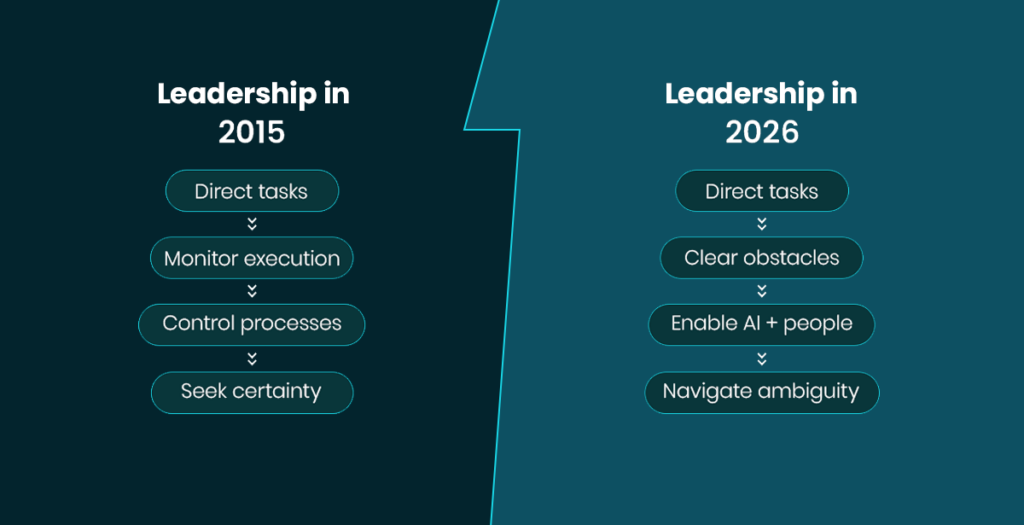
Leadership in the AI era rewards curiosity and comfort with ambiguity over control and certainty. The leader’s job shifts from directing tasks to setting direction and clearing obstacles.
Most leadership development programs still fail because they train leaders for a version of the job AI already changed. Our piece on executive leadership development in 2026 covers what actually needs to replace it.
The leaders who adapt fastest treat this shift as a skill to practice. It isn’t a personality trait some people simply have and others don’t.
AI Business Transformation Rewards the Fast Movers
AI business transformation isn’t gentle to companies that wait for certainty. Enterprise AI adoption stalls at exactly the companies with the most resources to move fast.
The 6% of leaders BCG identified didn’t wait for a perfect plan. They picked a workflow, measured it, and built from there, then repeated that pattern until it compounded.
Your competitor reading this same research right now faces the same choice. The only real edge left is speed of execution, and speed compounds the same way returns do.
Frequently Asked Questions
What’s the biggest mistake business leaders make with AI strategy?
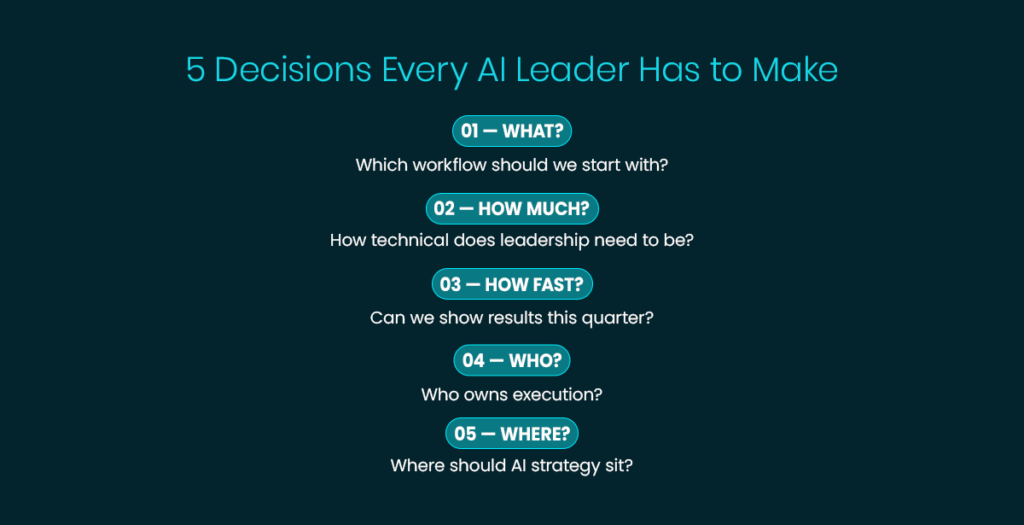
Treating it as a single big initiative instead of a sequence of small, proven wins. A sequenced approach builds real momentum. A single mega-project usually just builds a bigger failure.
Do business leaders need to understand the technical side of AI?
Not deeply. They need to understand where AI changes competitive position, then rely on technical experts for implementation. Direction matters more than depth here.
How fast should AI transformation strategy move?
Fast enough to show results within a quarter on one workflow. Full transformation happens in stages over a year or more, not in a single announcement.
Is AI business transformation different for smaller companies?
Smaller companies often move faster because they have fewer approval layers standing between a decision and its execution. Size isn’t the advantage here. Decision speed is.
Should AI strategy for executives live with the CEO or get delegated?
The CEO sets direction and removes roadblocks, but daily ownership works best closer to the actual work. Delegation without executive sponsorship tends to stall the moment budget gets tight.
Start Before Your Competitor Does
AI for business leaders comes down to one uncomfortable truth. Waiting for certainty is itself a decision, and it’s usually the wrong one.
Leadership in the AI era, a real AI transformation strategy, and closing the AI leadership skills gap all point in the same direction. Pick one workflow, move on it now, and build from there.
Talk to our leadership consulting team and find out which workflow to pick first.