








Scrum built the modern software industry. For two decades, two-week sprints, daily standups, and backlog grooming gave development teams a reliable delivery rhythm.
But that rhythm no longer fits.
When AI tools compress days of work into hours, a fixed two-week planning cycle creates drag rather than direction. Teams produce more output but lose the ability to respond to what they learn. Forward-thinking companies already run a different playbook. They’ve adopted an AI agile methodology designed for how work actually moves today, not how it moved in 2005.
Here’s what that shift looks like, and why it’s spreading fast.
Why the 2-Week Sprint No Longer Works
For years, sprints made sense when writing code was the bottleneck. Two weeks gave developers time to design, build, test, and review a meaningful slice of work. That logic held firm for over two decades.
AI has changed the underlying physics of software development. Tasks that once took days — drafting requirements, writing boilerplate code, generating tests, reviewing pull requests — now take hours. Research from AI-augmented teams shows a 20–40% reduction in time-to-market, with execution work compressing from weeks to single days.
AWS research on the AI-driven development lifecycle confirms this: AI shifts bottlenecks rather than eliminating them. It moves pressure from building to reviewing, from coding to validating.
So what happens when faster work sits inside a slower structure? Teams either pad sprints with low-value tasks to justify the cycle, or they build features faster without validating whether those features are worth building.
As a result, the two-week sprint paradox intensifies: AI sprint planning inside a fixed two-week window disconnects from reality.
Planning sessions review yesterday’s assumptions. Retrospectives audit work from last week rather than responding to what’s changing right now.
What Forward-Thinking Companies Are Using Instead
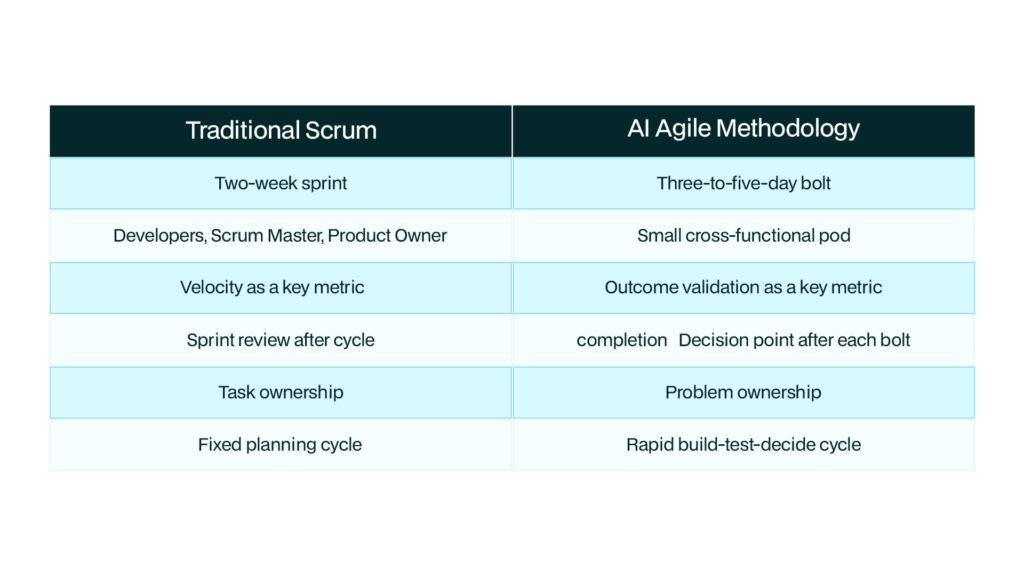
The AI agile methodology replacing Scrum restructures around three core changes.
Shorter execution cycles. Leading teams now run what practitioners call “bolts”: focused cycles of three to five days. These aren’t mini-sprints with compressed planning and rushed ceremonies. Each bolt starts with sharp alignment on one outcome, runs fast, and ends with a working artifact and a clear decision point.
Pods instead of traditional Scrum teams. Standard Scrum separates roles into developers, a Scrum Master, and a Product Owner. In contrast, pods collapse those distinctions. A pod is a small cross-functional unit, typically three to five people, working alongside AI agents as active team members. The pod owns the problem, not a set of tasks.
Outcome over velocity. Velocity made sense when human effort drove all results. For AI agile teams, velocity becomes noise. What matters is whether users, data, or a market signal confirms the outcome before the team moves to the next bolt.
Together, these three changes form what Future At Work calls the AI Development Lifecycle: a framework built for how AI agile teams actually deliver.
How AI Agile Teams Operate in Practice
The clearest way to understand the difference is to compare a single week.
In a standard Scrum setup, a team spends Monday in sprint planning, moves through a ticket queue during the week, and holds a sprint review on Friday. Coordination demand stays high. At the same time, context switching stays high. The distance between individual tasks and real outcomes stays wide.
By contrast, a pod picks up one specific outcome on Monday morning. Wednesday finds the pod with a working prototype in front of real users. Thursday produces actual usage data. Friday brings one clear decision: scale it, pivot it, or drop it. No waiting for the next sprint cycle to act.
That three-to-five-day cycle of build, test, and decide is the heartbeat of agile AI development. It eliminates sprint theater: the standups and ceremonies that generate activity reports rather than real decisions.
Making the Shift
The structural changes are relatively straightforward. The cultural ones take more work.
Most organizations run Scrum teams where managers get rewarded for process compliance, not outcome delivery. Shifting to an AI agile methodology means changing what managers measure, how teams form, and how teams make decisions. That’s a leadership problem before it’s a tooling problem.
Still, many teams attempt this shift without rethinking the AI development process itself. They layer AI tools on top of a two-week sprint and expect productivity gains to follow.
Those gains rarely appear, because the biggest obstacle to AI adoption is never the technology. It’s the process wrapping it.
In practice, the fastest path to real change is to run a single bolt with a single pod. Pick one outcome. Give the team three days. Run a prototype in front of real users by day two. Review results against actual user feedback, not a definition of done. That experiment reveals more about team readiness than a year of process frameworks.
For teams ready to go further, agile culture coaching built around the ADLC delivers the fastest structural shift. A discovery workshop can surface exactly where the current agile process blocks AI adoption.
Scrum Solved Yesterday’s Problem
Scrum solved a real problem. It gave chaotic development teams a structure that worked, and it served the industry well for a long time.
Yet the problem Scrum solved differs from what AI agile teams face today. Back then, the challenge was coordinating large teams writing complex code over long timelines. Today, the challenge is speed of validation, not speed of delivery. Building the right thing in three days matters more than building anything in two weeks.
Forward-thinking companies already see this. They’re not abandoning discipline. Instead, they’re redesigning it for an era where the tools have fundamentally changed. The teams that move first will build smarter, waste less, and outpace organizations still running yesterday’s methodology.