








Most companies still manage innovation the way they manage everything else: as a process. They build stage-gate pipelines, innovation committees, and quarterly review decks. Then they wonder why nothing ships.
Innovation management in the age of AI means turning ideas into validated, scaled outcomes. It uses AI-native ways of working, not static gates and committees. AI is rewriting the rules of competitive business. Organizations that still run on assembly-line thinking fall further behind every quarter.
The real fix isn’t a better process. It’s a different culture, one built for experimentation, ownership, and AI-native execution.
Why Traditional Innovation Management Fails in the AI Era
Eighty-seven percent of innovation leaders say turning ideas into real outcomes is their biggest challenge, according to the 2025 State of Corporate Innovation Report. Most organizations pour resources into early-stage ideation. Boards approve budgets. Committees review decks. Few ideas ever reach validation or scale.
This gap isn’t a resourcing problem. It’s structural. An estimated 65 to 70 percent of digital transformation programs fail. Companies bolt new technology onto old hierarchies instead of redesigning how they make decisions. Our research on why digital transformation stalls breaks down these failure patterns in detail.
Process fixes treat symptoms. Culture fixes treat causes.
Innovation Culture Is the Real Bottleneck, Not Process
Innovation culture, not process maturity, predicts whether ideas survive contact with the organization. Roughly three-quarters of innovation effort stalls before it ever becomes a product. Workplace research consistently names bureaucracy the top killer of new ideas.
Only about half of employees feel genuine freedom to experiment at work. Yet organizations with strong psychological safety turn a profit far more often. Corporate innovation culture either gives people room to try and fail, or it quietly punishes both.
That difference separates startup DNA from corporate DNA. One rewards initiative. The other rewards compliance.
Building an Innovation Mindset Across the Organization
An innovation mindset isn’t just for founders. Leaders can teach it, model it, and reinforce it through EQ-driven leadership instead of more rules.
Managers who lead through hierarchy and fear train employees to wait for permission. Managers who lead through trust and direct feedback train employees to act. That shift usually starts with leadership consulting focused on emotional intelligence instead of authority.
How do you build an innovation mindset at scale? Reward the attempt, not just the result. Give teams real decision-making authority instead of symbolic input.
The Innovation Lab as the New Operating Model
An innovation lab gives ideas a controlled space to prove themselves before teams scale them company-wide. It replaces the old digital factory model, which focused on process automation, with data-centric, rapid experimentation.
The Three-Stage AI Lab Model
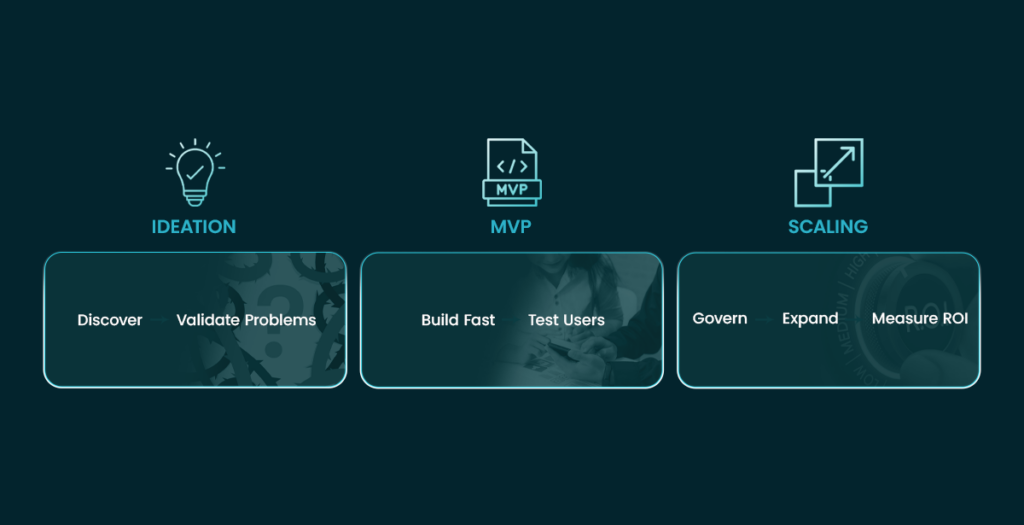
A well-run innovation lab typically moves through three stages:
- Ideation — use design thinking and a data audit to find real user problems worth solving.
- MVP development — build fast, then let real users test and validate it before major investment.
- Scaling — prove demand and ROI first, then scale with governance in place.
Skipping straight to scale is exactly why so many transformation programs collapse. Deloitte’s 2026 enterprise AI research found only 34 percent of leaders are truly reimagining their business with AI, even as worker access to AI tools rose 50 percent over the past year. Access without a lab structure just produces more pilots that never graduate.
How to Start Building a Culture of Innovation
Building a culture of innovation starts with an honest audit, not a mission statement. A discovery workshop is usually the fastest way to surface where structure, incentives, and leadership habits work against innovation.
From there, most teams benefit from a live, low-stakes forum to practice the behavior they want to build. A structured hackathon compresses months of cautious deliberation into days of hands-on building. It also shows leadership what’s possible when leaders trust teams to move fast.
Culture change compounds. Each small win, a shipped MVP or a hackathon prototype that becomes real product, makes the next one easier to greenlight.
The Takeaway
A better pipeline template won’t win innovation management in the age of AI. You win it by building a corporate innovation culture where people can experiment freely. You win it with an innovation mindset that leadership actively models, and an innovation lab that gives ideas a real path to scale.
Organizations that keep treating innovation as a process problem will keep getting process-shaped results: safe, slow, and forgettable. Organizations that treat it as a culture problem will still compete once AI finishes reshaping their industry.
If your organization is ready to move from talking about innovation to actually building it, a discovery workshop is the place to start.