







New ways of working are pushing out the two-week sprint. AI agents draft code, test features, and analyze data in hours, not days. Waiting two weeks for a retro wastes that speed.
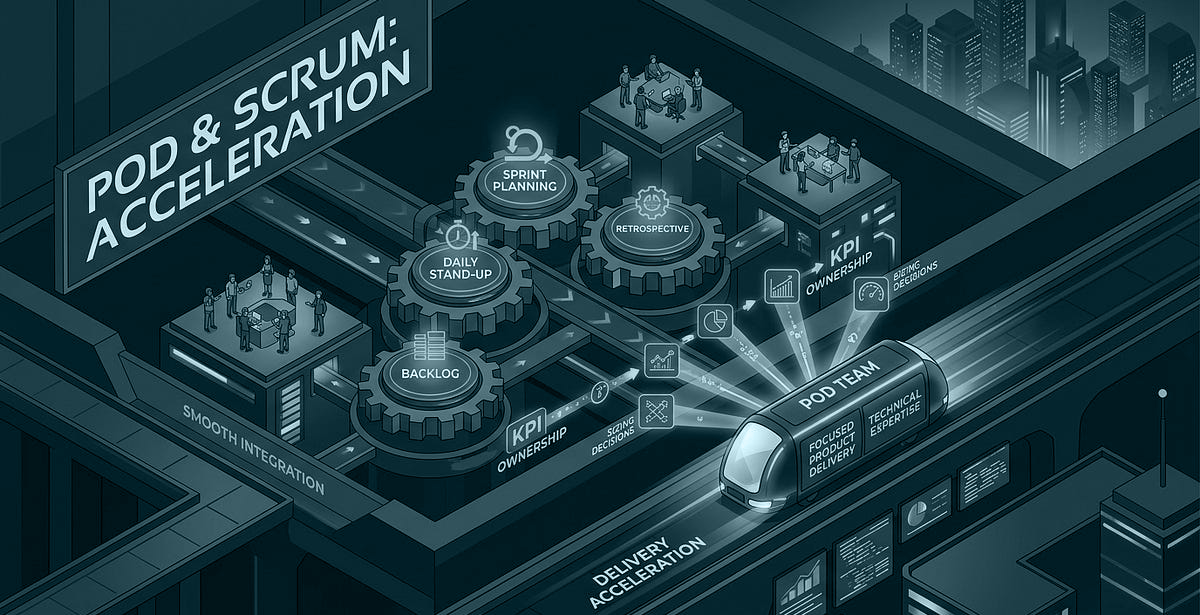
Forward-thinking companies already made the shift. They moved from Scrum sprints to pod-based execution. A pod pairs a handful of humans with AI agents. It ships work in three-day bolts instead of two-week sprints. Teams call this shift the ADLC, short for AI Development Lifecycle. It is quietly replacing the SDLC that shaped software work for two decades.
This article covers why Scrum is losing ground. It also covers what pods and bolts look like day to day, and how your team can start the shift.
Why Scrum Teams Struggle in an AI-Driven Workplace
Companies built Scrum for human-paced work. Sprint planning, daily standups, and retros all assume people write every line of code and make every call themselves. AI changes that math completely.
Most digital transformation programs still fail. Research puts the failure rate at 65% to 70%. A closer look at the root causes behind digital transformation failure shows the problem isn’t the tools. It’s a culture that resists experimentation, sitting on top of an old organizational structure.
Scrum teams inherit that same problem. Standups review yesterday’s work when an agent finished that work an hour ago. Sprint reviews make everyone wait two weeks to see something an AI could prototype in a single day. The rhythm no longer matches the pace of the work.
This is really a corporate DNA problem, not a Scrum problem. Companies with hierarchical, compliance-driven structures bolt AI onto old approval chains. Companies with startup DNA redesign the chain itself, and that’s where pods come from.
What Pods and 3-Day Bolts Actually Look Like
A pod is a small, cross-functional team. It mixes a few humans with one or more AI agents. It owns a problem end to end. There are no handoffs between departments and no waiting for another team’s sprint to line up.
Pods replace the usual Scrum lineup of product owner, scrum master, and specialists. A typical pod might pair one product thinker and one engineer with two or three AI agents. Those agents handle code generation, QA, and documentation. This mirrors the decentralized team structures many AI-native companies now use.
The 3-day bolt replaces the two-week sprint. A bolt starts with one clear, narrow goal. The pod builds, tests, and ships within three days, then picks its next bolt. This is agile with AI built into the operating model, not agile with AI added on top.
Team size isn’t the real story here. Deloitte’s research on team structure and AI outcomes found cross-functional teams were 30% more likely than others to report real efficiency and innovation gains from AI. The advantage comes from mixing skills tightly around agents. It doesn’t come from shrinking headcount for its own sake.
The Culture Shift Behind This Model
Pods only work when organizational culture change happens first. You can’t attach a pod to a rigid hierarchy and expect it to move at bolt speed. A pod needs real authority to decide, not just permission to build.
That shift is harder than most leaders expect. A 2026 survey of enterprise AI adoption found that 79% of organizations still face real challenges adopting AI, despite heavy investment. Many companies fund the tools but skip the culture work behind them. They keep the old approval chains in place and wonder why AI doesn’t speed anything up.
Trust breaks down fast when culture doesn’t shift alongside the technology. Employees who doubt the strategy start working around it instead of with it. That habit undermines every pod’s ability to move at bolt speed.
Distributed Leadership Replaces Command and Control
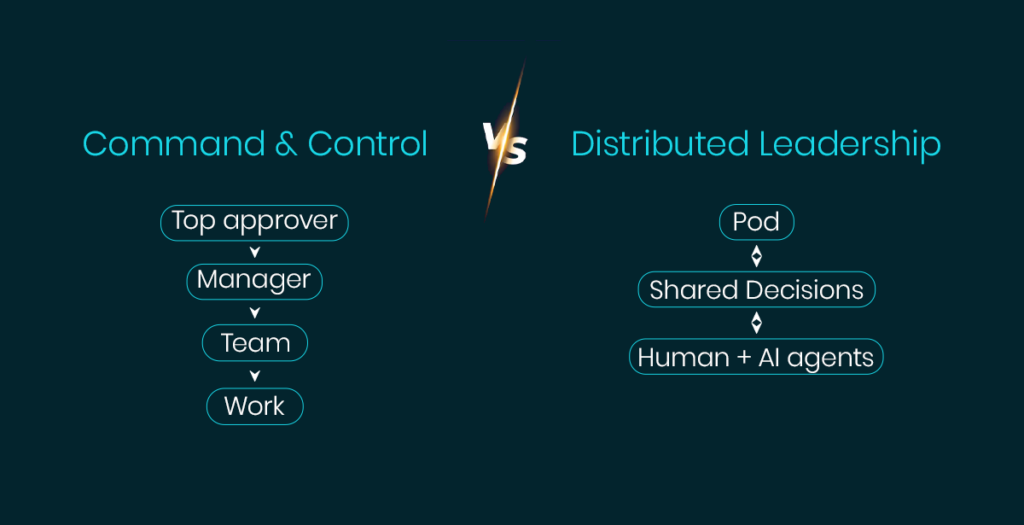
Pods need distributed leadership, not a single approver at the top. Each pod decides its own priority, scope, and trade-offs inside its three-day window.
This asks more of managers, not less. Leaders need real emotional intelligence here. They have to trust a pod’s judgment instead of reviewing every decision themselves. Future At Work covers this exact skill in its EQ-driven leadership masterclass.
Command-and-control leadership simply can’t keep pace with a three-day cycle. By the time an approval chain finishes its review, the pod has already shipped the bolt.
New Ways of Working Start With One Pilot Pod
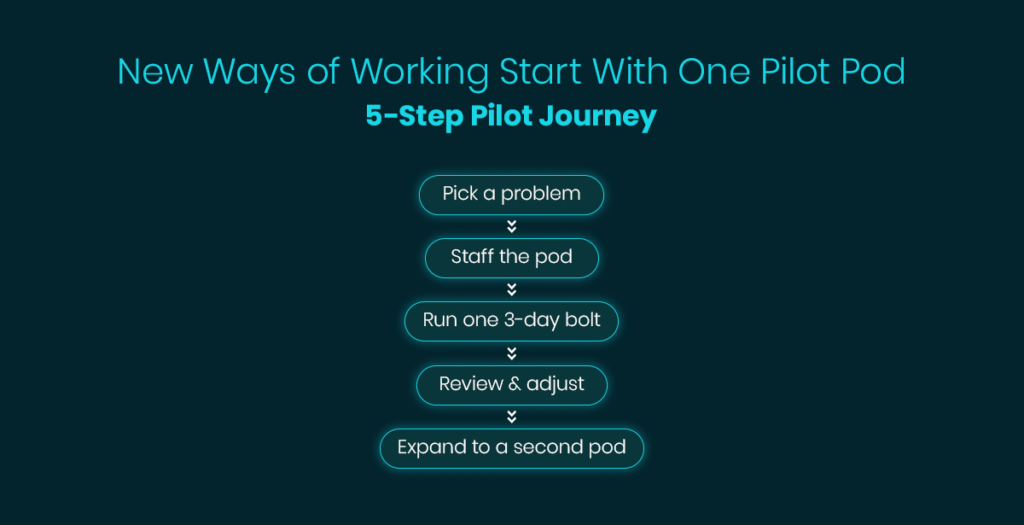
Don’t restructure your whole company overnight. Start with one pilot pod and learn from it. This kind of future of work AI shift works best as a pilot, not a company-wide mandate.
- Pick one problem a pod can own end to end.
- Staff it with two or three people and one or two AI agents.
- Run a single 3-day bolt and ship something real.
- Review what worked, then adjust the mix.
- Expand to a second pod once the first pilot proves itself.
Most rollouts stall right here. Companies try to convert every team to pods at once. That move triggers resistance instead of the fast learning a small pilot delivers. A structured pilot, run inside a program like Future At Work’s Innovation Lab, keeps risk small. It also keeps the lessons real.
Common Questions About Pods and 3-Day Bolts
How does a pod differ from a Scrum team?
A pod is smaller, and it includes AI agents as working members, not just tools. It owns outcomes end to end. A Scrum team follows fixed roles and a two-week rhythm instead.
Do 3-day bolts work for every kind of project?
No. Bolts fit discrete, shippable pieces of work well. Complex, multi-month initiatives still need a longer arc. Teams break that arc into a sequence of bolts instead of one long sprint.
Who leads a pod day to day?
No single person leads a pod the way a Scrum master leads a sprint. The pod shares that role. Each member, human or AI agent, owns the piece of the bolt they’re best suited for.
Conclusion
Scrum shaped the last two decades of software work. It won’t shape the next ten years. New ways of working, like pods and 3-day bolts, match how AI agents actually operate. They run fast, iterative, and always on.
Distributed leadership makes this possible. Without it, pods just become smaller versions of the same slow hierarchy.
The shift starts small. Pick one pod. Run one bolt. Learn from what happens. Companies that treat this as a real culture shift, not a tooling swap, end up with a future of work strategy that survives the AI shift. The ones that don’t will keep running sprints designed for a world that no longer exists.