









AI has changed both how buyers research vendors and how software gets built, and generic products and generic sales tactics are losing ground as a result. Marketing, not sales, now drives most of the pipeline, because buyers arrive already educated by AI before a sales conversation even starts.
Traditional lead channels are weakening, and the main competitive battle for enterprise deals has shifted from fending off AI-built alternatives to surviving vendor consolidation. The companies best positioned to come out ahead are the ones choosing a clear niche, building real moats around it, and pricing based on outcomes rather than hours or headcount.
To explore these shifts, Syed Ahmad, CEO of DPL, steered the discussion as moderator.
He was joined by panelists Umair Javed (CEO of Tkxel), Talhah Munir Khan (COO of CitrusBits), and Ali Syed (CEO of 7 Vals and EZO), who shared their real-world perspectives on navigating this evolving landscape.
Winning Sales Channels in the AI Era
- Review sites, once a dependable source of leads, have lost much of their pull. One platform reported that its own traffic fell by half after AI tools became mainstream, and buyers now research elsewhere.
- Cold outreach has become noisier rather than less useful. AI lets anyone produce a polished-sounding email or message, so response rates drop even though volume keeps rising.
- Simply mentioning AI in outreach still earns attention, since curiosity about AI capabilities is currently high enough that even large enterprises respond.
- The channel itself is rarely the real issue. When outreach is aimed at a well-defined audience and backed by a strong case study, it still converts well, which points to the offer, not the channel, as the usual weak link.
“It’s not really a channel problem, it’s a service line problem.”
What SaaS Models Are Dying vs. What Will Survive
- Narrow, single-feature SaaS tools are disappearing quickly, because teams can now recreate the same function by prompting an AI model directly, removing the need to pay for a separate product.
- Broad, deeply embedded platforms such as Zendesk, Jira, HubSpot, and Salesforce remain secure. Customers may use only a fraction of their features, but the overall value still justifies the cost.
- New buyers increasingly ask whether they could just build the tool themselves, which slows new customer acquisition, even as existing customers stay loyal and keep expanding their usage.
- The main competitive battle has shifted from fighting off AI-built alternatives to vendor consolidation, as customers actively look to cut the number of vendors, tools, and costs they manage.
The Role of Marketing vs. Sales Now
- Marketing and sales now play distinct, complementary roles: marketing studies the customer and builds recognition and urgency, while sales steps in to close the deal once that interest exists.
- Because buyers now arrive already educated through AI-driven research, sales teams spend far less time explaining the product and far more time clearing the practical obstacles to signing.
- Since AI tools recommend vendors based on visible brand presence and reputation, companies are directing most of their go-to-market budget into marketing rather than sales hiring.
- In companies below roughly $40 to 50 million in revenue, the CEO is typically still the person driving marketing in practice, even if the title belongs to someone else.
Team Structure and Resourcing in the AI Age
- Large, seven-person scrum teams are being replaced by small pods, typically one product owner, one developer, and one product manager, who together can cover the same scope of work.
- These smaller, AI-assisted teams are outperforming larger ones on output: one three-person team completed a project originally scoped for eight to ten people, and did it faster.
- The most valuable hires now are forward-deployed engineers, who work directly inside the customer’s business to learn their domain, because AI is replacing generic coding work, not the understanding of a customer’s problem.
- Demand for generic engineering skills is falling while demand for AI-capable, domain-aware talent is rising, though most professionals are expected to delay upskilling until they are forced to by necessity.
Pricing and Business Model Shifts
- The recommended direction is to move away from pricing based on headcount or hours and toward pricing based on the outcomes actually delivered to the client.
- Clients are likely to ask for renegotiated terms once they realize AI has lowered the underlying cost of delivery, so it is better for companies to propose the new pricing model themselves, before being asked.
- Cutting labor costs through AI does not eliminate cost, it shifts it. Cloud and token spend is a new line item that can grow larger than the labor cost it replaced if it isn’t planned for.
- Lasting differentiation increasingly comes from compliance work and system integrations, since these are harder to copy than the underlying software itself.
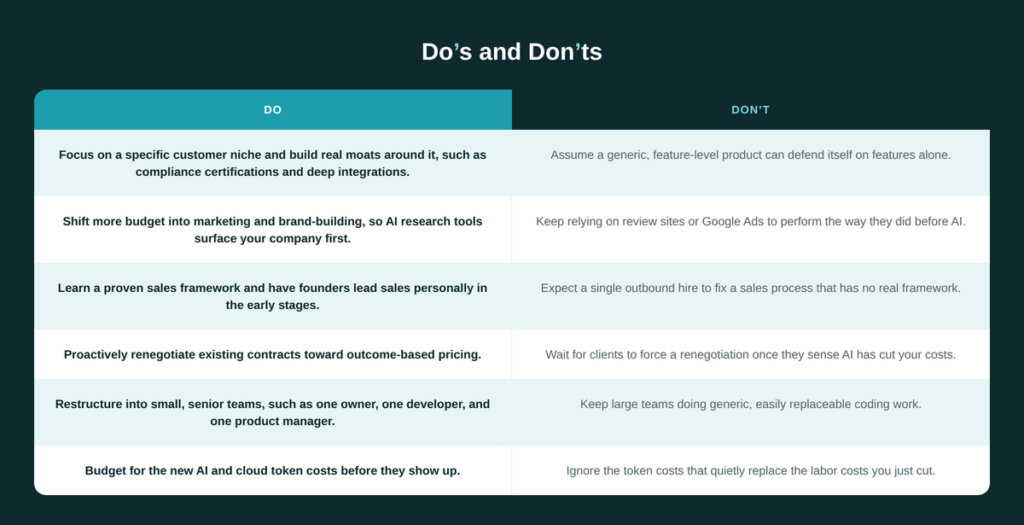
Do’s and Don’ts
Key Takeaways
- What many companies counted as sales success was, on closer look, really the result of strong marketing creating demand that sales simply closed.
- Review sites, long treated as a reliable lead source, have lost much of their traffic and influence since AI tools became widely used for research.
- Coding skill alone is losing value as AI absorbs routine engineering work, while understanding a customer’s specific domain is becoming the harder-to-replace skill.
- Holding onto a team you can no longer properly resource or pay, out of loyalty, does not fix the underlying business problem and usually delays a harder decision.
- Clients tend to ask for lower prices once they sense AI has cut a vendor’s delivery costs, so companies that renegotiate on their own terms first are in a stronger position than those who wait.
Watch the complete session here.
Closing Thought
Over the next six months, companies need to stop competing on generic products and generic sales pitches, since both are being commoditized quickly. The more durable path is to choose a specific niche, build real moats around it such as compliance and integration depth, and redirect budget from outbound sales into marketing so that AI-driven buyer research surfaces the company first.
Teams should be restructured into smaller, senior groups built around people who understand the customer’s domain, and pricing conversations, including with existing clients, should move proactively toward outcomes rather than waiting for clients to demand it.
At the same time, any labor cost saved through AI needs to be re-budgeted against the new and fast-growing cost of cloud and token usage. Companies that make these changes now will set the pace in their markets, while those that wait risk being renegotiated, undercut, or overtaken by competitors who moved first.