








The future of work AI conversation is loud right now, but most of it misses the point. Everyone debates tools. Few talk about the real future of work challenges hiding underneath. These are broken adoption habits, brittle culture, and leaders who manage change like it’s 2015.
Ask ten founders where their AI rollout stalled. Most blame the technology. They’re wrong. Gartner predicts organizations will cancel more than 40% of agentic AI projects by 2027. The reason is rarely the model. It’s unclear ownership, weak governance, and teams that never changed how they actually work.
That’s the pattern behind every one of the four challenges below. Each one gets discussed in isolation. Almost no one connects them. Here’s what’s actually holding organizations back, and what to do about it.
1. AI Adoption Challenges Run Deeper Than the Tools
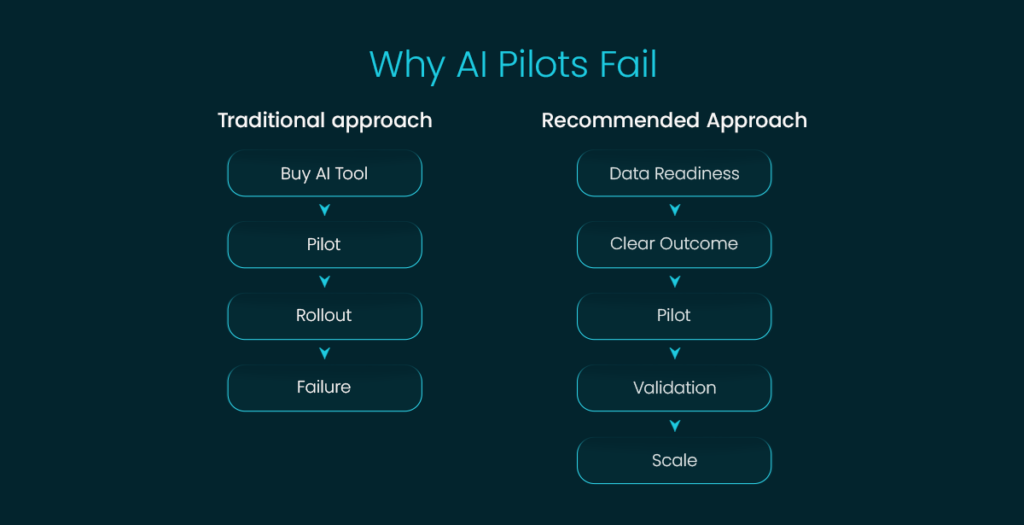
Most companies treat AI adoption as a shopping list. Pick a tool, run a pilot, hope it sticks. That approach explains why so many pilots quietly die.
MIT’s Project NANDA found that 95% of generative AI pilots produce no measurable return. The problem isn’t the model. It’s data readiness, unclear goals, and old workflows that never changed to fit new tools. Layer a smart tool on top of a broken process, and the process wins every time.
Real AI adoption challenges start with structure, not software. Our AI Adoption Roadmap for Growth-Stage Companies walks through the sequence that actually works. Audit your data first. Define one measurable outcome. Then build.
The AI Lab model solves this differently. Instead of one big rollout, it moves through three stages: ideation, MVP, and validated scaling.
Each stage has a gate. Nothing scales until it proves real value first. That structure alone counters the 65 to 70% failure rate common in traditional digital transformation efforts.
2. Organizational Culture Change Can’t Be Optional
You can buy the best AI stack on the market. It won’t matter if your culture still runs on fear and hierarchy.
Most organizations operate on what we call corporate DNA. It’s process-heavy and risk-averse. It’s built for compliance instead of speed. That model made sense on an assembly line. It fails inside a knowledge organization trying to move fast with AI.
Organizational culture change means shifting toward startup DNA. Think flat structures, fast decisions, and people who own outcomes instead of waiting for approval. Our piece on why agile structures still act like hierarchies breaks down the gap. Many companies claim agility. Few actually practice it.
This shift isn’t cosmetic. Teams with real ownership adapt to new tools faster. Teams run by fear just wait for permission, and permission is slow.
3. Workforce Transformation Needs More Than a Training Budget
Here’s a stat worth sitting with. The World Economic Forum projects that 39% of workers’ core skills will change by 2030. AI is the main driver, as it moves from experimentation into daily workflows.
Most companies respond with a single training session and call it done. That’s not workforce transformation. That’s a checkbox.
Real transformation means redesigning roles around what AI can now do, and what only humans still do well. It means building pods. Pods are small, cross-functional teams that pair people with AI agents. They replace rigid job descriptions and slow-moving Scrum teams.
We built our AI Upskilling Workshop around this exact gap. It goes past prompt basics. It focuses on how teams actually restructure work once AI joins the team as a working member, not just a tool.
4. AI Change Management Is a People Problem First
The fourth challenge is the one leaders avoid most. It’s managing the human side of change.
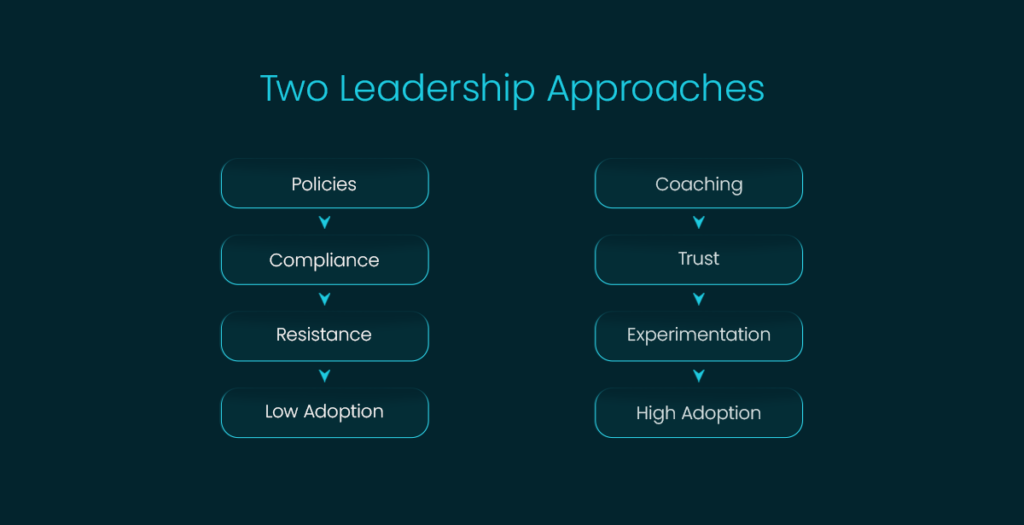
Policies and mandates don’t build trust. They just create compliance theater. Employees follow the letter of the rule while ignoring its spirit entirely.
AI change management works differently. It replaces enforcement with coaching. Leaders explain the why. They model the behavior themselves. They give people room to experiment without fear of punishment for an honest failure.
We cover this shift in The Future of HR: Why Coaching Will Replace Policy Enforcement. The short version is simple. People adopt change faster when they trust the person asking them to change.
What Actually Comes Next
These four future of work challenges share one root cause. Leaders treat AI as a technology problem. It’s actually an organizational one.
Fix the data and workflow gaps. Shift the culture toward ownership. Redesign roles around real skills, not old titles. Lead the change instead of mandating it. Do all four, and AI adoption stops being a gamble.
Common question: Why do most AI initiatives fail even with a good budget?
Money doesn’t fix broken workflows or a fearful culture. Most failures trace back to unclear ownership and no measurable goal. Add teams that never changed how they operate day to day, and failure becomes the default outcome, not the exception.
Common question: What’s the fastest way to start fixing this?
Start small and start honest. Pick one team, one workflow, and one clear outcome. Measure it before you scale anything further.
Ready to see where your organization actually stands? Start with a Discovery Workshop. You’ll get a clear read on your readiness before you spend another dollar on tools.