








Your teams run sprints. Standups happen every morning. A Scrum board covers the wall.
None of that makes you agile.
Agile organizational structure is one of the most misunderstood ideas in business today. Most companies adopt the ceremonies without the conditions that make them work. They speak the language fluently and miss the point entirely.
The result has a name: agile theater. And according to BCG research, nearly half of organizations that believe they’ve succeeded at agile transformation haven’t. Here’s how to tell and what to do about it.
The Signs You’re Running Agile Theater
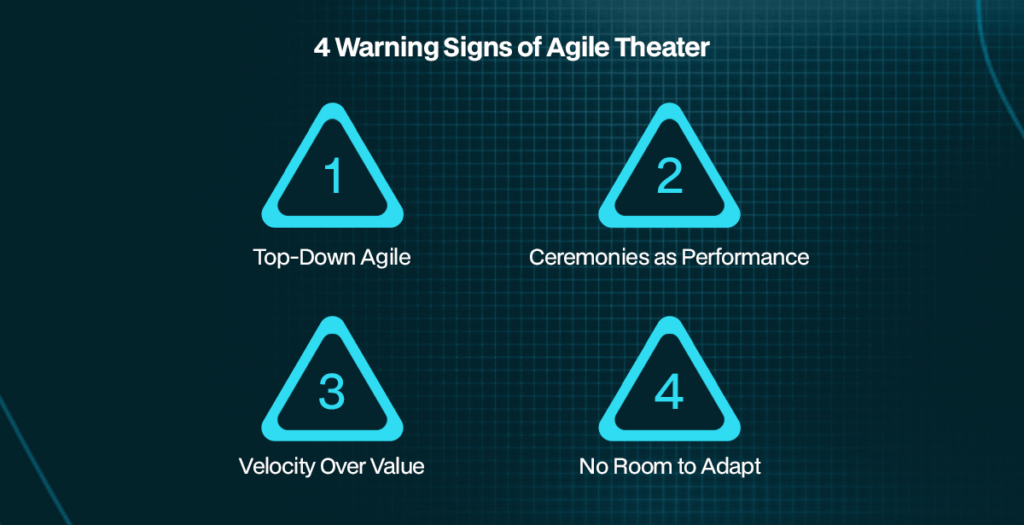
In practice, several patterns show up consistently in organizations stuck in agile theater.
Velocity over value. Teams measure story points completed, not outcomes delivered. The sprint looks productive. The customer sees nothing meaningful.
Top-down “agile.” Leaders demand agility from teams while making all meaningful decisions themselves. Agile theater thrives on this dynamic — the organizational chart flattens on paper, while authority remains concentrated at the top.
Ceremonies as performance. Standups take thirty minutes. Retrospectives produce the same action items every two weeks. Planning sessions feel like presentations to management rather than collaborative decisions.
No room to adapt. Sprints end but priorities never actually change. True agility means the ability to redirect. Yet most organizations don’t permit that.
The Real Problem Isn’t the Process
Most failed agile transformations don’t fail because of bad process design. They fail because the organizational DNA never actually changed.
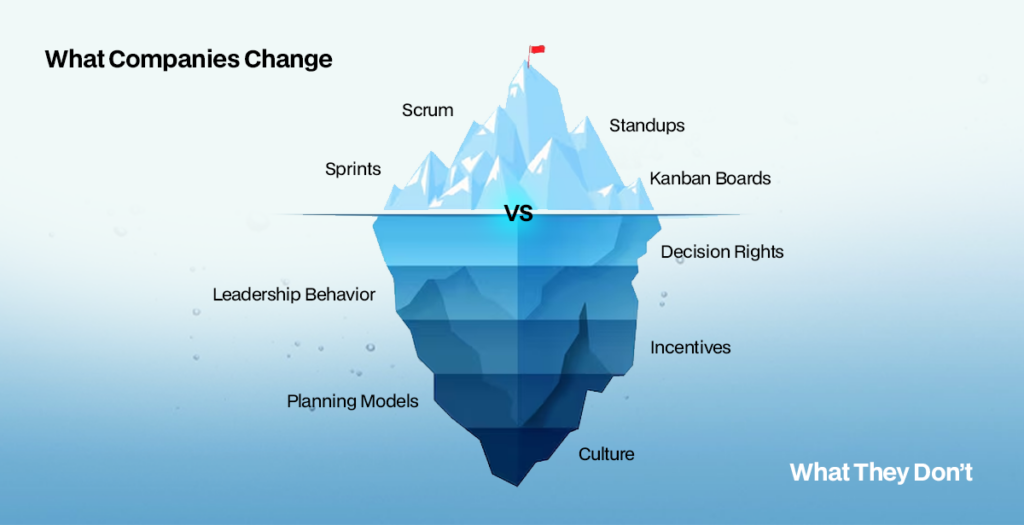
Consider the pattern. A company adopts Scrum. Two-week sprints replace project milestones. A product owner gets assigned. Agile vocabulary enters the org chart. Yet the same senior leader still approves every significant decision. Annual planning still locks priorities twelve months out. Incentive structures still reward individual performance over team outcomes.
Scrum.org makes this case directly: agile transformation is a culture and leadership challenge far more than a methodology challenge. Process adoption without behavior change is decoration, not transformation.
At its core, this is a corporate DNA problem. Organizations that graft agile ceremonies onto hierarchical, compliance-driven structures produce agile theater. The ceremonies are real. The agility is not.
That gap matters more today than it ever has. In an AI-driven environment, organizations that move slowly don’t just fall behind on delivery. They fall out of the competition.
What Genuine Agile Organizational Structure Looks Like
Genuine agile organizational structure does two things most companies never attempt.
First, it distributes decision-making to where the context lives. Teams that own outcomes also own the decisions required to reach them. Leadership sets direction and constraints. Teams determine method.
Second, it builds adaptation into the operating model — not just into sprints, but into how the organization plans, prioritizes, and responds to new information. Quarterly planning cycles, fixed annual budgets, and year-long roadmaps are structural features of the opposite of agility.
Real modern agile practices run shorter cycles, create tighter feedback loops, and give teams genuine authority to change course when they learn something. That’s a structural commitment, not a process preference.
In contrast, most organizational structures resist course changes at every level. For organizations operating in the AI era, this distinction becomes critical.
Building a future of work strategy that survives requires structural agility: the ability to redirect resources, recompose teams, and change priorities faster than the competitive environment changes.
Future At Work’s Innovation Lab model offers one practical path: structured experimentation with real outcomes, short cycles, and genuine team ownership.
Making the Shift Stick
Shifting from agile theater to genuine agile organizational structure requires changes in three places, not one.
Leadership behavior. The biggest single predictor of agile failure is leaders who demand agility from teams but don’t change how they make decisions. Real agile cultures form around leaders who model the behavior — shorter cycles, public learning, distributed authority.
Measurement systems. Teams optimize for whatever gets measured. Shift from measuring output (story points, features shipped) to measuring outcomes (user adoption, cycle time, business impact). That one change exposes more agile theater than any retrospective.
Org design. Agile culture coaching that stops at team-level practices without touching org design produces incremental improvement, not transformation. Structures, incentives, reporting lines, and decision rights all have to align with how agile teams actually operate.
A discovery workshop identifies which of these three levers creates the most drag in a specific organization — and where to start.
Stop Performing Agility. Start Building It.
Calling something agile doesn’t make it agile. Sprints, standups, and story points are tools. Without the organizational conditions that make those tools work, they produce friction rather than agility.
The organizations that genuinely crack this – distributed authority, adaptive planning, leaders who model the behavior they demand, build something that compounds over time. Faster decisions. Stronger ownership. Real adaptability.
Yet most organizations are still waiting for the methodology to do the cultural work. It never does. Stop performing agility. Start building