








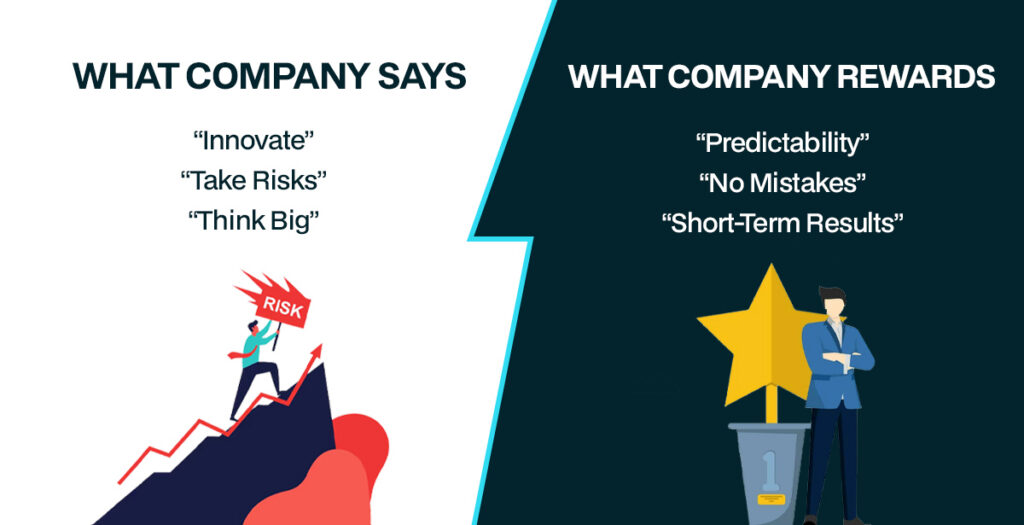
Most companies say they value innovation. Many post it on their walls. Some make it a core value in the employee handbook.
Almost none have built a culture that actually produces it.
BCG research on innovation culture reveals the gap clearly: 80 to 90 percent of executives call innovation a top priority. Yet only 6 percent are satisfied with their results — a number that hasn’t moved in nearly a decade.
The problem isn’t a lack of ambition. It’s a culture that says “innovate” while structurally preventing it.
Why Corporate Innovation Culture Fails
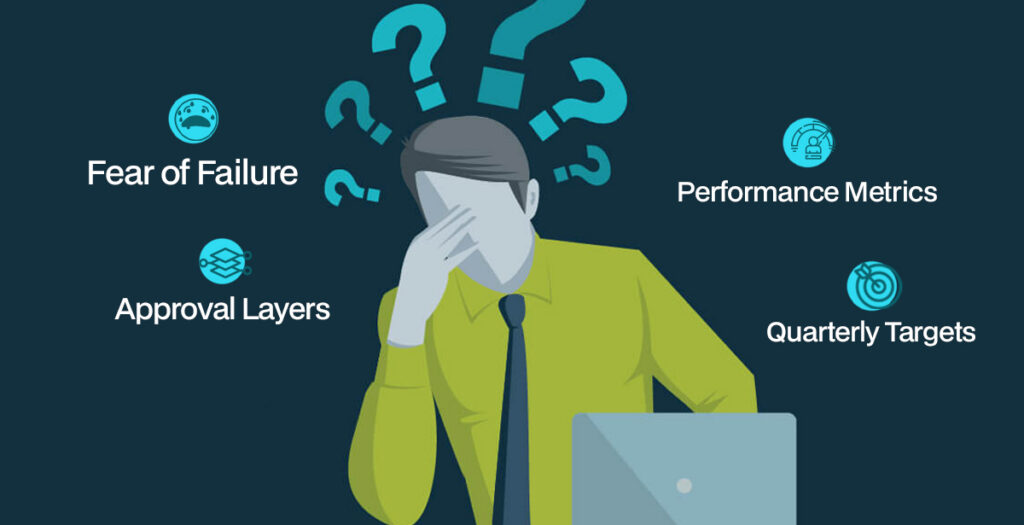
One stat captures what most organizations miss. McKinsey research on fear in innovation finds that more than 85 percent of innovation practitioners say fear regularly holds back innovation. Fewer than 11 percent of organizations are doing anything about it.
Fear shows up in specific ways: employees don’t share ideas that might be rejected. Middle managers filter out experiments that could threaten current performance metrics. Senior leaders declare innovation a priority, then punish the first team that misses a quarterly target while running an experiment.
In practice, this turns innovation into a performance — something organizations do visibly (hackathons, innovation days, idea portals) rather than an operating reality.
That mismatch has a name. At Future At Work, we call it Corporate DNA: the set of structures, incentives, and habits that large organizations build to optimize for consistency, not creation. Corporate DNA isn’t bad — it scales what already works. Yet it actively suppresses what might work next.
What Building a Culture of Innovation Actually Require
Genuine innovation culture examples look different from the outside than they feel from the inside.
From the outside, they often look like process: rapid prototyping, structured experiments, fast feedback loops. From the inside, they feel like permission. Employees at genuinely innovative organizations report feeling safe to try things, fail in front of colleagues, and change direction when they learn something new.
Great Place to Work research shows that psychological safety is the highest-leverage variable in innovation culture — teams with high psychological safety are 60 percent more likely to transform diverse perspectives into innovative solutions.
That safety doesn’t emerge from culture statements or off-site retreats. Instead, it builds through consistent, observable behavior: leaders who admit mistakes publicly, teams that debrief failures without blame, managers who ask questions rather than give answers.
The distinction matters because it shifts the intervention. Building a culture of innovation isn’t a communications exercise. It’s a behavioral one — starting with what leadership does on Tuesday morning, not what the strategy deck says.
The Structural Conditions That Make Innovation Stick
Culture is real, but it needs structural support to sustain.
Several concrete conditions separate organizations with a positive workplace culture for innovation from those that only aspire to one.
Short cycles with real outcomes. Innovation culture examples from leading companies consistently include a mechanism for fast, bounded experiments — not innovation theater, but structured cycles with real deliverables and real decisions at the end. Future At Work’s Innovation Lab runs on this model: 3-day bolts where teams build something real, test it, and decide whether to scale.
Cross-functional ownership. 83 percent of digitally mature organizations use cross-functional approaches to innovation, compared to 55 percent of early-stage companies. Siloed teams optimize their own function. Cross-functional pods optimize for the outcome.
Distributed decision-making. Organizations that extend decision authority beyond senior leadership see 30 percent efficiency gains. More importantly, they create the conditions where people feel ownership — and ownership is what turns an idea into an action.
Leadership’s Role in a Corporate Innovation Culture
None of this happens without leadership behavior change.
Senior leaders set the temperature for innovation culture in three ways.
First, they control resource allocation. Organizations where senior leaders visibly protect time and budget for experimentation — not just in good quarters, but especially in hard ones — build stronger innovation cultures than those that cut experiment budgets at the first sign of pressure.
Second, leadership consulting for innovation-ready organizations centers on one core shift: from leaders who are expected to have answers to leaders who are expected to ask better questions. That shift changes what teams bring to conversations, and therefore what gets explored.
Third, leaders model the behavior they want to see. An executive who presents failed experiments as learning moments makes the cultural statement that no communication campaign can. In contrast, an executive who only celebrates wins trains the organization to hide losses.
Innovation Culture Is Built, Not Declared
Building a culture of innovation isn’t about declaring innovation important. Most organizations already do that.
What separates companies that genuinely innovate from those that only talk about it comes down to three things: whether fear gets addressed structurally, whether experiments have real support, and whether leadership models the behavior it expects from teams.
Agile culture coaching built around these conditions produces sustainable change. A discovery workshop identifies exactly where the current culture blocks innovation — before committing to a full transformation.
Innovation culture isn’t a mindset. It’s a set of conditions. Build the conditions and the culture follows.