








Everyone keeps asking if AI will take their job. That is the wrong question. Future of work AI is not mainly about eliminating roles. It is dismantling the operating model built to run those roles in the first place.
Job titles can survive an AI transition and still feel completely different. The real disruption hits how people make decisions, how companies structure teams, and how work actually flows.
This guide explains why your operating model, not your org chart, is what’s actually at stake. It also covers what leaders need to redesign, and how to do it without losing their people.
The Future of Work AI Actually Threatens
Most leaders picture AI replacing specific jobs one by one. That picture is mostly wrong. AI rarely deletes a role cleanly. Instead, it hollows out the tasks that role used to justify.
A job can survive on paper while its actual content changes underneath it. The title stays the same. The operating model around it does not.
Take a typical customer support role as an example. AI now handles most routine tickets on its own. The human in that seat spends the day on judgment calls instead, not scripted replies.
AI use among employees climbed from 30% to 76% between 2023 and 2025. That is not a gradual shift. It is a structural break in how companies assign and review work.
Entry-level roles show this shift clearly. Over half of organizations report that AI reduces the need for entry-level positions. Early-career workers in AI-exposed fields already show a real, measurable employment decline.
None of this means jobs vanish overnight. It means the operating model around junior work, mentorship, and skill-building has to change fast. This is what future of work AI really means in practice.
AI in the Workplace Is Already Rewriting the Org Chart
AI in the workplace rarely stays confined to one department for long. It moves fast, and it moves sideways across functions that never used to touch each other.
Traditional org charts assume stable roles connected by fixed reporting lines. That assumption breaks the moment one person with the right AI tools outproduces an entire former team.
This is not a hypothetical scenario anymore. Companies already run lean pods instead of large departments. These pods mix humans and AI agents, and they report through much flatter structures than before.
A pod of four people can now ship what a twenty-person department once handled. That math alone forces leadership to rethink what a department is even for.
Executives feel this shift too. More than half of business leaders now expect AI to displace existing roles within their organizations. Roughly a quarter expect it to create meaningfully new roles instead.
Both outcomes point to the same underlying truth. The org chart is no longer the stable backbone it used to be. It has become a live variable that leadership has to keep redesigning constantly.
Future of Work Trends Point to Redesign, Not Replacement
Future of work trends keep circling back to one theme. Redesign beats replacement almost every single time. Companies that simply cut headcount without redesigning their operating model rarely see the gains they expected.
This pattern shows up across many industries, not only in tech. Retailers, banks, and manufacturers all report the same exact story once they skip structural redesign. The tool changes fast. The old structure quietly stays exactly in place behind it.
McKinsey’s State of Organizations research found something telling here. 88% of leaders say their organizations are deploying AI.
Yet 86% of those same leaders admit something uncomfortable. Their organization is not actually ready to run AI well day to day. Adoption and readiness are clearly two very different things.
That gap is the real story here. Leadership finds it easy to announce adoption. Building real structural readiness takes far more work, and most companies skip past it entirely.
This mirrors the failure pattern behind most digital transformation efforts too. Roughly 65% to 70% of them miss their stated goals. The reasons are almost always structural, not technical.
Culture resists the change first, before any system does. Old hierarchies then block the redesign that new technology actually requires to work. Middle managers often feel this tension hardest of all.
Leadership still judges them by old metrics while quietly expecting new behavior from them. Nobody rewrites the scorecard, so nothing structural really changes underneath the announcement.
Leaders who want a different outcome need a strategy that survives the AI shift, not another slide deck about tools. Strategy has to include structure, not just software.
Work Automation AI Changes Tasks, Not Just Headcount
Work automation AI mostly attacks tasks first, not entire jobs. It removes the repetitive middle of a role and leaves the judgment-heavy parts for humans to handle.
This creates an odd effect inside teams. People do less routine work but face harder, more ambiguous problems every single day. That shift demands new skills fast, not eventually.
Judgment, communication, and creative problem-solving matter more now than raw task speed ever did. Companies rarely train for these skills the way they once trained for software tools.
Large, established companies often move slower here than smaller competitors expect. Bureaucracy and legacy hierarchy get in the way of fast task redesign, even with plenty of budget to spend.
A single approval committee can stall a promising pilot for months. By the time it clears review, competitors have already tested three different approaches and moved on.
Future At Work has documented why the biggest companies adopt AI slowest despite having more resources than anyone else. Size without structural flexibility becomes a real liability fast.
Smaller, leaner teams redesign task flow faster because fewer layers need to agree first. That speed advantage compounds every quarter as AI capability keeps improving.
The Real AI Impact on Workforce Structure
The AI impact on workforce structure runs deeper than any single layoff announcement suggests. It changes how authority, ownership, and accountability actually spread across a company.
Traditional hierarchies push decisions up through several layers of approval. That works fine when change moves slowly. It fails badly once AI compresses decision cycles down to hours or minutes.
A manager who once approved requests weekly now needs to approve them hourly. Most approval chains were never built to move at that speed. Something eventually breaks under that pressure.
Usually it is trust, not process, that breaks first. Employees stop asking for approval and simply route around a manager who cannot keep pace.
Companies exploring a decentralized team structure push real decision-making authority down closer to the actual work. Small pods make calls fast instead of waiting on committee approval.
This is not just a structural experiment for its own sake. The same McKinsey research found something worth remembering here. Organizations that prioritize people investment are four times more likely to sustain strong financial performance.
That research also points to an unusual spending ratio. It suggests roughly five dollars on people for every one dollar spent on technology. Most companies still get that ratio backward, badly.
Spending big on tools while ignoring people rarely produces the returns leadership expects. The structure around the tool matters more than the tool itself.
Building an AI-Driven Workplace That Keeps Its Edge
An AI-driven workplace only works long-term if people trust the structure around them. Trust does not come from a new tool. It comes from clarity about roles, decisions, and what actually changes day to day.
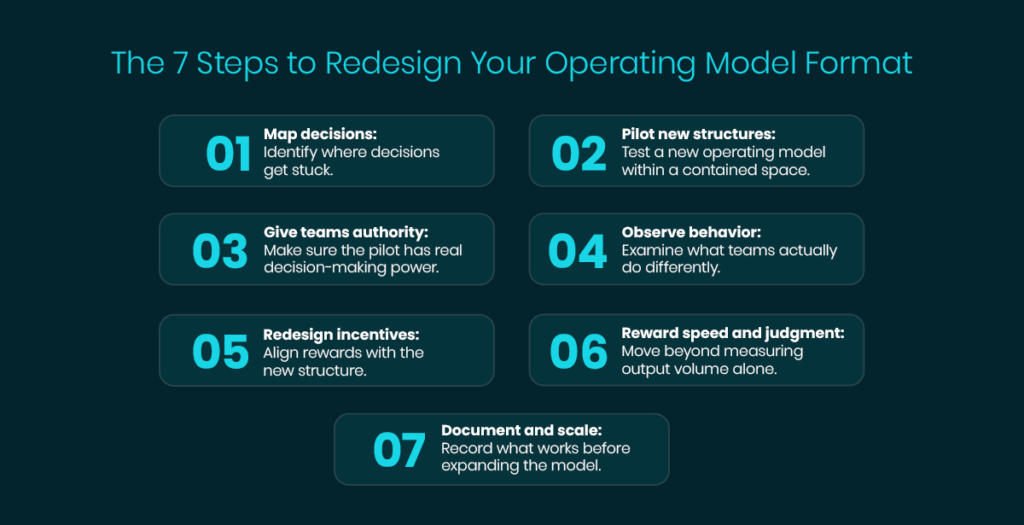
Start by mapping where decisions currently get stuck inside your company. Slow approval chains are usually the first thing AI-native competitors will out-execute you on.
Next, pilot new structures inside a contained space before rolling them out everywhere. A well-run innovation lab gives teams room to test new operating models safely.
Give that pilot team real authority, not just a symbolic mandate. A pilot with no actual decision-making power teaches leadership nothing useful about what will work at scale.
Watch what the pilot team actually does differently, not just what they report in a meeting. Behavior under real pressure reveals far more than any self-assessment survey ever will.
Redesign incentives to match the new structure, not the old one. People chase whatever leadership measures and rewards, no matter what leadership says out loud.
Reward speed and judgment instead of pure output volume. A team that ships less but decides faster is usually the one worth scaling company-wide.
Document what works before scaling it everywhere else. Skipping this step usually means repeating the same avoidable mistakes at a much larger, costlier scale.
Companies further along this path often replace old software cycles entirely. Many have already made the shift from SDLC to ADLC, trading two-week sprints for much faster three-day bolts.
Common Questions About the Future of Work and AI
Is AI actually going to eliminate most jobs?
Not in the way most headlines suggest. AI reshapes tasks and structures well before it eliminates entire roles outright. The bigger risk is an unchanged operating model wrapped around a changed job.
What should leaders redesign first?
Start with decision rights and approval chains, not job titles. Slow, layered decision-making is usually the biggest bottleneck once AI speeds up everything else around it. Fix that bottleneck before touching anything else.
How fast does this change need to happen?
Faster than most leaders expect, but not all at once. Pilot new structures in one team first. Expand only once that pod proves the new model actually works well in practice.
Your Operating Model Is the Real Battleground
AI will not send you a memo before it changes your business. It will simply keep compressing decision cycles until your old structure cannot keep up anymore.
The companies that win this future of work AI shift will not be the ones with the flashiest tools. They will be the ones willing to redesign how people actually decide, assign, and own work.
Start that redesign before a competitor forces your hand. A discovery workshop is a practical first step toward seeing your own operating model clearly.