







Most corporate AI training programs follow the same script: a half-day workshop, a slide deck on how to write prompts, a few practice exercises, and then everyone returns to work and nothing changes.
Prompt engineering matters. But learning to phrase a query doesn’t change how a team works, how decisions get made, or how AI fits into an actual workflow.
Yet 78% of employees who use AI regularly report receiving no formal training from their employers. The ones who do often get the surface version — the mechanics of asking, not the practice of applying.
Here’s what real AI training for employees looks like.
Why Prompt Engineering Training Isn’t Enough
Prompt engineering is a real skill. Knowing how to structure a query, give context, and iterate on outputs makes a genuine difference. Most employees never get even that. But it’s the floor, not the ceiling.
Research on the AI training gap shows this clearly. Only 23% of organizations offer prompt engineering training. Yet even those that do find skills rarely transfer into sustained productivity gains without broader organizational change.
So the issue isn’t just that most corporate AI training is too thin. The deeper problem is that tool-focused training treats AI adoption as an individual learning challenge rather than an organizational one.
Real AI skills training addresses both. It builds individual capability and organizational readiness — the workflows, norms, and structures that let individual skills compound into something meaningful.
What Effective AI Training for Employees Actually Covers
Good AI workshop for teams goes well beyond prompting. It covers three areas that most programs skip entirely.
How AI changes the work, not just the tools. Effective training helps employees understand where AI genuinely accelerates their specific role, where it introduces risk, and how to make judgment calls in the gap. That understanding shifts behavior far more than prompt templates.
How to apply AI in real workflows. McKinsey’s research on AI upskilling makes the case directly: embedding learning in actual work produces more lasting change than isolated training events. Employees need to practice with real tasks, real outputs, and real feedback.
How to work alongside AI agents as collaborators. At the leading edge of AI skills training, teams learn to design how humans and AI agents divide work, make decisions together, and hand off tasks appropriately. That’s a different skill set from prompting.
Together, these three areas build capability that compounds rather than fades after the workshop ends.
Context Is the Missing Layer
The real gap in most AI training for employees isn’t content. It’s context.
Generic training teaches employees how AI works in the abstract. Organization-specific training teaches them how AI applies to the problems their team actually solves, the tools they use daily, and the decisions they own.
Generic AI literacy doesn’t create AI-capable teams. Application does.
That gap matters more than it sounds. An employee who learns prompt engineering in isolation may never connect it to their work. Someone who practices AI in the context of a real project, using actual workflows and real deliverables, builds a habit, not just a skill.
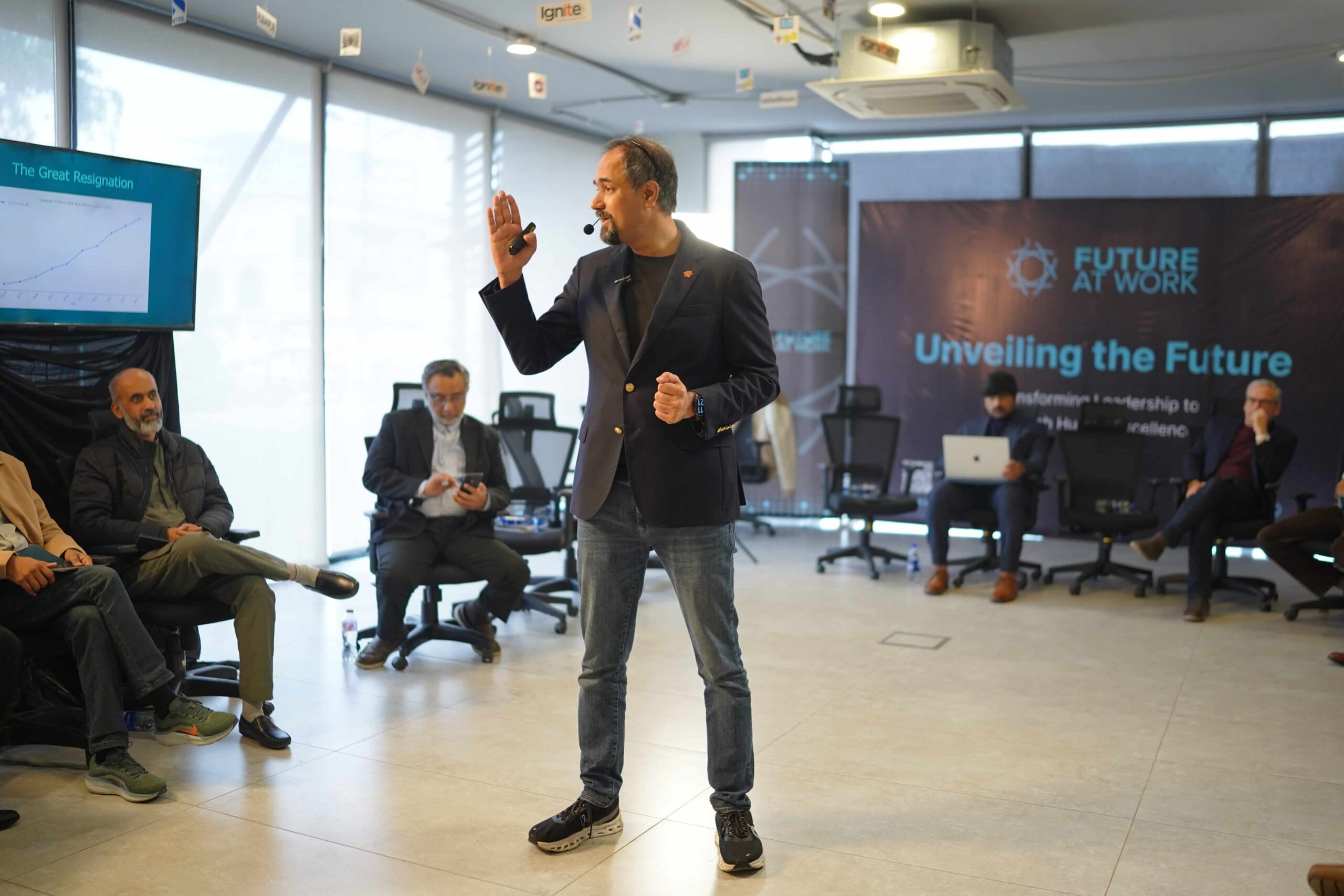
This is the design principle behind Future At Work’s AI upskilling workshop: training built around the real work of the team, not a generic curriculum.
In practice, the most effective AI learning and development programs look less like courses and more like guided experiments: structured, time-boxed, and applied to real outcomes.
Building a Real AI Learning and Development Program
Most organizations approve AI training budgets without changing how work happens. Research on the execution gap in AI upskilling confirms the pattern: leaders increase learning activity without changing the structures, norms, and incentives that would make new skills stick.
Breaking out of that pattern means treating AI upskilling as organizational change, not just individual learning.
Several practical steps make a real difference.
Start with one real use case: a specific team, a specific workflow, a specific AI application. Not an enterprise-wide rollout. One team. One outcome. Prove the value before scaling.
Run a structured AI workshop for teams that builds capability in the actual context of their work, not on generic examples.
Build feedback loops fast. Teams that test, adjust, and share what they learn accelerate faster than teams that train in isolation.
Consider running an AI hackathon to create a concentrated burst of applied learning. Done well, a hackathon builds more practical capability in three days than most training programs build in three months.
For organizations at the start of this journey, a discovery workshop identifies where AI can create the most value before committing to a full training program.
The Difference Between AI Literacy and AI Capability
Prompt engineering is where AI training for employees begins. It shouldn’t be where it ends.
The organizations that build real AI capability do something different. They embed AI learning into actual work, build accountability structures around AI use, and keep iterating as tools evolve.
That takes more investment than a half-day workshop. Yet it produces something more useful than a workforce that knows how to ask better questions. It produces teams that know how to get better results.
Corporate AI training that stops at prompting trains people for a world that no longer exists.