





AI Change Management: How to Move Your People Without Losing Them

Most AI rollouts fail for one reason. Leaders change the tools first and the people last. AI change management flips that order. It puts your people at the center of every technology decision, not at the end of it.

Founders who get this right build teams that move fast with AI. Founders who skip it lose their best people right when they need them most.

This guide breaks down why the process fails. It also covers what the shift actually requires and how to build a strategy that keeps your team intact.

Why AI Change Management Fails Before It Starts

This work means guiding people, roles, and culture through an AI transition. It is not just installing new software and hoping people catch up. Most leaders treat AI like an IT rollout instead of a people transition. That mistake costs them their best talent.

Only 27% of executives have a comprehensive AI strategy. Just 20% believe their own workforce is truly ready for AI. Leaders often mistake basic tool adoption for real transformation.

Gartner calls this pattern the enablement illusion. Teams get access to a new AI tool. But nothing about how they actually work changes underneath it. Usage numbers go up, dashboards look good, and leadership declares victory too soon.

Meanwhile, employees quietly disengage. No one addressed how their daily work, incentives, or career paths actually shift. The stakes here are real and growing every quarter.

Gartner predicts a sobering outcome for 2027. Half of enterprises without a people-centric AI strategy will lose their top AI talent to competitors. Your best engineers and operators will leave for companies that invest in them, not just in tools.

The Real AI Adoption Challenges Leaders Face

AI adoption challenges rarely start with the technology itself. They start with fear, and fear is a people problem, not a technical one. Leaders who skip this reality end up solving the wrong problem entirely.

Fear of Replacement

Employees hear “AI transformation” and think “job cuts.” That fear is not irrational. Some companies have used AI as cover for layoffs, and word travels fast between industries.

Once trust breaks, employees stop sharing honest feedback about what actually works. Leaders need to name this fear directly instead of ignoring it. Silence breeds worse rumors than the truth ever does.

Tell people clearly and early what will change and what will stay the same. Companies that get ahead of this fear usually share one trait. They treat honest, two-way communication as a discipline, not a one-time announcement.

That habit forms the foundation of a genuine culture of innovation. Employees feel safe raising concerns instead of burying them. Safety, not policy, is what actually keeps people talking honestly.

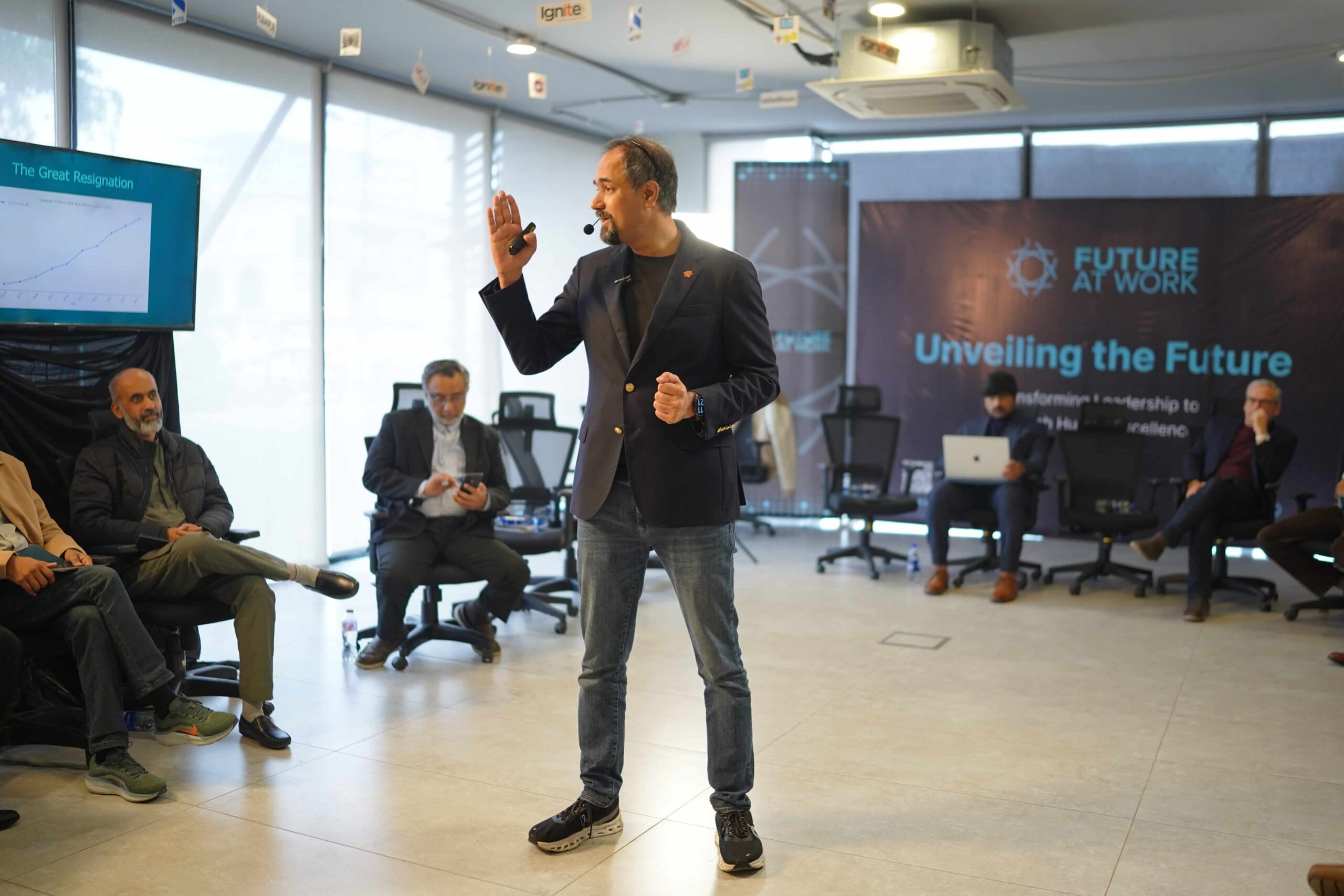
Fear like this rarely stays quiet for long. It shows up later as disengagement, and disengagement often turns into resignation. The Great Resignation proved how fast talented people leave once trust erodes inside a company.

Skill Gaps and Confidence Loss

Many employees feel behind before they even start. They worry AI tools require skills they simply do not have yet. This gap creates quiet disengagement long before anyone raises a hand to object out loud.

Left unaddressed, that quiet disengagement spreads fast through an entire team. It rarely announces itself in a meeting.

Confidence, not just competence, drives real adoption. People need small, visible wins early in the process. Short, guided practice sessions work far better than long manuals or generic courses ever do.

A well-run AI upskilling workshop builds both skill and confidence at the same time. That combination matters more than either one alone.

Leaders Who Model Resistance

Some executives quietly resist AI themselves while asking their teams to embrace it fully. Employees notice this gap almost immediately. If leadership will not use the tools daily, why should anyone else bother?

What AI Organizational Change Actually Requires

AI organizational change is not a training problem. It is a structural one. New tools rarely fit neatly inside old hierarchies and rigid reporting lines built for a different era.

Traditional org charts assume tasks stay fixed and roles stay narrow forever. AI breaks that assumption fast and without much warning. A single person with the right AI tools can now do the work of an entire team. Five years ago, that same output took many more people.

This calls for real structural change, not another tool bolted onto an old chart. Companies need an agile organizational structure that actually works, built around small, empowered teams instead of rigid departments. Flat structures let decisions move at the speed AI now demands from every team.

Roles need genuine redesigning too, not just reshuffling on paper. Just over half of organizations have already redefined roles because of AI in the past year alone. The other half are quietly falling behind their competitors.

An AI Transformation Strategy That Keeps People

A strong AI transformation strategy treats people and technology as one connected system. It never treats them as two separate workstreams running on parallel tracks. Here is a simple four-step approach that works well for growth-stage companies.

  1. Run a discovery phase first. Assess where your teams actually stand before you buy a single tool. Skipping this step guarantees wasted investment later on.
  2. Pilot in a small, safe environment. Let one team experiment with AI before scaling it company-wide. Small wins build the case for bigger change ahead.
  3. Invest in real upskilling, not a single webinar. Ongoing coaching beats one-time training sessions every single time. People need hands-on practice, not just another slide deck.
  4. Communicate constantly, not just once at launch. Share what is changing, why it matters, and what stays the same. Repeat this message far more often than feels necessary to you.

Gartner’s research on change management trends found something striking. Organizations that continuously adapt their change plans based on real employee feedback are four times more likely to succeed. Rigid plans break the moment reality shifts, and reality shifts constantly once AI enters the picture.

Organizational Culture Change Is the Real Work

Organizational culture change is the hardest part of any AI transition, and most leaders underestimate it badly. Culture, not technology, ultimately decides whether AI adoption actually sticks around.

Rigid processes, strict hierarchies, and fear-based compliance built most corporate cultures around control. That model made people replaceable on purpose, by design. It simply cannot support the judgment and creativity that AI-native work now demands from every level of the company.

Shifting culture starts with how leaders actually behave day to day, not with a company-wide memo. Leaders need real emotional intelligence to guide people through uncertainty without leaning on authority alone. An EQ-driven leadership masterclass gives founders practical, usable tools for exactly this kind of shift.

Transparency matters just as much as empathy here. Tell your team the truth about what AI means for their roles. Say this even when the truth feels uncomfortable to admit out loud. Trust survives honesty far better than it survives spin.

AI Business Transformation Reshapes Roles, Not Just Tasks

AI business transformation changes what work looks like at its core, not simply how fast people finish tasks. Companies built traditional Scrum teams and two-week sprints for a pre-AI world that no longer exists. This shift can feel disorienting at first, especially for long-tenured employees who mastered the old model.

Small pods of humans and AI agents now consistently outperform larger, slower teams. These pods work in short three-day cycles instead of two-week sprints, testing ideas and adjusting course fast. This is not a minor process tweak worth a footnote. It is a fundamentally different way of organizing work.

Companies exploring an AI agile methodology replacing Scrum report faster iteration and noticeably higher engagement. Teams feel real ownership over outcomes instead of just tickets sitting in a backlog. That sense of ownership rarely survives in a rigid, hierarchical structure.

Pods also change how people grow inside a company. Instead of climbing a fixed ladder, employees rotate across problems and pick up new skills constantly. This keeps ambitious people engaged instead of restless and job-hunting elsewhere.

This pattern echoes what hackathon-style sprints already show elsewhere. Teams given real autonomy tend to solve harder problems, faster. They also tend to stay longer, because the work itself feels less routine and more genuinely theirs.

This entire shift only works if people genuinely trust the process behind it. Trust takes far longer to build than any new pod structure does. McKinsey’s State of AI research found something telling about that exact gap. Only 6% of companies see major financial returns from AI so far.

Most still report individual productivity gains, though. The real gap sits between personal productivity and enterprise-wide results. Structure explains most of that gap, not the technology itself.

Common Questions Leaders Ask

What is AI change management?

It is the structured process of helping employees adapt to new AI tools, workflows, and roles. It focuses on people and culture first, then technology second. Done well, it prevents talent loss and builds real, lasting adoption across the organization.

How long does AI adoption take to stick?

AI adoption is not a single event with a fixed end date. It is a continuous process that needs regular check-ins, feedback loops, and honest adjustments. Most successful transitions run in phases over six to twelve months, not a few rushed weeks.

How do you handle employee resistance to AI?

Name the fear directly instead of dismissing it as irrational. Explain exactly what will change and what will not change. Then back your words with real upskilling support and small, visible wins that build genuine trust over time.

Moving Forward Without Losing Your People

AI change management is not optional anymore for growth-stage companies. But losing your best people to a rushed, careless rollout is not inevitable either. The companies that win will treat people as the strategy itself, not as an afterthought bolted onto it.

Start small. Listen constantly, and act on what you actually hear. Redesign roles together with your team, never around them behind closed doors.

If you want a clear-eyed look at where your organization stands today, start with a discovery workshop. It is the right place to begin real, lasting change.

AI for Business Leaders: What You Need to Know Before Your Competitor Figures It Out

Only 6% of companies qualify as real AI adoption leaders, according to BCG’s latest research. That small group posts a 9.3% return advantage over laggards. Everyone else sees almost no difference at all.

That gap is the whole story of AI for business leaders right now. A handful of companies pull ahead, and the rest compete for what’s left over.

This isn’t a call to panic-buy every AI tool on the market. It’s a call to build the specific skills, strategy, and sequencing that separate the 6% from everyone else. The good news is that none of those three things require a massive budget to start.

What they do require is a leader willing to make a real decision. Funding a dozen small experiments that never connect to each other isn’t a strategy. It’s expensive indecision.

What Does “AI for Business Leaders” Actually Mean?

AI for business leaders isn’t about learning to prompt a chatbot. It’s about deciding where AI changes your competitive position and where it doesn’t.

A leader who understands this spends less time chasing every new tool. They spend more time deciding which three problems actually matter this year.

That distinction is what separates a leader with an AI strategy from a leader with an AI subscription. One drives decisions. The other just drives a bill.

Neither requires a technical background. Both require the discipline to say no to eight ideas so the ninth one actually gets the attention it needs.

The AI Leadership Skills Gap Nobody Wants to Admit To

The Conference Board found that 43% of executives now name AI as their top investment priority for 2026, ahead of product innovation. The budget is there.

The AI leadership skills usually aren’t. Investment without training and organizational redesign tends to underperform, no matter how large the check.

Most leaders can talk about AI at a conference. Fewer can actually direct where it should go inside their own company. That second skill is the one worth building first, and it doesn’t show up on a slide.

Building an AI Strategy for Executives That Isn’t Just a Slide Deck

A real AI strategy for executives names specific workflows, specific owners, and specific deadlines. A slide deck names “digital transformation” and calls it done.

Our strategic engagements page breaks down the actual formats this work can take. Options range from a single workshop to a full advisory retainer.

Pick the format that matches your actual bandwidth, not the one that looks most impressive in a board deck. A modest plan you finish beats an ambitious one that stalls in month two.

Executives who skip this step often end up with a strategy document nobody reads again after the kickoff meeting. A working plan gets referenced weekly, not filed away.

Why Your AI Transformation Strategy Needs a Sequence, Not a Wishlist

An AI transformation strategy fails fastest when it tries to fix everything simultaneously. Ten pilot projects launched in the same month usually means ten pilots that get half the attention each.

Our guide on building a future of work strategy that survives the AI shift walks through the sequencing that actually holds up. One workflow gets proven before the next one starts.

Sequence beats scope. A leader who sequences well ships results a board can point to, quarter after quarter.

Leadership in the AI Era Looks Different From Leadership in 2015

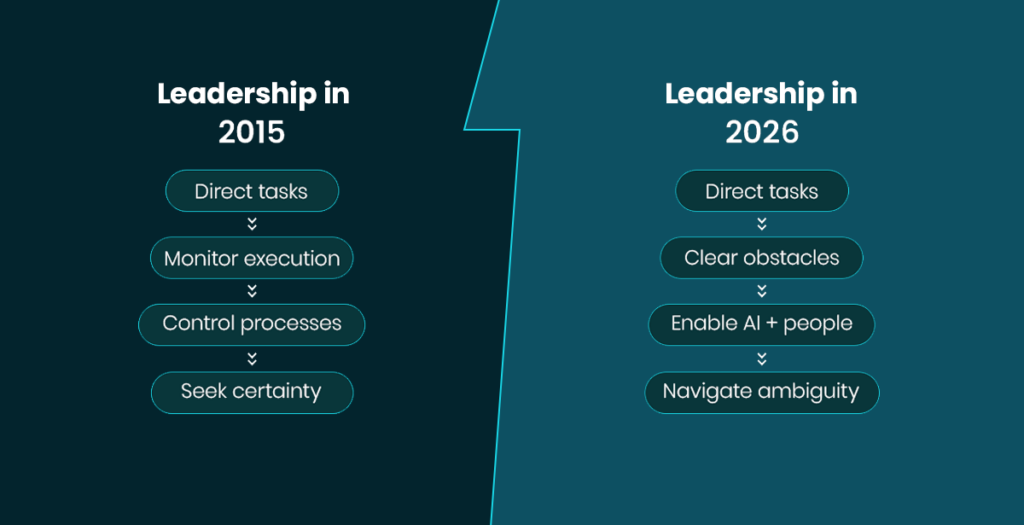
Leadership in the AI era rewards curiosity and comfort with ambiguity over control and certainty. The leader’s job shifts from directing tasks to setting direction and clearing obstacles.

Most leadership development programs still fail because they train leaders for a version of the job AI already changed. Our piece on executive leadership development in 2026 covers what actually needs to replace it.

The leaders who adapt fastest treat this shift as a skill to practice. It isn’t a personality trait some people simply have and others don’t.

AI Leadership

AI Business Transformation Rewards the Fast Movers

AI business transformation isn’t gentle to companies that wait for certainty. Enterprise AI adoption stalls at exactly the companies with the most resources to move fast.

The 6% of leaders BCG identified didn’t wait for a perfect plan. They picked a workflow, measured it, and built from there, then repeated that pattern until it compounded.

Your competitor reading this same research right now faces the same choice. The only real edge left is speed of execution, and speed compounds the same way returns do.

Frequently Asked Questions

What’s the biggest mistake business leaders make with AI strategy?

Treating it as a single big initiative instead of a sequence of small, proven wins. A sequenced approach builds real momentum. A single mega-project usually just builds a bigger failure.

Do business leaders need to understand the technical side of AI?

Not deeply. They need to understand where AI changes competitive position, then rely on technical experts for implementation. Direction matters more than depth here.

How fast should AI transformation strategy move?

Fast enough to show results within a quarter on one workflow. Full transformation happens in stages over a year or more, not in a single announcement.

Is AI business transformation different for smaller companies?

Smaller companies often move faster because they have fewer approval layers standing between a decision and its execution. Size isn’t the advantage here. Decision speed is.

Should AI strategy for executives live with the CEO or get delegated?

The CEO sets direction and removes roadblocks, but daily ownership works best closer to the actual work. Delegation without executive sponsorship tends to stall the moment budget gets tight.

AI Leadership

Start Before Your Competitor Does

AI for business leaders comes down to one uncomfortable truth. Waiting for certainty is itself a decision, and it’s usually the wrong one.

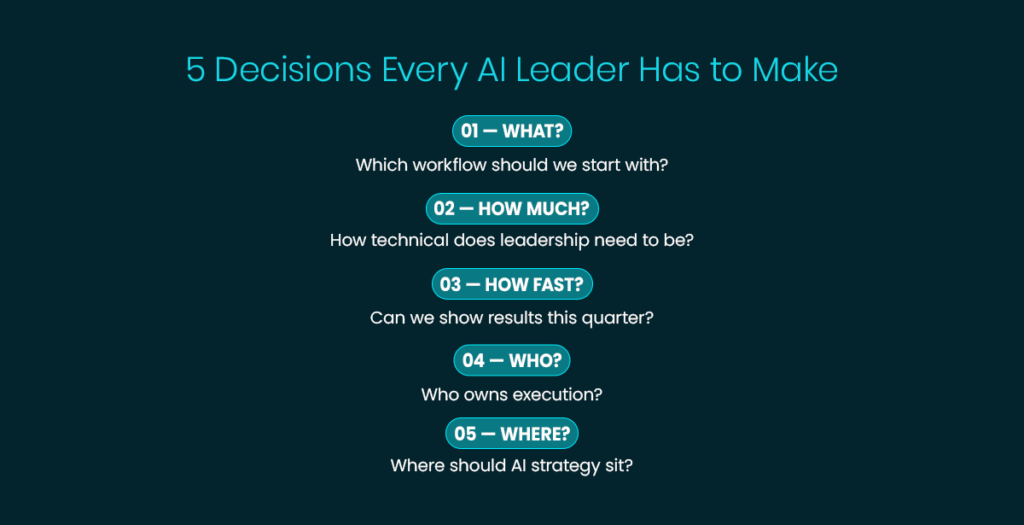
Leadership in the AI era, a real AI transformation strategy, and closing the AI leadership skills gap all point in the same direction. Pick one workflow, move on it now, and build from there.

Talk to our leadership consulting team and find out which workflow to pick first.

Agentic AI in Business: What Happens When Your AI Starts Making Decisions

Agentic AI in business is no longer a research demo. It’s live in procurement systems, customer service queues, and financial approval chains. These systems don’t just answer questions. They take actions, chain tasks together, and make calls that used to require a human sign-off.

Gartner expects task-specific AI agents to sit inside 40% of enterprise applications by the end of 2026. That’s up from under 5% a year earlier, a fast climb for something most leadership teams haven’t fully planned for.

The real question isn’t whether your AI will start making decisions. It already has, somewhere in your stack. The question is whether you’ve built the structure and oversight to handle it. That’s what separates an AI-native company from one that bolted AI onto an old operating model.

What Does It Mean When AI Starts Making Decisions?

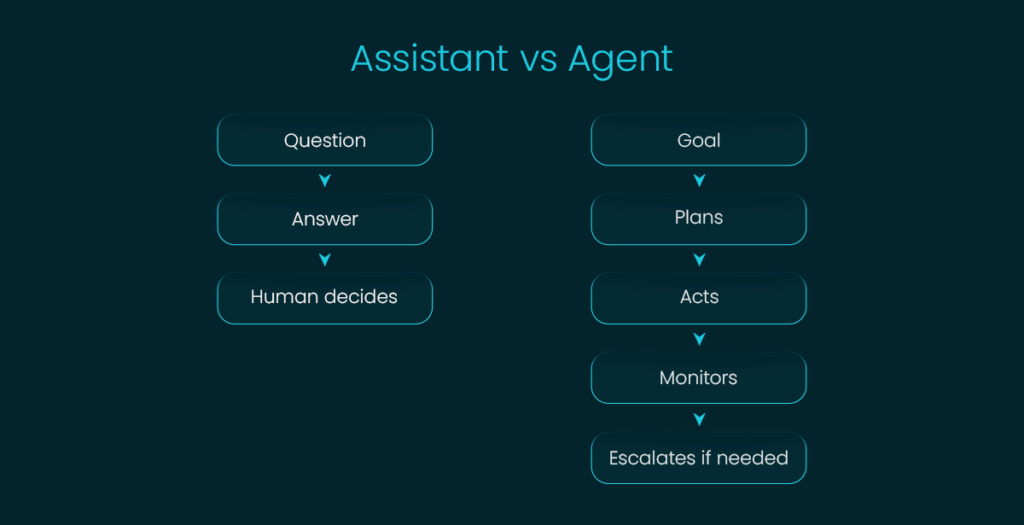
Agentic AI is software that plans, acts, and adjusts without waiting for a human at every step. A traditional AI tool answers a question. An agentic system decides what to do next and executes it. It loops in a person only when something falls outside its rules.

That distinction matters more than it sounds. Once an AI agent approves a refund, reroutes a shipment, or flags a hire, it has crossed a line. It moved from assistant to actor. Your business now has a non-human decision-maker on the payroll, in effect.

This is the heart of agentic AI in business: authority, not just intelligence, is shifting to machines.

Agentic AI

How Fast Is Agentic AI Moving in Business?

Adoption is accelerating fast. Gartner tracks this shift in its 2026 Hype Cycle for Agentic AI. The report shows task-specific agents climbing quickly, moving from under 5% of enterprise applications in 2025 toward 40% by the end of 2026.

Deloitte separately found that autonomous agent deployment will double among generative AI users. It grows from 25% in 2025 to 50% by 2027.

That pace creates a problem most leadership teams underestimate. Deloitte’s research on why AI agents are scaling faster than their guardrails found a gap. Only 21% of organizations have a mature governance model for autonomous agents. The rest are letting agents act before deciding who’s accountable when something goes wrong.

Building an AI-Native Company vs. Bolting AI On

An AI-native company designs its workflows around agents from the start. A company that bolts AI onto legacy processes just automates the same broken structure, faster.

The difference shows up first in how decisions get made. In a bolted-on setup, an agent drafts a recommendation. A manager approves it inside the same rigid hierarchy that existed before.

In an AI-native setup, the agent has clear boundaries and real authority within them. That’s the core distinction between an AI first organization and one running old playbooks with new tools.

This is also why the biggest companies tend to move slowest on agentic AI. Legacy hierarchies weren’t built to grant a machine decision rights. Rewriting them takes more courage than budget.

Future At Work’s AI Lab framework treats this shift as three stages: ideation, MVP development, and governed scaling. Skipping straight to scaling without validating an agent’s judgment is a common mistake. It’s exactly how most digital transformations fail, and agentic AI in business is no exception.

Managing AI Agents: New Team Structures for a New Kind of Worker

Managing AI agents isn’t a software problem. It’s a team design problem. Traditional Scrum teams weren’t built to include a non-human member that acts autonomously between stand-ups.

This is why forward-thinking companies are replacing two-week sprints with three-day bolts. The work runs through pods: small teams of humans and agents working side by side.

Future At Work breaks this down in its piece on AI agile methodology replacing Scrum. It also covers the underlying team design in decentralized, pod-based team structures.

The shift isn’t about adding an AI tool to an existing team. It’s about redesigning who owns which decisions. Managing AI agents works like managing any new hire: clear scope, feedback loops, and consequences.

Human-AI Collaboration: Who’s Actually Accountable?

Human AI collaboration works only when accountability stays human, even as execution becomes shared. An agent can recommend, act, and even learn. It cannot own the outcome the way a person can.

Leaders who get this wrong tend to repeat an old mistake: promoting technical capability without matching judgment. Future At Work’s work on executive leadership development for AI-era leaders makes a clear case. EQ, not technical fluency, decides whether human-AI collaboration works at scale.

Companies that treat this as a values shift, not just a technology rollout, see it stick. That’s where real AI business transformation happens.

Frequently Asked Questions

Do AI agents make decisions without any human oversight?

No. Most agentic AI systems in business operate inside defined rules and escalate anything outside them. Good systems design the oversight in, rather than bolting it on afterward.

What’s the first step toward becoming an AI-native company?

Start small. Map one workflow where an agent could safely own a decision. Test it in a contained environment, then expand once it proves reliable.

How is managing AI agents different from managing software?

Software executes fixed rules. AI agents interpret situations and choose actions. That means agents need ongoing feedback, monitoring, and clear escalation paths, much like a junior employee.

The Real Work Starts Now

Agentic AI in business isn’t a future scenario. It’s already approving refunds, screening resumes, and rerouting logistics inside companies that haven’t updated their org charts to match.

The organizations that win this shift won’t be the ones with the most advanced models. They’ll be the ones that redesigned team structures and built real governance. They trusted people to manage AI agents as seriously as they manage each other.

If you’re not sure where your organization stands, start with a discovery workshop. It’s a practical way to map where agent authority already exists. It also shows where a human still needs to stay in the loop.

A No-Nonsense AI Adoption Roadmap for Growth-Stage Companies

Most growth-stage companies are approaching AI the wrong way.

They buy tools. They run a pilot. Someone publishes a LinkedIn post about “levering AI.” Six months later, nothing has changed and the budget is lighter.

This is not an AI problem. It is a strategy problem.

According to RAND Corporation’s analysis, 80% of AI projects fail to deliver intended business value. McKinsey’s 2025 State of AI report found that while 88% of organizations are now using AI in some capacity, only 1% consider their AI strategies mature.

Read that again: 88% using AI. 1% doing it well.

If you are leading a growth-stage company, you cannot afford to be in the 80%. What you need is a clear AI adoption roadmap — not a vendor pitch, not a buzzword framework. A real sequence of decisions.

Here is what that looks like.

Start With Honest Assessment, Not Tools

The most common mistake is skipping the diagnosis. Leadership sees a competitor using an AI tool and panics. They buy a license. No one uses it properly. The tool gets blamed.

Before any AI transformation strategy can work, you need an honest AI readiness assessment. That means asking hard questions.

1) Do you have clean, accessible data?

AI runs on data. Most organizations have data that is siloed, inconsistent, or simply not captured at all. If your CRM is a mess and your ops data lives in spreadsheets, no AI tool will save you.

2) Do your people understand what AI actually does?

Not at a hype level. At a working level. Can they distinguish between automation and AI? Can they identify which of their tasks are genuinely AI-solvable? Most teams cannot.

3) Does leadership have the appetite for failure?

AI adoption requires experimentation. Experimentation means failed attempts. In organizations where a failed pilot gets someone fired, AI transformation will never take root. Not with any tool.

If you are not sure how ready your organization is, a structured discovery workshop can give you that honest baseline before you spend a dirham or dollar on tools.

Build a Three-Stage Adoption Sequence

A sound AI adoption roadmap for business does not try to transform everything at once. It moves in three stages.

Stage 1: Ideation and Data Audit

Identify two or three genuine business problems, not vanity projects. Problems where AI can meaningfully reduce cost, accelerate speed, or improve quality. Then audit your data for those problems. Do you have it? Is it clean? Is it accessible?

Most companies skip ahead here. They want to be doing AI, not auditing spreadsheets. But the audit is the work. It tells you where to actually invest.

Stage 2: MVP Development

Pick one problem. Build a minimum viable AI solution. Test it with real users. Collect feedback. Measure whether it actually moves the needle.

This is the stage that most pilots fail to complete properly. They build. They demo. They do not test with real users under real conditions. Running an internal AI hackathon at this stage can compress the ideation-to-prototype cycle dramatically and build team buy-in in ways that top-down mandates never do.

Stage 3: Scaling What Works

Only after Stage 2 validates real ROI does it make sense to scale. This means governance: who owns the AI output? What happens when the model is wrong? What data does it continue to train on?

Scaling without governance is how organizations create expensive new problems while solving old ones. This is where an Innovation Lab structure, a dedicated team accountable for AI deployment, pays its full dividend.

AI Transformation Framework: People First

Here is the uncomfortable truth that most enterprise AI adoption frameworks skip over: your technology is not your bottleneck. Your people are.

Deloitte’s 2026 State of AI in the Enterprise report found that organizations scoring above 70% on AI readiness are three times more likely to implement AI successfully within twelve months. The top differentiator? Not the tools. Not the budget. Organizational readiness, specifically whether leadership and teams have the skills and cultural orientation to actually use AI.

We have documented this pattern in detail, looking at why enterprise AI adoption keeps stalling even in the most well-resourced companies. The root cause is always cultural and structural, not technical.

This is why AI upskilling is not optional on a serious AI adoption roadmap. Not generic “AI awareness” training. Practical, role-specific capability building that helps your people work with AI tools, not around them.

Gartner predicts that all IT work will involve AI by 2030. The window to build that capability ahead of competitors is closing.

The Operating Model Has to Change Too

Buying AI tools without changing how work is structured is like installing a jet engine in a bullock cart. The engine will not help. The cart will break.

Growth-stage companies that succeed at AI adoption restructure around it. That means smaller, cross-functional teams, what we call pods, combining human judgment with AI execution. It means shorter delivery cycles: not month-long sprints, but focused three-day bolts that move fast and validate faster.

It also means leadership that can tolerate ambiguity, make decisions without complete data, and coach teams through experimentation rather than policing outputs. That is a different kind of leader than most organizations are currently developing.

Our guide to building a future-ready operating model covers the full architecture of this shift, from restructuring teams into pods to replacing sprints with bolts. And if you want to understand the broader operating model design, our AI Lab whitepaper lays out why the traditional digital factory approach fails and what replaces it.

Your AI Adoption Roadmap: A Practical Summary

The companies winning with AI right now are not the ones with the biggest budgets. They are the ones that treat AI adoption as an organizational design problem — not a technology procurement problem.

Start with an honest readiness assessment. Identify real problems, not pilot theater. Build and test with real users before you scale anything. Upskill your team, because tools without capability are wasted spend. Restructure for AI-native ways of working. Then govern as you scale.

If you are ready to move from intent to execution, Future At Work works with growth-stage leadership teams to design and implement AI adoption roadmaps that actually stick.

Enterprise AI Adoption: Why the Biggest Companies Move the Slowest

There’s a puzzle that keeps coming up in boardrooms across Karachi, Dubai, and Riyadh. A company with 5,000 employees, a technology budget in the tens of millions, and a board mandate to “become AI-driven” is being consistently outmaneuvered by a 40-person startup running on open-source models and a shared Notion board.

The small team ships an AI feature in three days. The enterprise forms a committee to study the feasibility.

Enterprise AI adoption is not failing because of a lack of resources. It is failing because of a lack of organizational readiness. And the bigger the company, the deeper the misalignment runs.

The Slow Mover Paradox

The assumption is that large organizations have the advantage in AI. More data, more capital, more talent access. In theory, this should make them faster.

In practice, size compounds every structural problem that was already there.

According to McKinsey’s State of AI research, less than a third of companies report meaningful value from their AI investments, despite years of spending, announcements, and pilot programs. The organizations getting value tend to be the ones that moved fastest and embedded AI into actual operations, not those with the largest budgets.

The reason isn’t technology. It’s culture, structure, and decision-making architecture — things that scale with an organization’s age, not its ambition.

The Real Culprit: Corporate DNA

Most large organizations were built on assembly-line thinking. Work is broken into standardized, repeatable tasks. Accountability flows upward. Decisions require sign-off. Deviation is discouraged because deviation introduces variance, and variance is the enemy of operational efficiency.

That model was designed for manufacturing in the 20th century. It is actively hostile to the kind of experimentation that AI business transformation requires.

When an AI initiative lands inside a corporate DNA organization, it doesn’t get accelerated. It gets managed. Stakeholder committees are formed. Use cases are approved. Risk assessments are conducted. By the time anything is ready to test in production, the market has already moved.

Startups don’t have this problem, not because they’re smarter, but because they haven’t had time to build the institutional scaffolding that slows decision-making down. The goal isn’t to become a startup. It’s to cultivate startup DNA inside your existing structure: lean, cross-functional, empowered to act, and safe to fail fast.

Why Transformation Programs Keep Failing

The industry has known this for a while. Research consistently shows that 65 to 70% of digital transformation programs fail to meet their stated goals. That’s not a technology problem. The tools are available, capable, and increasingly affordable. It’s a leadership and culture problem, and AI adoption inherits every weakness the previous transformation failed to fix.

Three failure patterns show up consistently across industries and geographies.

Organizations try to run new AI workflows on old organizational structures. They layer the technology on top of a hierarchy that was never designed for rapid iteration. The result is AI tools that nobody uses the way they were intended.

They underfund the human layer. AI change management — the work of shifting how people think about their roles, accountability, and relationship with AI tools — rarely appears as a line item in transformation budgets. But it’s what determines whether a rollout sticks.

And they skip validation. Projects go from ideation to enterprise rollout without a real MVP phase. As our whitepaper on the AI Lab model outlines, the structured path from experimentation to proven ROI is the mechanism that separates successful transformations from expensive ones.

What Fast Movers Do Differently

The organizations winning at AI transformation strategy share a pattern worth studying closely.

They don’t start with technology selection. They start with a clear problem worth solving, a small cross-functional team with real authority to act, and a mandate to produce something working within days, not quarters.

This is the logic behind the AI Lab model: a dedicated hub for experimentation that operates outside the normal approval architecture, runs short validated cycles, and hands off only what has been proven. It’s the successor to the digital factory, designed for the probabilistic, data-centric nature of AI work rather than the deterministic logic of traditional software projects. Our Innovation Lab is how we help organizations stand this model up in practice.

The AI Lab also gives organizations something most transformation programs don’t: a place to build organizational muscle for working with AI before asking the entire enterprise to change how it operates.

The Human Layer: Where Most AI Strategies Stop Short

Here’s the uncomfortable truth about AI adoption for business at scale: the technology is the easy part.

What’s hard is the leader who built their reputation on knowing the answers, and now needs to be comfortable delegating to an AI agent. The middle manager whose job was aggregating information upward, and who now has to reimagine what value they add. The team that had a clear lane and is now being asked to work alongside tools that didn’t exist last year.

None of these people are obstacles to transformation. They are the transformation. Getting this right requires more than a technology rollout.

It requires AI upskilling that goes beyond prompt engineering, and leadership development that addresses the identity shifts AI adoption triggers, not just the workflow changes.

According to Harvard Business Review’s research on transformation failure, the most common reason digital initiatives stall is not technical. It’s that the people and culture side was treated as secondary to the technology implementation. AI adoption doesn’t escape this pattern. It amplifies it.

AI competitive advantage belongs to the organizations that solve the human problem first.

FAQ: Enterprise AI Adoption

Why do large companies struggle with AI adoption more than smaller ones?

Size compounds structural problems. Large organizations have approval hierarchies, risk frameworks, and incumbent processes built to reduce variance. AI experimentation requires variance. Smaller organizations move faster not because they are better resourced, but because they have fewer layers between an idea and a test.

What is the right first step toward AI transformation?

A realistic assessment of where you actually are, not where your AI strategy document says you should be. That means looking at decision-making speed, cultural appetite for failure, data readiness, and leadership alignment before selecting any tools. A discovery workshop is one of the most effective ways to surface what is actually blocking transformation before you spend on technology.

Conclusion

The companies moving fastest on enterprise AI adoption are not the biggest ones. They are the most organizationally honest ones, willing to examine the structures and cultural defaults making transformation slow, and willing to change them before they change the technology stack.

The window for getting this right is narrowing. Not because AI will stop developing, but because the gap between organizations that have embedded AI into how they work and those still discussing it is already visible in the market, and it widens every quarter. Future At Work works with founders and leadership teams who have decided to be on the right side of that gap