






Innovation Management in the Age of AI: From Process to Culture

Most companies still manage innovation the way they manage everything else: as a process. They build stage-gate pipelines, innovation committees, and quarterly review decks. Then they wonder why nothing ships.

Innovation management in the age of AI means turning ideas into validated, scaled outcomes. It uses AI-native ways of working, not static gates and committees. AI is rewriting the rules of competitive business. Organizations that still run on assembly-line thinking fall further behind every quarter.

The real fix isn’t a better process. It’s a different culture, one built for experimentation, ownership, and AI-native execution.

Why Traditional Innovation Management Fails in the AI Era

Eighty-seven percent of innovation leaders say turning ideas into real outcomes is their biggest challenge, according to the 2025 State of Corporate Innovation Report. Most organizations pour resources into early-stage ideation. Boards approve budgets. Committees review decks. Few ideas ever reach validation or scale.

This gap isn’t a resourcing problem. It’s structural. An estimated 65 to 70 percent of digital transformation programs fail. Companies bolt new technology onto old hierarchies instead of redesigning how they make decisions. Our research on why digital transformation stalls breaks down these failure patterns in detail.

Process fixes treat symptoms. Culture fixes treat causes.

Innovation Culture Is the Real Bottleneck, Not Process

Innovation culture, not process maturity, predicts whether ideas survive contact with the organization. Roughly three-quarters of innovation effort stalls before it ever becomes a product. Workplace research consistently names bureaucracy the top killer of new ideas.

Only about half of employees feel genuine freedom to experiment at work. Yet organizations with strong psychological safety turn a profit far more often. Corporate innovation culture either gives people room to try and fail, or it quietly punishes both.

That difference separates startup DNA from corporate DNA. One rewards initiative. The other rewards compliance.

Building an Innovation Mindset Across the Organization

An innovation mindset isn’t just for founders. Leaders can teach it, model it, and reinforce it through EQ-driven leadership instead of more rules.

Managers who lead through hierarchy and fear train employees to wait for permission. Managers who lead through trust and direct feedback train employees to act. That shift usually starts with leadership consulting focused on emotional intelligence instead of authority.

How do you build an innovation mindset at scale? Reward the attempt, not just the result. Give teams real decision-making authority instead of symbolic input.

The Innovation Lab as the New Operating Model

An innovation lab gives ideas a controlled space to prove themselves before teams scale them company-wide. It replaces the old digital factory model, which focused on process automation, with data-centric, rapid experimentation.

The Three-Stage AI Lab Model

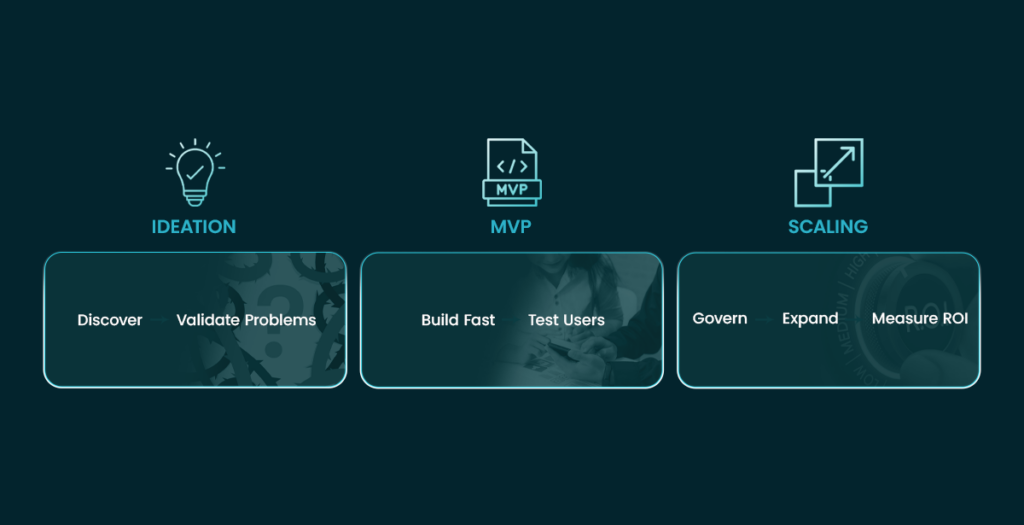
A well-run innovation lab typically moves through three stages:

  1. Ideation — use design thinking and a data audit to find real user problems worth solving.
  2. MVP development — build fast, then let real users test and validate it before major investment.
  3. Scaling — prove demand and ROI first, then scale with governance in place.

Skipping straight to scale is exactly why so many transformation programs collapse. Deloitte’s 2026 enterprise AI research found only 34 percent of leaders are truly reimagining their business with AI, even as worker access to AI tools rose 50 percent over the past year. Access without a lab structure just produces more pilots that never graduate.
How to Start Building a Culture of Innovation

Building a culture of innovation starts with an honest audit, not a mission statement. A discovery workshop is usually the fastest way to surface where structure, incentives, and leadership habits work against innovation.

From there, most teams benefit from a live, low-stakes forum to practice the behavior they want to build. A structured hackathon compresses months of cautious deliberation into days of hands-on building. It also shows leadership what’s possible when leaders trust teams to move fast.

Culture change compounds. Each small win, a shipped MVP or a hackathon prototype that becomes real product, makes the next one easier to greenlight.

The Takeaway

A better pipeline template won’t win innovation management in the age of AI. You win it by building a corporate innovation culture where people can experiment freely. You win it with an innovation mindset that leadership actively models, and an innovation lab that gives ideas a real path to scale.

Organizations that keep treating innovation as a process problem will keep getting process-shaped results: safe, slow, and forgettable. Organizations that treat it as a culture problem will still compete once AI finishes reshaping their industry.

If your organization is ready to move from talking about innovation to actually building it, a discovery workshop is the place to start.

A No-Nonsense AI Adoption Roadmap for Growth-Stage Companies

Most growth-stage companies are approaching AI the wrong way.

They buy tools. They run a pilot. Someone publishes a LinkedIn post about “levering AI.” Six months later, nothing has changed and the budget is lighter.

This is not an AI problem. It is a strategy problem.

According to RAND Corporation’s analysis, 80% of AI projects fail to deliver intended business value. McKinsey’s 2025 State of AI report found that while 88% of organizations are now using AI in some capacity, only 1% consider their AI strategies mature.

Read that again: 88% using AI. 1% doing it well.

If you are leading a growth-stage company, you cannot afford to be in the 80%. What you need is a clear AI adoption roadmap — not a vendor pitch, not a buzzword framework. A real sequence of decisions.

Here is what that looks like.

Start With Honest Assessment, Not Tools

The most common mistake is skipping the diagnosis. Leadership sees a competitor using an AI tool and panics. They buy a license. No one uses it properly. The tool gets blamed.

Before any AI transformation strategy can work, you need an honest AI readiness assessment. That means asking hard questions.

1) Do you have clean, accessible data?

AI runs on data. Most organizations have data that is siloed, inconsistent, or simply not captured at all. If your CRM is a mess and your ops data lives in spreadsheets, no AI tool will save you.

2) Do your people understand what AI actually does?

Not at a hype level. At a working level. Can they distinguish between automation and AI? Can they identify which of their tasks are genuinely AI-solvable? Most teams cannot.

3) Does leadership have the appetite for failure?

AI adoption requires experimentation. Experimentation means failed attempts. In organizations where a failed pilot gets someone fired, AI transformation will never take root. Not with any tool.

If you are not sure how ready your organization is, a structured discovery workshop can give you that honest baseline before you spend a dirham or dollar on tools.

Build a Three-Stage Adoption Sequence

A sound AI adoption roadmap for business does not try to transform everything at once. It moves in three stages.

Stage 1: Ideation and Data Audit

Identify two or three genuine business problems, not vanity projects. Problems where AI can meaningfully reduce cost, accelerate speed, or improve quality. Then audit your data for those problems. Do you have it? Is it clean? Is it accessible?

Most companies skip ahead here. They want to be doing AI, not auditing spreadsheets. But the audit is the work. It tells you where to actually invest.

Stage 2: MVP Development

Pick one problem. Build a minimum viable AI solution. Test it with real users. Collect feedback. Measure whether it actually moves the needle.

This is the stage that most pilots fail to complete properly. They build. They demo. They do not test with real users under real conditions. Running an internal AI hackathon at this stage can compress the ideation-to-prototype cycle dramatically and build team buy-in in ways that top-down mandates never do.

Stage 3: Scaling What Works

Only after Stage 2 validates real ROI does it make sense to scale. This means governance: who owns the AI output? What happens when the model is wrong? What data does it continue to train on?

Scaling without governance is how organizations create expensive new problems while solving old ones. This is where an Innovation Lab structure, a dedicated team accountable for AI deployment, pays its full dividend.

AI Transformation Framework: People First

Here is the uncomfortable truth that most enterprise AI adoption frameworks skip over: your technology is not your bottleneck. Your people are.

Deloitte’s 2026 State of AI in the Enterprise report found that organizations scoring above 70% on AI readiness are three times more likely to implement AI successfully within twelve months. The top differentiator? Not the tools. Not the budget. Organizational readiness, specifically whether leadership and teams have the skills and cultural orientation to actually use AI.

We have documented this pattern in detail, looking at why enterprise AI adoption keeps stalling even in the most well-resourced companies. The root cause is always cultural and structural, not technical.

This is why AI upskilling is not optional on a serious AI adoption roadmap. Not generic “AI awareness” training. Practical, role-specific capability building that helps your people work with AI tools, not around them.

Gartner predicts that all IT work will involve AI by 2030. The window to build that capability ahead of competitors is closing.

The Operating Model Has to Change Too

Buying AI tools without changing how work is structured is like installing a jet engine in a bullock cart. The engine will not help. The cart will break.

Growth-stage companies that succeed at AI adoption restructure around it. That means smaller, cross-functional teams, what we call pods, combining human judgment with AI execution. It means shorter delivery cycles: not month-long sprints, but focused three-day bolts that move fast and validate faster.

It also means leadership that can tolerate ambiguity, make decisions without complete data, and coach teams through experimentation rather than policing outputs. That is a different kind of leader than most organizations are currently developing.

Our guide to building a future-ready operating model covers the full architecture of this shift, from restructuring teams into pods to replacing sprints with bolts. And if you want to understand the broader operating model design, our AI Lab whitepaper lays out why the traditional digital factory approach fails and what replaces it.

Your AI Adoption Roadmap: A Practical Summary

The companies winning with AI right now are not the ones with the biggest budgets. They are the ones that treat AI adoption as an organizational design problem — not a technology procurement problem.

Start with an honest readiness assessment. Identify real problems, not pilot theater. Build and test with real users before you scale anything. Upskill your team, because tools without capability are wasted spend. Restructure for AI-native ways of working. Then govern as you scale.

If you are ready to move from intent to execution, Future At Work works with growth-stage leadership teams to design and implement AI adoption roadmaps that actually stick.