





Design Thinking in the AI Era: What Still Works and What Needs to Change

AI can generate fifty interface concepts in a minute. It still can’t tell you which one your customer actually needs. That gap is exactly what design thinking was built to close, and it matters more now than ever.

This approach gives teams a structured way to solve real problems for real people. Speed means nothing if you build the wrong thing faster. AI is reshaping ideation, prototyping, and delivery. Leaders need to know which parts of the process still hold and which parts need a rework.

Future At Work’s Innovation Lab exists for exactly this reason. It helps teams experiment with AI-native ways of working without losing the human judgment that makes innovation stick.

Why Design Thinking Still Matters in the AI Era

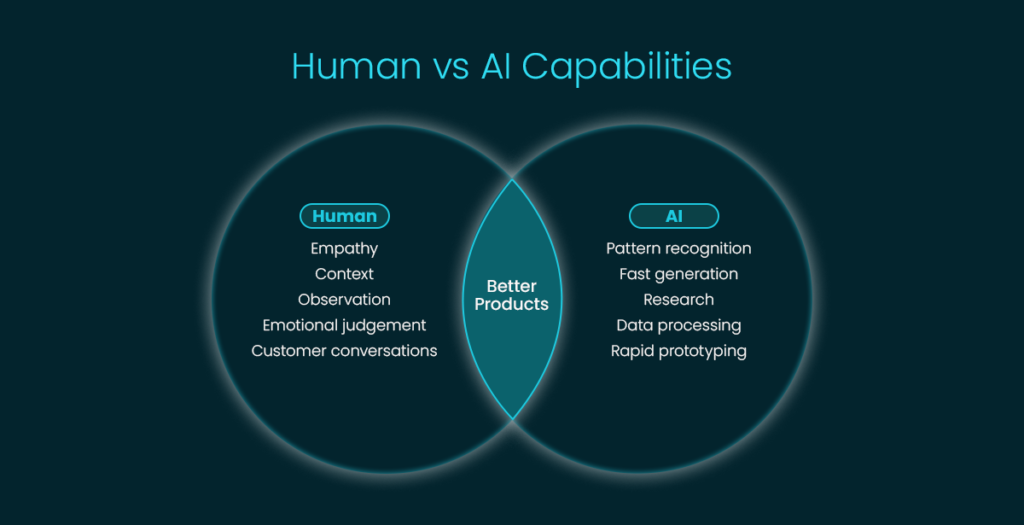
Human centered design starts with empathy, not technology. It asks one question before any other: what does this person actually need? AI can process data at a scale no human matches. It still can’t feel frustration, notice hesitation, or read the story behind a customer complaint.

That’s why human centered design remains the foundation of good product work. Teams that skip the empathy stage and jump straight to AI-generated solutions often build fast and wrong. They ship features nobody asked for, backed by a slick prototype and zero real demand.

This discipline forces a pause before that happens. It insists that teams define the problem clearly before reaching for any tool, AI or otherwise. That habit hasn’t aged. If anything, it’s the one part of the process AI can’t shortcut.
design thinking

What AI Actually Changes About the Process

AI doesn’t replace design thinking. It compresses it.

Ideation and prototyping, once the slowest stages, now move at a different speed. A designer can ask an AI tool to generate dozens of interface directions in minutes. That used to take days of sketching and revision.

Figma’s 2026 design statistics report found that 85% of designers and developers say AI will be essential to their future success. Another 78% say AI tools speed up their workflows significantly.

Only 58% say it improves the quality of their work. That gap between speed and quality is the real story.

Faster ideation only helps if a human still filters the output through empathy and judgment. This is where an innovation mindset matters more than any single tool.

Teams need people who can look at fifty AI-generated options. They need to know, based on real user insight, which one actually solves the problem.

The Innovation Culture Gap Nobody Talks About

Most companies don’t fail at innovation because they lack a process template. They fail because their culture punishes the experimentation real problem-solving requires.

Digital transformation efforts fall short of their stated goals far more often than leaders expect. That’s according to McKinsey’s research on transformation. The tools were rarely the main problem. Risk-averse, hierarchical cultures block the honest customer feedback and rapid iteration that good product work depends on.

Building a culture of innovation means giving teams permission to test, fail small, and adjust fast. Without that permission, even the best innovation workshop produces a nice deck and no real change. Leadership has to model the behavior it wants, not just fund the workshop and walk away.

We covered this in more depth in How to Create a Culture of Innovation in the Workplace. It walks through the specific structural shifts that make real experimentation possible.

Innovation Management Turns Good Ideas Into Shipped Products

A one-off design sprint doesn’t fix a culture problem. The process needs a system around it, one that carries an idea to a shipped product.

This is where innovation management earns its keep. It’s the connective tissue between a good idea and a validated one. Our AI Lab framework uses this same approach as its first stage. It pairs ideation with a data readiness audit, before a single line of code gets written.

Teams also need the right structure to execute what that first stage uncovers. A decentralized, pod-based team structure lets small groups of humans and AI agents act on an idea immediately. There’s no need to route it through five layers of approval and a quarterly planning cycle.

How to Adapt the Process for AI-Native Teams

Three shifts matter most for teams putting this into practice today.

  1. Treat AI as a brainstorming partner, not a decision-maker. Use it to widen the pool of options. Keep the final call with a human who understands the user.
  2. Compress your cycles. Test ideas in days, not months. Faster AI-assisted prototyping only pays off if your validation loop moves just as fast.
  3. Measure adoption, not just output volume. A hundred AI-generated concepts mean nothing if your team can’t act on the one idea that actually works.

How does this work when AI agents sit on the team? It works the same way it always has. Someone still has to define the problem, talk to the real user, and decide what “good” looks like. AI expands the toolkit. It does not replace the thinking behind it.

The Bottom Line

Design thinking isn’t outdated. It’s being tested by a tool that moves faster than the process was ever designed for.

The teams that win won’t be the ones with the flashiest AI. They’ll be the ones who pair AI speed with real human insight. Their culture lets people experiment without fear of getting it wrong.

If you want to find out where the gaps sit in your own organization, start with a Discovery Workshop. It’s the fastest way to see whether your process, and your culture, are ready for what AI demands next.

Innovation Management in the Age of AI: From Process to Culture

Most companies still manage innovation the way they manage everything else: as a process. They build stage-gate pipelines, innovation committees, and quarterly review decks. Then they wonder why nothing ships.

Innovation management in the age of AI means turning ideas into validated, scaled outcomes. It uses AI-native ways of working, not static gates and committees. AI is rewriting the rules of competitive business. Organizations that still run on assembly-line thinking fall further behind every quarter.

The real fix isn’t a better process. It’s a different culture, one built for experimentation, ownership, and AI-native execution.

Why Traditional Innovation Management Fails in the AI Era

Eighty-seven percent of innovation leaders say turning ideas into real outcomes is their biggest challenge, according to the 2025 State of Corporate Innovation Report. Most organizations pour resources into early-stage ideation. Boards approve budgets. Committees review decks. Few ideas ever reach validation or scale.

This gap isn’t a resourcing problem. It’s structural. An estimated 65 to 70 percent of digital transformation programs fail. Companies bolt new technology onto old hierarchies instead of redesigning how they make decisions. Our research on why digital transformation stalls breaks down these failure patterns in detail.

Process fixes treat symptoms. Culture fixes treat causes.

Innovation Culture Is the Real Bottleneck, Not Process

Innovation culture, not process maturity, predicts whether ideas survive contact with the organization. Roughly three-quarters of innovation effort stalls before it ever becomes a product. Workplace research consistently names bureaucracy the top killer of new ideas.

Only about half of employees feel genuine freedom to experiment at work. Yet organizations with strong psychological safety turn a profit far more often. Corporate innovation culture either gives people room to try and fail, or it quietly punishes both.

That difference separates startup DNA from corporate DNA. One rewards initiative. The other rewards compliance.

Building an Innovation Mindset Across the Organization

An innovation mindset isn’t just for founders. Leaders can teach it, model it, and reinforce it through EQ-driven leadership instead of more rules.

Managers who lead through hierarchy and fear train employees to wait for permission. Managers who lead through trust and direct feedback train employees to act. That shift usually starts with leadership consulting focused on emotional intelligence instead of authority.

How do you build an innovation mindset at scale? Reward the attempt, not just the result. Give teams real decision-making authority instead of symbolic input.

The Innovation Lab as the New Operating Model

An innovation lab gives ideas a controlled space to prove themselves before teams scale them company-wide. It replaces the old digital factory model, which focused on process automation, with data-centric, rapid experimentation.

The Three-Stage AI Lab Model

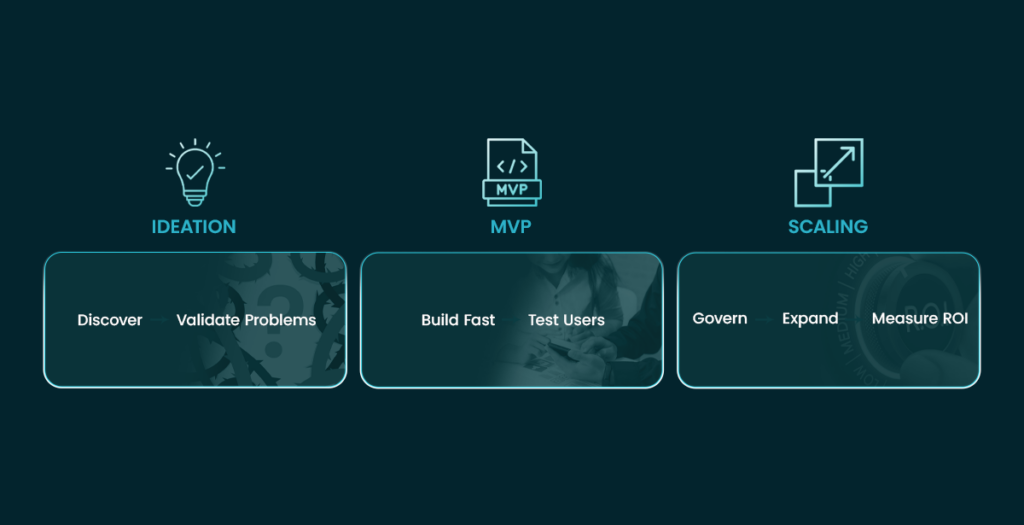
A well-run innovation lab typically moves through three stages:

  1. Ideation — use design thinking and a data audit to find real user problems worth solving.
  2. MVP development — build fast, then let real users test and validate it before major investment.
  3. Scaling — prove demand and ROI first, then scale with governance in place.

Skipping straight to scale is exactly why so many transformation programs collapse. Deloitte’s 2026 enterprise AI research found only 34 percent of leaders are truly reimagining their business with AI, even as worker access to AI tools rose 50 percent over the past year. Access without a lab structure just produces more pilots that never graduate.

How to Start Building a Culture of Innovation

Building a culture of innovation starts with an honest audit, not a mission statement. A discovery workshop is usually the fastest way to surface where structure, incentives, and leadership habits work against innovation.

From there, most teams benefit from a live, low-stakes forum to practice the behavior they want to build. A structured hackathon compresses months of cautious deliberation into days of hands-on building. It also shows leadership what’s possible when leaders trust teams to move fast.

Culture change compounds. Each small win, a shipped MVP or a hackathon prototype that becomes real product, makes the next one easier to greenlight.

The Takeaway

A better pipeline template won’t win innovation management in the age of AI. You win it by building a corporate innovation culture where people can experiment freely. You win it with an innovation mindset that leadership actively models, and an innovation lab that gives ideas a real path to scale.

Organizations that keep treating innovation as a process problem will keep getting process-shaped results: safe, slow, and forgettable. Organizations that treat it as a culture problem will still compete once AI finishes reshaping their industry.

If your organization is ready to move from talking about innovation to actually building it, a discovery workshop is the place to start.

How to Create a Culture of Innovation in the Workplace (Without the Buzzwords)

Most companies say they value innovation. Many post it on their walls. Some make it a core value in the employee handbook.

Almost none have built a culture that actually produces it.

BCG research on innovation culture reveals the gap clearly: 80 to 90 percent of executives call innovation a top priority. Yet only 6 percent are satisfied with their results — a number that hasn’t moved in nearly a decade.

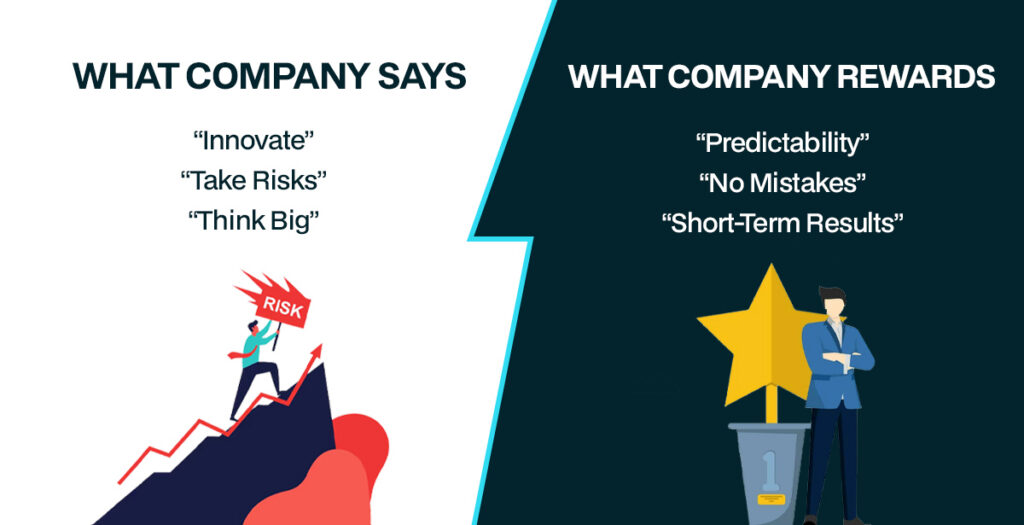
The problem isn’t a lack of ambition. It’s a culture that says “innovate” while structurally preventing it.

Why Corporate Innovation Culture Fails

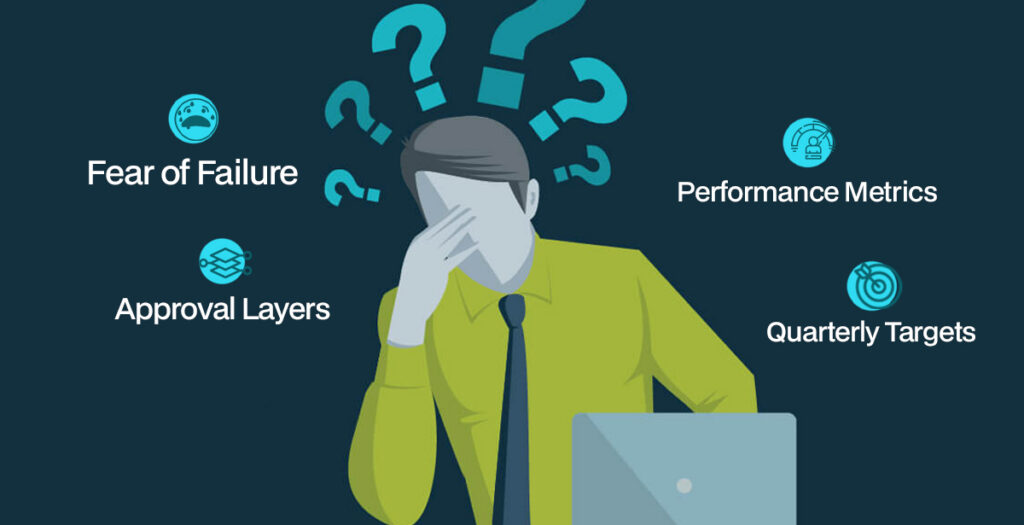
One stat captures what most organizations miss. McKinsey research on fear in innovation finds that more than 85 percent of innovation practitioners say fear regularly holds back innovation. Fewer than 11 percent of organizations are doing anything about it.

Fear shows up in specific ways: employees don’t share ideas that might be rejected. Middle managers filter out experiments that could threaten current performance metrics. Senior leaders declare innovation a priority, then punish the first team that misses a quarterly target while running an experiment.

In practice, this turns innovation into a performance — something organizations do visibly (hackathons, innovation days, idea portals) rather than an operating reality.

That mismatch has a name. At Future At Work, we call it Corporate DNA: the set of structures, incentives, and habits that large organizations build to optimize for consistency, not creation. Corporate DNA isn’t bad — it scales what already works. Yet it actively suppresses what might work next.

What Building a Culture of Innovation Actually Require

Genuine innovation culture examples look different from the outside than they feel from the inside.

From the outside, they often look like process: rapid prototyping, structured experiments, fast feedback loops. From the inside, they feel like permission. Employees at genuinely innovative organizations report feeling safe to try things, fail in front of colleagues, and change direction when they learn something new.

Great Place to Work research shows that psychological safety is the highest-leverage variable in innovation culture — teams with high psychological safety are 60 percent more likely to transform diverse perspectives into innovative solutions.

That safety doesn’t emerge from culture statements or off-site retreats. Instead, it builds through consistent, observable behavior: leaders who admit mistakes publicly, teams that debrief failures without blame, managers who ask questions rather than give answers.

The distinction matters because it shifts the intervention. Building a culture of innovation isn’t a communications exercise. It’s a behavioral one — starting with what leadership does on Tuesday morning, not what the strategy deck says.

The Structural Conditions That Make Innovation Stick

Culture is real, but it needs structural support to sustain.

Several concrete conditions separate organizations with a positive workplace culture for innovation from those that only aspire to one.

Short cycles with real outcomes. Innovation culture examples from leading companies consistently include a mechanism for fast, bounded experiments — not innovation theater, but structured cycles with real deliverables and real decisions at the end. Future At Work’s Innovation Lab runs on this model: 3-day bolts where teams build something real, test it, and decide whether to scale.

Cross-functional ownership. 83 percent of digitally mature organizations use cross-functional approaches to innovation, compared to 55 percent of early-stage companies. Siloed teams optimize their own function. Cross-functional pods optimize for the outcome.

Distributed decision-making. Organizations that extend decision authority beyond senior leadership see 30 percent efficiency gains. More importantly, they create the conditions where people feel ownership — and ownership is what turns an idea into an action.

Leadership’s Role in a Corporate Innovation Culture

None of this happens without leadership behavior change.

Senior leaders set the temperature for innovation culture in three ways.

First, they control resource allocation. Organizations where senior leaders visibly protect time and budget for experimentation — not just in good quarters, but especially in hard ones — build stronger innovation cultures than those that cut experiment budgets at the first sign of pressure.

Second, leadership consulting for innovation-ready organizations centers on one core shift: from leaders who are expected to have answers to leaders who are expected to ask better questions. That shift changes what teams bring to conversations, and therefore what gets explored.

Third, leaders model the behavior they want to see. An executive who presents failed experiments as learning moments makes the cultural statement that no communication campaign can. In contrast, an executive who only celebrates wins trains the organization to hide losses.

Innovation Culture Is Built, Not Declared

Building a culture of innovation isn’t about declaring innovation important. Most organizations already do that.

What separates companies that genuinely innovate from those that only talk about it comes down to three things: whether fear gets addressed structurally, whether experiments have real support, and whether leadership models the behavior it expects from teams.

Agile culture coaching built around these conditions produces sustainable change. A discovery workshop identifies exactly where the current culture blocks innovation — before committing to a full transformation.

Innovation culture isn’t a mindset. It’s a set of conditions. Build the conditions and the culture follows.