







AI can generate fifty interface concepts in a minute. It still can’t tell you which one your customer actually needs. That gap is exactly what design thinking was built to close, and it matters more now than ever.
This approach gives teams a structured way to solve real problems for real people. Speed means nothing if you build the wrong thing faster. AI is reshaping ideation, prototyping, and delivery. Leaders need to know which parts of the process still hold and which parts need a rework.
Future At Work’s Innovation Lab exists for exactly this reason. It helps teams experiment with AI-native ways of working without losing the human judgment that makes innovation stick.
Why Design Thinking Still Matters in the AI Era
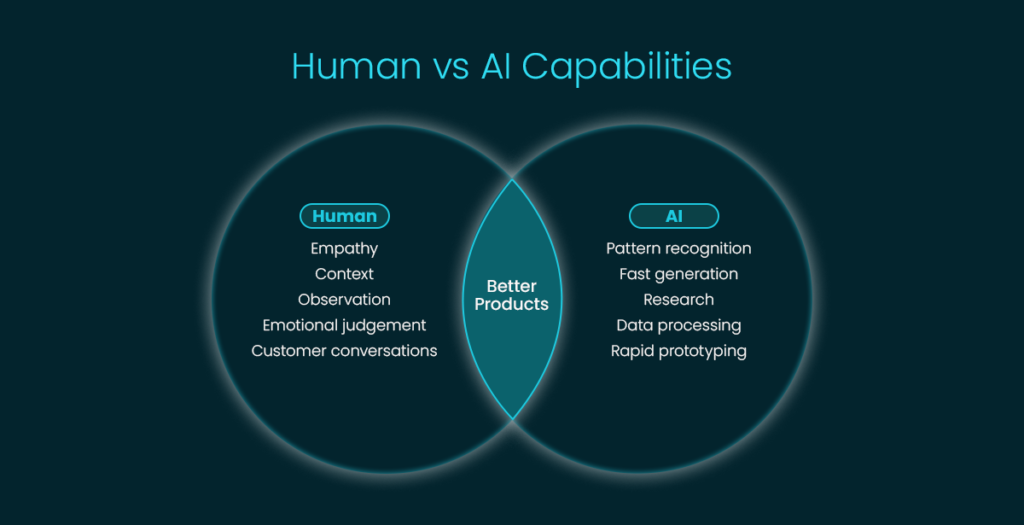
Human centered design starts with empathy, not technology. It asks one question before any other: what does this person actually need? AI can process data at a scale no human matches. It still can’t feel frustration, notice hesitation, or read the story behind a customer complaint.
That’s why human centered design remains the foundation of good product work. Teams that skip the empathy stage and jump straight to AI-generated solutions often build fast and wrong. They ship features nobody asked for, backed by a slick prototype and zero real demand.
This discipline forces a pause before that happens. It insists that teams define the problem clearly before reaching for any tool, AI or otherwise. That habit hasn’t aged. If anything, it’s the one part of the process AI can’t shortcut.
What AI Actually Changes About the Process
AI doesn’t replace design thinking. It compresses it.
Ideation and prototyping, once the slowest stages, now move at a different speed. A designer can ask an AI tool to generate dozens of interface directions in minutes. That used to take days of sketching and revision.
Figma’s 2026 design statistics report found that 85% of designers and developers say AI will be essential to their future success. Another 78% say AI tools speed up their workflows significantly.
Only 58% say it improves the quality of their work. That gap between speed and quality is the real story.
Faster ideation only helps if a human still filters the output through empathy and judgment. This is where an innovation mindset matters more than any single tool.
Teams need people who can look at fifty AI-generated options. They need to know, based on real user insight, which one actually solves the problem.
The Innovation Culture Gap Nobody Talks About
Most companies don’t fail at innovation because they lack a process template. They fail because their culture punishes the experimentation real problem-solving requires.
Digital transformation efforts fall short of their stated goals far more often than leaders expect. That’s according to McKinsey’s research on transformation. The tools were rarely the main problem. Risk-averse, hierarchical cultures block the honest customer feedback and rapid iteration that good product work depends on.
Building a culture of innovation means giving teams permission to test, fail small, and adjust fast. Without that permission, even the best innovation workshop produces a nice deck and no real change. Leadership has to model the behavior it wants, not just fund the workshop and walk away.
We covered this in more depth in How to Create a Culture of Innovation in the Workplace. It walks through the specific structural shifts that make real experimentation possible.
Innovation Management Turns Good Ideas Into Shipped Products
A one-off design sprint doesn’t fix a culture problem. The process needs a system around it, one that carries an idea to a shipped product.
This is where innovation management earns its keep. It’s the connective tissue between a good idea and a validated one. Our AI Lab framework uses this same approach as its first stage. It pairs ideation with a data readiness audit, before a single line of code gets written.
Teams also need the right structure to execute what that first stage uncovers. A decentralized, pod-based team structure lets small groups of humans and AI agents act on an idea immediately. There’s no need to route it through five layers of approval and a quarterly planning cycle.
How to Adapt the Process for AI-Native Teams
Three shifts matter most for teams putting this into practice today.
- Treat AI as a brainstorming partner, not a decision-maker. Use it to widen the pool of options. Keep the final call with a human who understands the user.
- Compress your cycles. Test ideas in days, not months. Faster AI-assisted prototyping only pays off if your validation loop moves just as fast.
- Measure adoption, not just output volume. A hundred AI-generated concepts mean nothing if your team can’t act on the one idea that actually works.
How does this work when AI agents sit on the team? It works the same way it always has. Someone still has to define the problem, talk to the real user, and decide what “good” looks like. AI expands the toolkit. It does not replace the thinking behind it.
The Bottom Line
Design thinking isn’t outdated. It’s being tested by a tool that moves faster than the process was ever designed for.
The teams that win won’t be the ones with the flashiest AI. They’ll be the ones who pair AI speed with real human insight. Their culture lets people experiment without fear of getting it wrong.
If you want to find out where the gaps sit in your own organization, start with a Discovery Workshop. It’s the fastest way to see whether your process, and your culture, are ready for what AI demands next.