





Why Your Agile Organizational Structure Isn’t Actually Agile

Your teams run sprints. Standups happen every morning. A Scrum board covers the wall.

None of that makes you agile.

Agile organizational structure is one of the most misunderstood ideas in business today. Most companies adopt the ceremonies without the conditions that make them work. They speak the language fluently and miss the point entirely.

The result has a name: agile theater. And according to BCG research, nearly half of organizations that believe they’ve succeeded at agile transformation haven’t. Here’s how to tell and what to do about it.

The Signs You’re Running Agile Theater
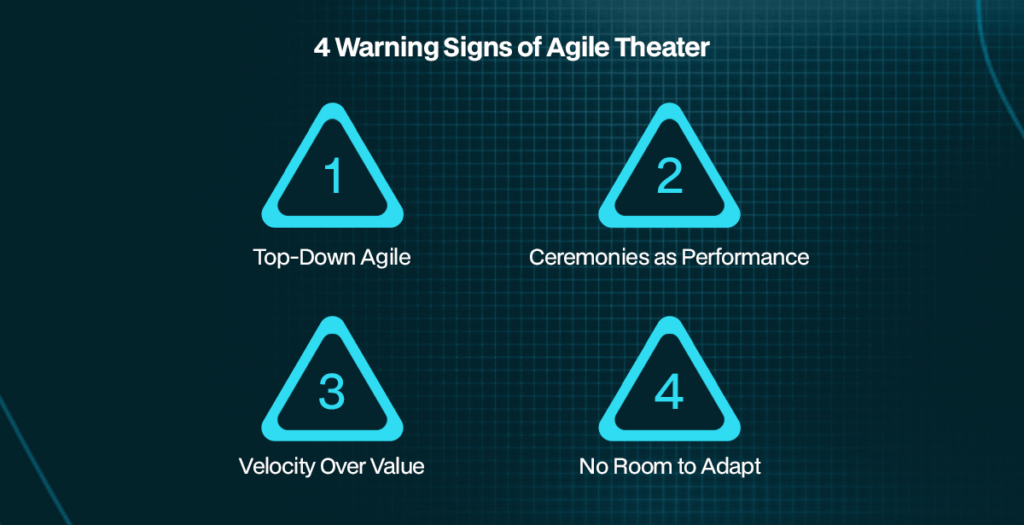
In practice, several patterns show up consistently in organizations stuck in agile theater.

Velocity over value. Teams measure story points completed, not outcomes delivered. The sprint looks productive. The customer sees nothing meaningful.

Top-down “agile.” Leaders demand agility from teams while making all meaningful decisions themselves. Agile theater thrives on this dynamic — the organizational chart flattens on paper, while authority remains concentrated at the top.

Ceremonies as performance. Standups take thirty minutes. Retrospectives produce the same action items every two weeks. Planning sessions feel like presentations to management rather than collaborative decisions.

No room to adapt. Sprints end but priorities never actually change. True agility means the ability to redirect. Yet most organizations don’t permit that.

The Real Problem Isn’t the Process

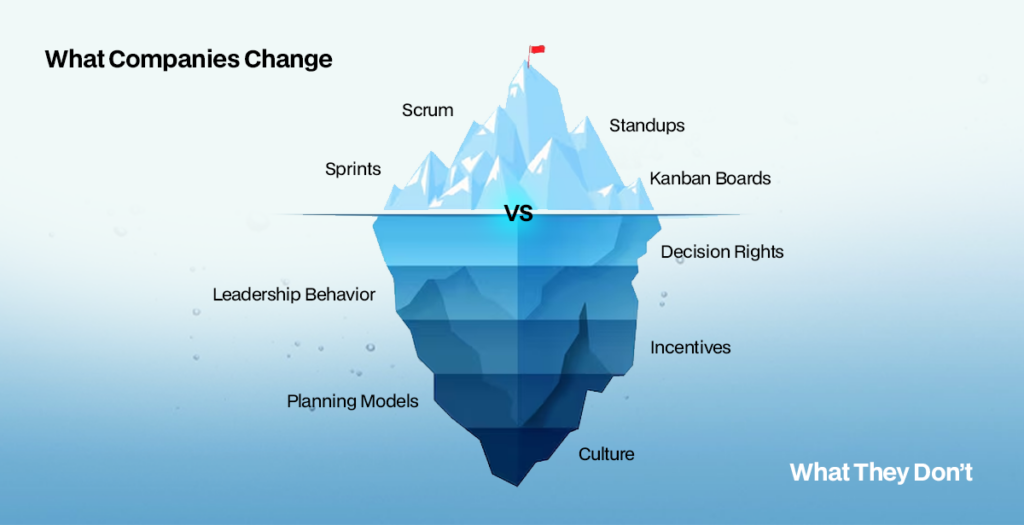
Most failed agile transformations don’t fail because of bad process design. They fail because the organizational DNA never actually changed.

Consider the pattern. A company adopts Scrum. Two-week sprints replace project milestones. A product owner gets assigned. Agile vocabulary enters the org chart. Yet the same senior leader still approves every significant decision. Annual planning still locks priorities twelve months out. Incentive structures still reward individual performance over team outcomes.

Scrum.org makes this case directly: agile transformation is a culture and leadership challenge far more than a methodology challenge. Process adoption without behavior change is decoration, not transformation.

At its core, this is a corporate DNA problem. Organizations that graft agile ceremonies onto hierarchical, compliance-driven structures produce agile theater. The ceremonies are real. The agility is not.
That gap matters more today than it ever has. In an AI-driven environment, organizations that move slowly don’t just fall behind on delivery. They fall out of the competition.

What Genuine Agile Organizational Structure Looks Like

Genuine agile organizational structure does two things most companies never attempt.

First, it distributes decision-making to where the context lives. Teams that own outcomes also own the decisions required to reach them. Leadership sets direction and constraints. Teams determine method.

Second, it builds adaptation into the operating model — not just into sprints, but into how the organization plans, prioritizes, and responds to new information. Quarterly planning cycles, fixed annual budgets, and year-long roadmaps are structural features of the opposite of agility.

Real modern agile practices run shorter cycles, create tighter feedback loops, and give teams genuine authority to change course when they learn something. That’s a structural commitment, not a process preference.

In contrast, most organizational structures resist course changes at every level. For organizations operating in the AI era, this distinction becomes critical.

Building a future of work strategy that survives requires structural agility: the ability to redirect resources, recompose teams, and change priorities faster than the competitive environment changes.

Future At Work’s Innovation Lab model offers one practical path: structured experimentation with real outcomes, short cycles, and genuine team ownership.

Making the Shift Stick

Shifting from agile theater to genuine agile organizational structure requires changes in three places, not one.

Leadership behavior. The biggest single predictor of agile failure is leaders who demand agility from teams but don’t change how they make decisions. Real agile cultures form around leaders who model the behavior — shorter cycles, public learning, distributed authority.

Measurement systems. Teams optimize for whatever gets measured. Shift from measuring output (story points, features shipped) to measuring outcomes (user adoption, cycle time, business impact). That one change exposes more agile theater than any retrospective.

Org design. Agile culture coaching that stops at team-level practices without touching org design produces incremental improvement, not transformation. Structures, incentives, reporting lines, and decision rights all have to align with how agile teams actually operate.

A discovery workshop identifies which of these three levers creates the most drag in a specific organization — and where to start.

Stop Performing Agility. Start Building It.

Calling something agile doesn’t make it agile. Sprints, standups, and story points are tools. Without the organizational conditions that make those tools work, they produce friction rather than agility.

The organizations that genuinely crack this – distributed authority, adaptive planning, leaders who model the behavior they demand, build something that compounds over time. Faster decisions. Stronger ownership. Real adaptability.

Yet most organizations are still waiting for the methodology to do the cultural work. It never does. Stop performing agility. Start building


Corporate AI Training That Goes Beyond Prompt Engineering 101

Most corporate AI training programs follow the same script: a half-day workshop, a slide deck on how to write prompts, a few practice exercises, and then everyone returns to work and nothing changes.

Prompt engineering matters. But learning to phrase a query doesn’t change how a team works, how decisions get made, or how AI fits into an actual workflow.

Yet 78% of employees who use AI regularly report receiving no formal training from their employers. The ones who do often get the surface version — the mechanics of asking, not the practice of applying.

Here’s what real AI training for employees looks like.

Why Prompt Engineering Training Isn’t Enough

Prompt engineering is a real skill. Knowing how to structure a query, give context, and iterate on outputs makes a genuine difference. Most employees never get even that. But it’s the floor, not the ceiling.

Research on the AI training gap shows this clearly. Only 23% of organizations offer prompt engineering training. Yet even those that do find skills rarely transfer into sustained productivity gains without broader organizational change.

So the issue isn’t just that most corporate AI training is too thin. The deeper problem is that tool-focused training treats AI adoption as an individual learning challenge rather than an organizational one.

Real AI skills training addresses both. It builds individual capability and organizational readiness — the workflows, norms, and structures that let individual skills compound into something meaningful.

What Effective AI Training for Employees Actually Covers

Good AI workshop for teams goes well beyond prompting. It covers three areas that most programs skip entirely.

How AI changes the work, not just the tools. Effective training helps employees understand where AI genuinely accelerates their specific role, where it introduces risk, and how to make judgment calls in the gap. That understanding shifts behavior far more than prompt templates.

How to apply AI in real workflows. McKinsey’s research on AI upskilling makes the case directly: embedding learning in actual work produces more lasting change than isolated training events. Employees need to practice with real tasks, real outputs, and real feedback.

How to work alongside AI agents as collaborators. At the leading edge of AI skills training, teams learn to design how humans and AI agents divide work, make decisions together, and hand off tasks appropriately. That’s a different skill set from prompting.

Together, these three areas build capability that compounds rather than fades after the workshop ends.

Context Is the Missing Layer

The real gap in most AI training for employees isn’t content. It’s context.

Generic training teaches employees how AI works in the abstract. Organization-specific training teaches them how AI applies to the problems their team actually solves, the tools they use daily, and the decisions they own.

Generic AI literacy doesn’t create AI-capable teams. Application does.

That gap matters more than it sounds. An employee who learns prompt engineering in isolation may never connect it to their work. Someone who practices AI in the context of a real project, using actual workflows and real deliverables, builds a habit, not just a skill.

This is the design principle behind Future At Work’s AI upskilling workshop: training built around the real work of the team, not a generic curriculum.

In practice, the most effective AI learning and development programs look less like courses and more like guided experiments: structured, time-boxed, and applied to real outcomes.

Building a Real AI Learning and Development Program

Most organizations approve AI training budgets without changing how work happens. Research on the execution gap in AI upskilling confirms the pattern: leaders increase learning activity without changing the structures, norms, and incentives that would make new skills stick.

Breaking out of that pattern means treating AI upskilling as organizational change, not just individual learning.

Several practical steps make a real difference.

Start with one real use case: a specific team, a specific workflow, a specific AI application. Not an enterprise-wide rollout. One team. One outcome. Prove the value before scaling.

Run a structured AI workshop for teams that builds capability in the actual context of their work, not on generic examples.

Build feedback loops fast. Teams that test, adjust, and share what they learn accelerate faster than teams that train in isolation.

Consider running an AI hackathon to create a concentrated burst of applied learning. Done well, a hackathon builds more practical capability in three days than most training programs build in three months.

For organizations at the start of this journey, a discovery workshop identifies where AI can create the most value before committing to a full training program.

The Difference Between AI Literacy and AI Capability

Prompt engineering is where AI training for employees begins. It shouldn’t be where it ends.

The organizations that build real AI capability do something different. They embed AI learning into actual work, build accountability structures around AI use, and keep iterating as tools evolve.

That takes more investment than a half-day workshop. Yet it produces something more useful than a workforce that knows how to ask better questions. It produces teams that know how to get better results.

Corporate AI training that stops at prompting trains people for a world that no longer exists.

Decentralized Team Structure: How to Distribute Authority Without Losing Alignment

Most leaders who try to decentralize end up with one of two outcomes: confusion or conflict.

They distribute the authority but the alignment doesn’t follow. Teams drift in different directions. Decisions slow rather than speed up. As a result, senior leaders quietly reclaim control because the alternative feels like chaos.

A real decentralized team structure produces faster decisions, higher ownership, and organizations that respond to change without waiting for permission. But it requires more than removing layers from an org chart.

Here’s what it actually takes.

Why Most Attempts at Decentralization Fail

The most common mistake is decentralizing structure without decentralizing context.

Organizations announce flat structures or self-organizing teams, remove a management layer, and expect things to work. Without shared context — a clear direction, defined priorities, and explicit decision rights — teams don’t move toward company goals. They move toward whatever feels manageable.

Research on decentralized workplaces shows that efforts to distribute authority face significant obstacles and frequently fail — not because the idea is wrong, but because organizations never built the conditions for it to work.

Spotify’s squad model illustrates both the promise and the limit. Squads had real autonomy and cross-functional ownership. Yet even Spotify discovered that alignment required deliberate, continuous investment in shared context. Structure alone didn’t sustain it.

Layering enterprise AI adoption on top of an unaligned structure only compounds the problem. Authority distributes even further while the context problem stays unsolved.

What Distributed Authority Actually Means

Genuine decentralization distributes three things: authority, context, and accountability. Most organizations only distribute the first.

Authority means the right to make decisions within a defined domain. A pod team structure gives each team clear ownership over a problem, not a task list. The pod decides how to solve it.

Context is what keeps autonomous teams moving in the same direction. Without shared context — company priorities, customer signals, real constraints — each team makes locally rational decisions that don’t add up globally. Instead, good distributed leadership means context travels continuously, not just during planning cycles.

Accountability keeps authority honest. Distributed leadership breaks down when it removes the expectation of outcomes. Teams need ownership over results, not just over their work.

Together, these three elements produce something fundamentally different from a flat organizational structure that simply strips out management layers. They create self-organizing teams that move fast, own outcomes, and stay aligned — because alignment comes from shared understanding, not from permission chains.

Without all three, decentralization produces drift. With all three, it produces one of the fastest-moving organizational designs available.

The Pod Model in Practice

The pod is the most practical unit for building a decentralized team structure that holds together under real pressure.

A pod is a small cross-functional team, typically three to five people and sometimes including AI agents, that owns a complete outcome from start to finish. Unlike a traditional functional team, the pod controls design, execution, and validation. No handoffs between departments. Teams don’t wait on sign-off from a function that doesn’t own the outcome.

For pod team structure to work, three design choices matter.

First, give pods a domain: a problem they own, not a queue to drain.

Second, give pods visibility into what matters: priorities and reasoning, not just instructions.

Third, build fast feedback loops. Pods need signals from real users or data, not approval cycles from people who don’t own the outcome.

Atlassian’s analysis of the Spotify squad model confirms this at scale: autonomy produces results when context and accountability travel with it.

Leadership in a Distributed Structure

The fear behind most failed decentralization attempts is that leaders lose relevance. That fear drives the quiet recentralization that kills flat organizational structures before they take hold.

In a decentralized team structure, leadership changes shape. It doesn’t disappear.

Leaders shift from directing work to building the conditions that make distributed leadership possible. That means three things.

Setting direction without prescribing method. Founders and executives define where the organization needs to go. Teams decide how to get there.

Building shared context actively. Continuous visibility into priorities and market signals, shared across teams rather than saved for annual reviews.

EQ-driven leadership matters most when it comes to holding accountability without control. Holding a team to outcomes without micromanaging the path requires trust, communication skill, and genuine belief that the team can own the problem.

Those who thrive in agile organizational structures replace control with context and instructions with clear ownership.

Starting the Shift

Most organizations don’t need a full restructure to begin distributing authority. One team, one clear domain, and one real outcome is enough to start.

Pick a problem the organization needs to solve. Assign a cross-functional pod with full ownership. Give the pod context: the goal, the constraint, the timeline. Then get out of the way.

The first thing that surfaces is that blockers become visible faster. Without a hierarchy to route decisions through, problems appear immediately rather than hiding inside approval queues. That visibility is a feature, not a flaw.

The second thing that emerges is sharper accountability. When teams own outcomes rather than tasks, they engage with results differently.

For organizations ready to go deeper, agile culture coaching built around pod structures and distributed leadership models accelerates the shift. A discovery workshop surfaces exactly where the current structure blocks ownership and alignment.

Decentralized Doesn’t Mean Leaderless

Decentralized team structure doesn’t mean leaderless. It means leadership changes jobs.

Organizations that get this right build something that scales differently. Teams move faster because decisions happen where the context lives. Alignment holds because context travels with authority, not just authority alone.

Yet most organizations still treat decentralization as a structural event — a reorg, a new chart, a new language. Real distributed leadership requires sustained cultural investment.

The teams that own their outcomes, understand the direction, and trust the people beside them don’t need permission to move fast. They already have everything it takes.

The AI Agile Methodology Replacing Scrum at Forward-Thinking Companies

Scrum built the modern software industry. For two decades, two-week sprints, daily standups, and backlog grooming gave development teams a reliable delivery rhythm.

But that rhythm no longer fits.

When AI tools compress days of work into hours, a fixed two-week planning cycle creates drag rather than direction. Teams produce more output but lose the ability to respond to what they learn. Forward-thinking companies already run a different playbook. They’ve adopted an AI agile methodology designed for how work actually moves today, not how it moved in 2005.

Here’s what that shift looks like, and why it’s spreading fast.

Why the 2-Week Sprint No Longer Works

For years, sprints made sense when writing code was the bottleneck. Two weeks gave developers time to design, build, test, and review a meaningful slice of work. That logic held firm for over two decades.

AI has changed the underlying physics of software development. Tasks that once took days — drafting requirements, writing boilerplate code, generating tests, reviewing pull requests — now take hours. Research from AI-augmented teams shows a 20–40% reduction in time-to-market, with execution work compressing from weeks to single days.

AWS research on the AI-driven development lifecycle confirms this: AI shifts bottlenecks rather than eliminating them. It moves pressure from building to reviewing, from coding to validating.

So what happens when faster work sits inside a slower structure? Teams either pad sprints with low-value tasks to justify the cycle, or they build features faster without validating whether those features are worth building.

As a result, the two-week sprint paradox intensifies: AI sprint planning inside a fixed two-week window disconnects from reality.

Planning sessions review yesterday’s assumptions. Retrospectives audit work from last week rather than responding to what’s changing right now.

What Forward-Thinking Companies Are Using Instead

The AI agile methodology replacing Scrum restructures around three core changes.

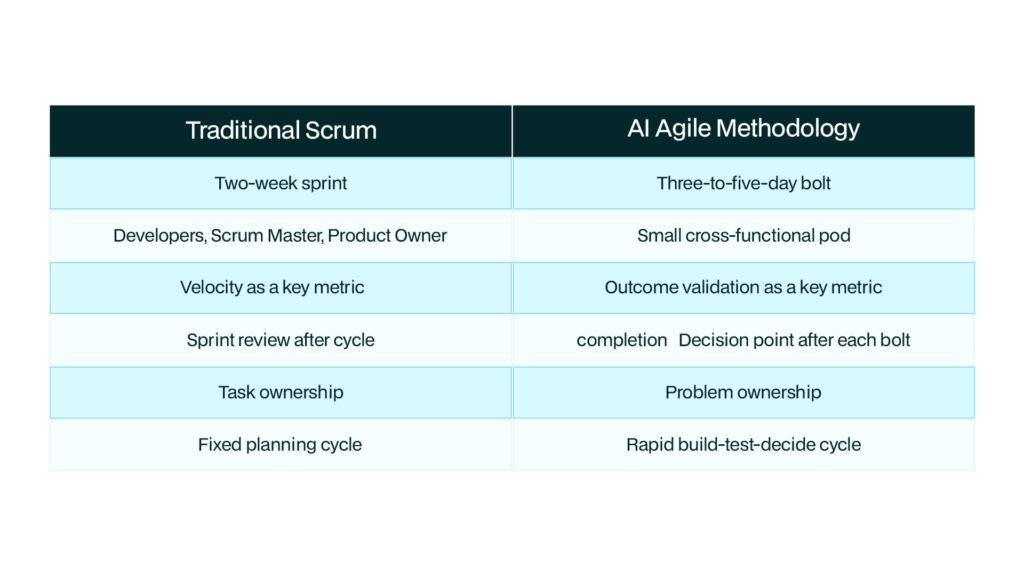
Shorter execution cycles. Leading teams now run what practitioners call “bolts”: focused cycles of three to five days. These aren’t mini-sprints with compressed planning and rushed ceremonies. Each bolt starts with sharp alignment on one outcome, runs fast, and ends with a working artifact and a clear decision point.

Pods instead of traditional Scrum teams. Standard Scrum separates roles into developers, a Scrum Master, and a Product Owner. In contrast, pods collapse those distinctions. A pod is a small cross-functional unit, typically three to five people, working alongside AI agents as active team members. The pod owns the problem, not a set of tasks.

Outcome over velocity. Velocity made sense when human effort drove all results. For AI agile teams, velocity becomes noise. What matters is whether users, data, or a market signal confirms the outcome before the team moves to the next bolt.

Together, these three changes form what Future At Work calls the AI Development Lifecycle: a framework built for how AI agile teams actually deliver.

How AI Agile Teams Operate in Practice

The clearest way to understand the difference is to compare a single week.

In a standard Scrum setup, a team spends Monday in sprint planning, moves through a ticket queue during the week, and holds a sprint review on Friday. Coordination demand stays high. At the same time, context switching stays high. The distance between individual tasks and real outcomes stays wide.

By contrast, a pod picks up one specific outcome on Monday morning. Wednesday finds the pod with a working prototype in front of real users. Thursday produces actual usage data. Friday brings one clear decision: scale it, pivot it, or drop it. No waiting for the next sprint cycle to act.

That three-to-five-day cycle of build, test, and decide is the heartbeat of agile AI development. It eliminates sprint theater: the standups and ceremonies that generate activity reports rather than real decisions.

Making the Shift

The structural changes are relatively straightforward. The cultural ones take more work.

Most organizations run Scrum teams where managers get rewarded for process compliance, not outcome delivery. Shifting to an AI agile methodology means changing what managers measure, how teams form, and how teams make decisions. That’s a leadership problem before it’s a tooling problem.

Still, many teams attempt this shift without rethinking the AI development process itself. They layer AI tools on top of a two-week sprint and expect productivity gains to follow.

Those gains rarely appear, because the biggest obstacle to AI adoption is never the technology. It’s the process wrapping it.

In practice, the fastest path to real change is to run a single bolt with a single pod. Pick one outcome. Give the team three days. Run a prototype in front of real users by day two. Review results against actual user feedback, not a definition of done. That experiment reveals more about team readiness than a year of process frameworks.

For teams ready to go further, agile culture coaching built around the ADLC delivers the fastest structural shift. A discovery workshop can surface exactly where the current agile process blocks AI adoption.

Scrum Solved Yesterday’s Problem

Scrum solved a real problem. It gave chaotic development teams a structure that worked, and it served the industry well for a long time.

Yet the problem Scrum solved differs from what AI agile teams face today. Back then, the challenge was coordinating large teams writing complex code over long timelines. Today, the challenge is speed of validation, not speed of delivery. Building the right thing in three days matters more than building anything in two weeks.

Forward-thinking companies already see this. They’re not abandoning discipline. Instead, they’re redesigning it for an era where the tools have fundamentally changed. The teams that move first will build smarter, waste less, and outpace organizations still running yesterday’s methodology.

Why Most Leadership Development Programs Fail in an AI-Driven World

Every year, organizations globally spend over $366 billion on leadership development programs. Only 10% of that training delivers measurable results.

If you’ve sat through a two-day offsite and returned to find your behavior unchanged, your team unchanged, your culture unchanged – you already know this.

The failure isn’t a budget problem. Research shows 86% of companies rate leadership development as a top priority, yet only 13% feel they do it well. The gap between investment and impact is enormous. And AI is making it impossible to ignore any longer.

Here’s why most programs fail, and what executive leadership development actually looks like when it works.

The Training Is Disconnected from Real Work

Most leadership development programs share the same design flaw: they teach leadership in the abstract. A workshop. A framework. A set of competencies printed on a laminated card.

McKinsey identified this as one of the four root causes of program failure. Context is everything. A leader who performs well in a stable corporate environment may be completely underprepared for a team navigating AI-driven role changes. Moreover, a founder who thrives in startup chaos may lack the emotional regulation to lead a scaling team through a difficult transition.

Leadership cannot be developed in a vacuum. It has to happen inside the actual pressures, tensions, and decisions of real work. That means working through a real hire who isn’t performing, a real strategic pivot that’s creating fear, a real conflict between two senior leaders. Not a simulated version of these things.

Mindsets Are Never Addressed

The second failure is more uncomfortable: most programs change the language without changing the belief.

You can run a delegation workshop. You can teach a manager the vocabulary of empowerment. But if that manager genuinely believes control is safety, if they’ve built their career on being the smartest person in the room, the workshop will not change that. They’ll use the new words and keep the old behavior.

The behaviors you want from a leader are always downstream of what they believe about themselves, their team, and what good leadership looks like. Therefore, without confronting those beliefs, you’re decorating the surface.

This is the core of what makes leadership coaching for founders different from a standard program. Founders have usually built something real. That’s their identity. Asking them to let go, to trust others, to distribute decision-making is not a skills gap. That’s a worldview challenge. And it takes a different kind of engagement to address it.

AI Is Exposing What Was Already Broken

Here’s what the AI era has changed: it’s removed the hiding spots.

In a traditional organization, a manager could compensate for weak leadership with process. You couldn’t always tell whether a team was disengaged or thriving because the system kept things moving. Metrics got hit. Meetings happened. Work got done.

AI changes that equation. When agents start handling execution tasks, when junior roles shrink, when teams become small pods of humans and AI working together, leadership quality becomes the primary variable. You can no longer paper over weak management with bureaucratic scaffolding.

McKinsey’s research on leadership in the age of AI puts it plainly: the biggest barrier to scaling AI is not employees. It’s leaders who are not steering fast enough.

The organizations that struggle most with AI transformation are almost always the same ones that failed at leadership development. The culture was already hostile to experimentation. The management layer was already too controlling. AI just surfaces it faster and at a much greater cost.

No Ownership. No Measurement. No Change.

The third and fourth failure modes compound everything else: no one owns the development, and no one measures whether it worked.

Most leadership programs are designed by HR, delivered by an external vendor, and attended by managers who were told to show up. There is no ownership. No consequence. And almost never a rigorous follow-up to ask: did this person’s behavior actually change? Did their team perform differently? Did the culture shift at all?

Leadership accountability has to be built into how development is designed, not as a compliance checkbox, but as a genuine commitment loop. What will you do differently? How will we know? Who holds you to it?

This is where leadership transformation differs from a leadership development program. A program has a start and an end date. Whereas transformation is a sustained engagement, one that builds in measurement, honest feedback, and real accountability structures over time.

What Actually Works

A few things consistently deliver results in the AI era.

First, development embedded in real decisions. The most effective leadership consulting doesn’t run workshops. It coaches leaders through the actual problems they’re facing right now: the team member who isn’t stepping up, the board dynamic creating friction, the strategic decision that keeps getting deferred. Real context, real stakes, real change.

Second, addressing mindsets before behaviors. This requires psychological safety, honest feedback, and a trusted advisory relationship over time. It also means building genuine fluency in how AI is rewriting the nature of work and what that demands from leaders specifically. Not generic AI literacy, but practical capability in leading teams that include both humans and agents.

Third, building real accountability structures so that behavior change is tracked, visible, and held over time. Not a quarterly check-in. Ongoing, embedded, consequential.

If you want to understand where your leadership culture actually stands before investing in another program that produces nothing, start with a structured discovery process to surface what’s actually in the way.

Leadership Transformation Is a Decision, Not a Program

Most leadership development programs fail not because the content is wrong, but because they treat leadership as a skill to be taught rather than a worldview to be challenged.

In an AI-driven world, that gap closes fast, the leaders who will build high-performing, AI-native organizations are not the ones who attended the most workshops. They’re the ones who did the harder work: confronting their assumptions, building real accountability, and learning to lead in conditions that have no precedent.

A leadership development program will not get you there. A genuine commitment to leadership transformation will.

A No-Nonsense AI Adoption Roadmap for Growth-Stage Companies

Most growth-stage companies are approaching AI the wrong way.

They buy tools. They run a pilot. Someone publishes a LinkedIn post about “levering AI.” Six months later, nothing has changed and the budget is lighter.

This is not an AI problem. It is a strategy problem.

According to RAND Corporation’s analysis, 80% of AI projects fail to deliver intended business value. McKinsey’s 2025 State of AI report found that while 88% of organizations are now using AI in some capacity, only 1% consider their AI strategies mature.

Read that again: 88% using AI. 1% doing it well.

If you are leading a growth-stage company, you cannot afford to be in the 80%. What you need is a clear AI adoption roadmap — not a vendor pitch, not a buzzword framework. A real sequence of decisions.

Here is what that looks like.

Start With Honest Assessment, Not Tools

The most common mistake is skipping the diagnosis. Leadership sees a competitor using an AI tool and panics. They buy a license. No one uses it properly. The tool gets blamed.

Before any AI transformation strategy can work, you need an honest AI readiness assessment. That means asking hard questions.

1) Do you have clean, accessible data?

AI runs on data. Most organizations have data that is siloed, inconsistent, or simply not captured at all. If your CRM is a mess and your ops data lives in spreadsheets, no AI tool will save you.

2) Do your people understand what AI actually does?

Not at a hype level. At a working level. Can they distinguish between automation and AI? Can they identify which of their tasks are genuinely AI-solvable? Most teams cannot.

3) Does leadership have the appetite for failure?

AI adoption requires experimentation. Experimentation means failed attempts. In organizations where a failed pilot gets someone fired, AI transformation will never take root. Not with any tool.

If you are not sure how ready your organization is, a structured discovery workshop can give you that honest baseline before you spend a dirham or dollar on tools.

Build a Three-Stage Adoption Sequence

A sound AI adoption roadmap for business does not try to transform everything at once. It moves in three stages.

Stage 1: Ideation and Data Audit

Identify two or three genuine business problems, not vanity projects. Problems where AI can meaningfully reduce cost, accelerate speed, or improve quality. Then audit your data for those problems. Do you have it? Is it clean? Is it accessible?

Most companies skip ahead here. They want to be doing AI, not auditing spreadsheets. But the audit is the work. It tells you where to actually invest.

Stage 2: MVP Development

Pick one problem. Build a minimum viable AI solution. Test it with real users. Collect feedback. Measure whether it actually moves the needle.

This is the stage that most pilots fail to complete properly. They build. They demo. They do not test with real users under real conditions. Running an internal AI hackathon at this stage can compress the ideation-to-prototype cycle dramatically and build team buy-in in ways that top-down mandates never do.

Stage 3: Scaling What Works

Only after Stage 2 validates real ROI does it make sense to scale. This means governance: who owns the AI output? What happens when the model is wrong? What data does it continue to train on?

Scaling without governance is how organizations create expensive new problems while solving old ones. This is where an Innovation Lab structure, a dedicated team accountable for AI deployment, pays its full dividend.

AI Transformation Framework: People First

Here is the uncomfortable truth that most enterprise AI adoption frameworks skip over: your technology is not your bottleneck. Your people are.

Deloitte’s 2026 State of AI in the Enterprise report found that organizations scoring above 70% on AI readiness are three times more likely to implement AI successfully within twelve months. The top differentiator? Not the tools. Not the budget. Organizational readiness, specifically whether leadership and teams have the skills and cultural orientation to actually use AI.

We have documented this pattern in detail, looking at why enterprise AI adoption keeps stalling even in the most well-resourced companies. The root cause is always cultural and structural, not technical.

This is why AI upskilling is not optional on a serious AI adoption roadmap. Not generic “AI awareness” training. Practical, role-specific capability building that helps your people work with AI tools, not around them.

Gartner predicts that all IT work will involve AI by 2030. The window to build that capability ahead of competitors is closing.

The Operating Model Has to Change Too

Buying AI tools without changing how work is structured is like installing a jet engine in a bullock cart. The engine will not help. The cart will break.

Growth-stage companies that succeed at AI adoption restructure around it. That means smaller, cross-functional teams, what we call pods, combining human judgment with AI execution. It means shorter delivery cycles: not month-long sprints, but focused three-day bolts that move fast and validate faster.

It also means leadership that can tolerate ambiguity, make decisions without complete data, and coach teams through experimentation rather than policing outputs. That is a different kind of leader than most organizations are currently developing.

Our guide to building a future-ready operating model covers the full architecture of this shift, from restructuring teams into pods to replacing sprints with bolts. And if you want to understand the broader operating model design, our AI Lab whitepaper lays out why the traditional digital factory approach fails and what replaces it.

Your AI Adoption Roadmap: A Practical Summary

The companies winning with AI right now are not the ones with the biggest budgets. They are the ones that treat AI adoption as an organizational design problem — not a technology procurement problem.

Start with an honest readiness assessment. Identify real problems, not pilot theater. Build and test with real users before you scale anything. Upskill your team, because tools without capability are wasted spend. Restructure for AI-native ways of working. Then govern as you scale.

If you are ready to move from intent to execution, Future At Work works with growth-stage leadership teams to design and implement AI adoption roadmaps that actually stick.

Enterprise AI Adoption: Why the Biggest Companies Move the Slowest

There’s a puzzle that keeps coming up in boardrooms across Karachi, Dubai, and Riyadh. A company with 5,000 employees, a technology budget in the tens of millions, and a board mandate to “become AI-driven” is being consistently outmaneuvered by a 40-person startup running on open-source models and a shared Notion board.

The small team ships an AI feature in three days. The enterprise forms a committee to study the feasibility.

Enterprise AI adoption is not failing because of a lack of resources. It is failing because of a lack of organizational readiness. And the bigger the company, the deeper the misalignment runs.

The Slow Mover Paradox

The assumption is that large organizations have the advantage in AI. More data, more capital, more talent access. In theory, this should make them faster.

In practice, size compounds every structural problem that was already there.

According to McKinsey’s State of AI research, less than a third of companies report meaningful value from their AI investments, despite years of spending, announcements, and pilot programs. The organizations getting value tend to be the ones that moved fastest and embedded AI into actual operations, not those with the largest budgets.

The reason isn’t technology. It’s culture, structure, and decision-making architecture — things that scale with an organization’s age, not its ambition.

The Real Culprit: Corporate DNA

Most large organizations were built on assembly-line thinking. Work is broken into standardized, repeatable tasks. Accountability flows upward. Decisions require sign-off. Deviation is discouraged because deviation introduces variance, and variance is the enemy of operational efficiency.

That model was designed for manufacturing in the 20th century. It is actively hostile to the kind of experimentation that AI business transformation requires.

When an AI initiative lands inside a corporate DNA organization, it doesn’t get accelerated. It gets managed. Stakeholder committees are formed. Use cases are approved. Risk assessments are conducted. By the time anything is ready to test in production, the market has already moved.

Startups don’t have this problem, not because they’re smarter, but because they haven’t had time to build the institutional scaffolding that slows decision-making down. The goal isn’t to become a startup. It’s to cultivate startup DNA inside your existing structure: lean, cross-functional, empowered to act, and safe to fail fast.

Why Transformation Programs Keep Failing

The industry has known this for a while. Research consistently shows that 65 to 70% of digital transformation programs fail to meet their stated goals. That’s not a technology problem. The tools are available, capable, and increasingly affordable. It’s a leadership and culture problem, and AI adoption inherits every weakness the previous transformation failed to fix.

Three failure patterns show up consistently across industries and geographies.

Organizations try to run new AI workflows on old organizational structures. They layer the technology on top of a hierarchy that was never designed for rapid iteration. The result is AI tools that nobody uses the way they were intended.

They underfund the human layer. AI change management — the work of shifting how people think about their roles, accountability, and relationship with AI tools — rarely appears as a line item in transformation budgets. But it’s what determines whether a rollout sticks.

And they skip validation. Projects go from ideation to enterprise rollout without a real MVP phase. As our whitepaper on the AI Lab model outlines, the structured path from experimentation to proven ROI is the mechanism that separates successful transformations from expensive ones.

What Fast Movers Do Differently

The organizations winning at AI transformation strategy share a pattern worth studying closely.

They don’t start with technology selection. They start with a clear problem worth solving, a small cross-functional team with real authority to act, and a mandate to produce something working within days, not quarters.

This is the logic behind the AI Lab model: a dedicated hub for experimentation that operates outside the normal approval architecture, runs short validated cycles, and hands off only what has been proven. It’s the successor to the digital factory, designed for the probabilistic, data-centric nature of AI work rather than the deterministic logic of traditional software projects. Our Innovation Lab is how we help organizations stand this model up in practice.

The AI Lab also gives organizations something most transformation programs don’t: a place to build organizational muscle for working with AI before asking the entire enterprise to change how it operates.

The Human Layer: Where Most AI Strategies Stop Short

Here’s the uncomfortable truth about AI adoption for business at scale: the technology is the easy part.

What’s hard is the leader who built their reputation on knowing the answers, and now needs to be comfortable delegating to an AI agent. The middle manager whose job was aggregating information upward, and who now has to reimagine what value they add. The team that had a clear lane and is now being asked to work alongside tools that didn’t exist last year.

None of these people are obstacles to transformation. They are the transformation. Getting this right requires more than a technology rollout.

It requires AI upskilling that goes beyond prompt engineering, and leadership development that addresses the identity shifts AI adoption triggers, not just the workflow changes.

According to Harvard Business Review’s research on transformation failure, the most common reason digital initiatives stall is not technical. It’s that the people and culture side was treated as secondary to the technology implementation. AI adoption doesn’t escape this pattern. It amplifies it.

AI competitive advantage belongs to the organizations that solve the human problem first.

FAQ: Enterprise AI Adoption

Why do large companies struggle with AI adoption more than smaller ones?

Size compounds structural problems. Large organizations have approval hierarchies, risk frameworks, and incumbent processes built to reduce variance. AI experimentation requires variance. Smaller organizations move faster not because they are better resourced, but because they have fewer layers between an idea and a test.

What is the right first step toward AI transformation?

A realistic assessment of where you actually are, not where your AI strategy document says you should be. That means looking at decision-making speed, cultural appetite for failure, data readiness, and leadership alignment before selecting any tools. A discovery workshop is one of the most effective ways to surface what is actually blocking transformation before you spend on technology.

Conclusion

The companies moving fastest on enterprise AI adoption are not the biggest ones. They are the most organizationally honest ones, willing to examine the structures and cultural defaults making transformation slow, and willing to change them before they change the technology stack.

The window for getting this right is narrowing. Not because AI will stop developing, but because the gap between organizations that have embedded AI into how they work and those still discussing it is already visible in the market, and it widens every quarter. Future At Work works with founders and leadership teams who have decided to be on the right side of that gap