






Every founder feels the same pressure right now. Competitors are shipping AI features. Investors ask about your AI roadmap. Your best engineer just tried a new tool and wants budget for ten more.
Building an AI-driven workplace feels urgent because it is urgent, but urgency isn’t a strategy. Moving fast in the wrong direction still gets you nowhere.
Most companies respond to that pressure by buying tools. Few respond by rethinking how work actually gets done. That gap is where AI investment quietly goes to waste, and it’s the same gap that shows up in every failed pilot project.
This piece gives you a real starting point: one problem, one tool, one redesigned workflow. Everything else can wait a quarter.
What Is an AI-Driven Workplace?
An AI-driven workplace uses AI as a working member of the team, not a bolt-on feature. Agents draft, research, and flag risks alongside people, inside the actual workflow.
That’s different from a company that simply bought some software. A tool sitting unused in a tab is just a line item, not a working part of the team.
The real marker is decision speed. When AI handles the grunt work, people spend their time on judgment calls instead of data entry.
Most companies overestimate how “AI-driven” they already are. Buying a license isn’t the same as changing how a team actually works day to day.
Ask a simple test question. If AI access disappeared tomorrow, would anyone notice within an hour? If the honest answer is no, the workplace isn’t AI-driven yet, no matter what the software budget says.
The Future of Work AI Is Already Here
The future of work AI promised five years ago already arrived, just unevenly. Some teams run on it daily. Others still print reports and manually copy numbers into slides.
The Federal Reserve’s own research found that 78% of the U.S. labor force now works at companies that have adopted AI in some form. That’s not a future trend. That’s the current baseline.
Waiting for more certainty before you act just means competing against companies who didn’t wait.
AI Adoption for Business Starts With One Problem, Not Ten
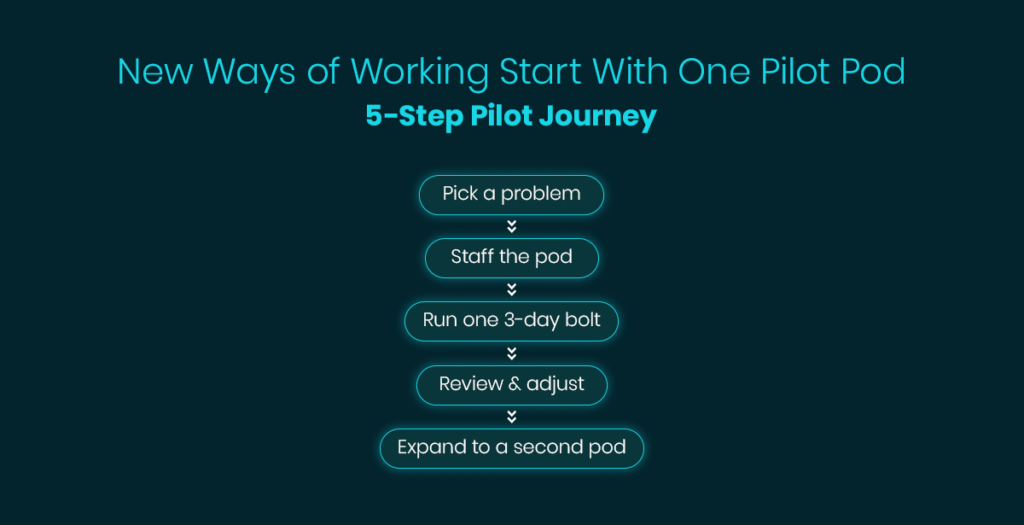
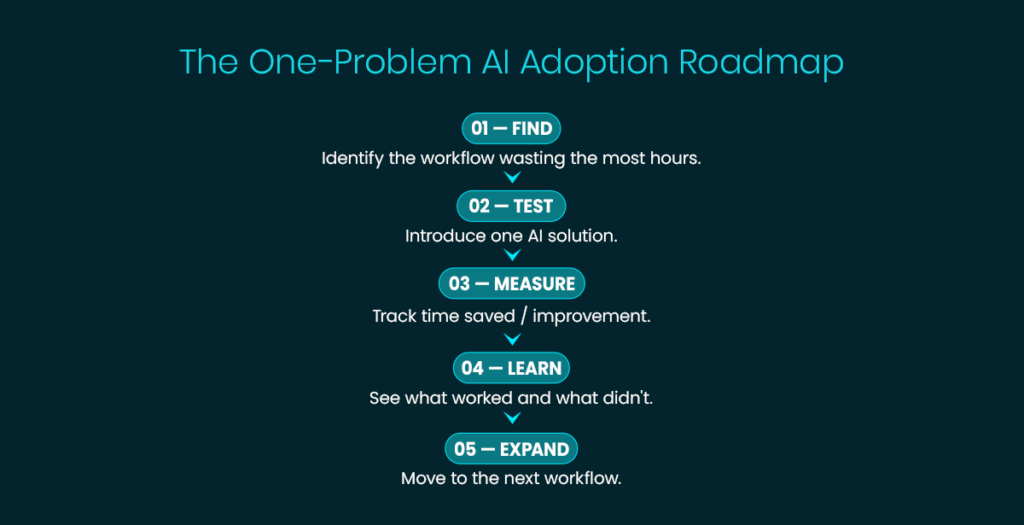
Real AI adoption for business starts small and specific. Pick the one workflow that wastes the most hours every week. Fix that first.
Our no-nonsense AI adoption roadmap walks through this exact sequencing for growth-stage teams. Start narrow, prove value, then expand.
Bigger companies often move slower here, not faster. Enterprise AI adoption stalls because layers of approval slow down even a simple pilot.
A smaller team can test, learn, and adjust fast. A large company might still be scheduling the kickoff meeting.
Choosing AI Collaboration Tools Your Team Will Actually Use
Plenty of AI collaboration tools exist. Most get tried once and abandoned. The failure usually isn’t the tool. It’s the rollout.
Pick tools that plug into work your team already does, not tools that require a whole new process. A writing assistant inside your existing docs beats a separate app nobody opens.
Give people a real reason to use it daily, not a mandate to use it “when convenient.” Habits form around convenience, not policy memos.
Test with a small group first. Let them tell you what actually saves time before you roll anything out company-wide.
AI Workforce Transformation Means Redesigning Roles, Not Just Adding Tools
AI workforce transformation fails when companies treat it as a software rollout. It succeeds when companies redesign what a role actually does.
Our AI Lab whitepaper covers this in depth. The AI Lab model treats AI adoption as structured experimentation, not a one-time deployment. Ideation, MVP, then scaling, each stage validated before moving on.
A role redesigned around AI looks different. Less manual reporting, more judgment and oversight. That shift is the actual transformation, not the tool itself.
Human AI Collaboration Is a Skill Gap, Not a Tech Gap
Human AI collaboration is where most companies quietly stall. Deloitte’s 2026 research found something telling. Only 14% of leaders feel adept at shaping how people and AI work together, even as adoption keeps climbing.
That gap isn’t a technology problem. It’s a training and coaching problem.
Our piece on corporate AI training that goes beyond prompt engineering covers what real upskilling looks like. Prompting is a start, not the finish line.
Our AI upskilling workshop builds this skill directly with leadership teams, not just individual contributors.
Frequently Asked Questions
What makes a workplace actually AI-driven, versus just using AI tools?
An AI-driven workplace redesigns workflows around AI, not just software purchases. The test is whether removing the AI would break how work happens, not whether people opened the app once.
Where should a growth-stage company start with AI adoption for business?
Start with one high-friction workflow. Prove it works, measure the time saved, then expand to the next process. Skip the company-wide rollout on day one.
Do AI collaboration tools replace the need for new skills?
No. Tools without training create frustration, not transformation. Teams need both the tool and the coaching to use it well.
How long does AI workforce transformation actually take?
Longer than a quarter, shorter than most leaders assume. Role redesign around one workflow can show results in weeks. Company-wide transformation takes longer and happens in stages, not in one big announcement.
Who should own AI adoption inside a growth-stage company?
Someone close to the actual work, not a committee three layers removed from it. Ownership works best when the person driving adoption also feels the pain of the broken workflow.
Start With One Problem This Week
An AI-driven workplace isn’t built in a single sprint. It’s built one redesigned workflow at a time, starting with whatever wastes the most hours right now.
Human AI collaboration, AI workforce transformation, and real AI adoption for business come down to the same habit. Pick one problem, fix it for real, then move to the next.
Visit our Innovation Lab and see how we help teams run that first experiment. You won’t need to bet the whole roadmap on it.