





The 4 Future of Work Challenges No One Is Talking About

The future of work AI conversation is loud right now, but most of it misses the point. Everyone debates tools. Few talk about the real future of work challenges hiding underneath. These are broken adoption habits, brittle culture, and leaders who manage change like it’s 2015.

Ask ten founders where their AI rollout stalled. Most blame the technology. They’re wrong. Gartner predicts organizations will cancel more than 40% of agentic AI projects by 2027. The reason is rarely the model. It’s unclear ownership, weak governance, and teams that never changed how they actually work.

That’s the pattern behind every one of the four challenges below. Each one gets discussed in isolation. Almost no one connects them. Here’s what’s actually holding organizations back, and what to do about it.

1. AI Adoption Challenges Run Deeper Than the Tools

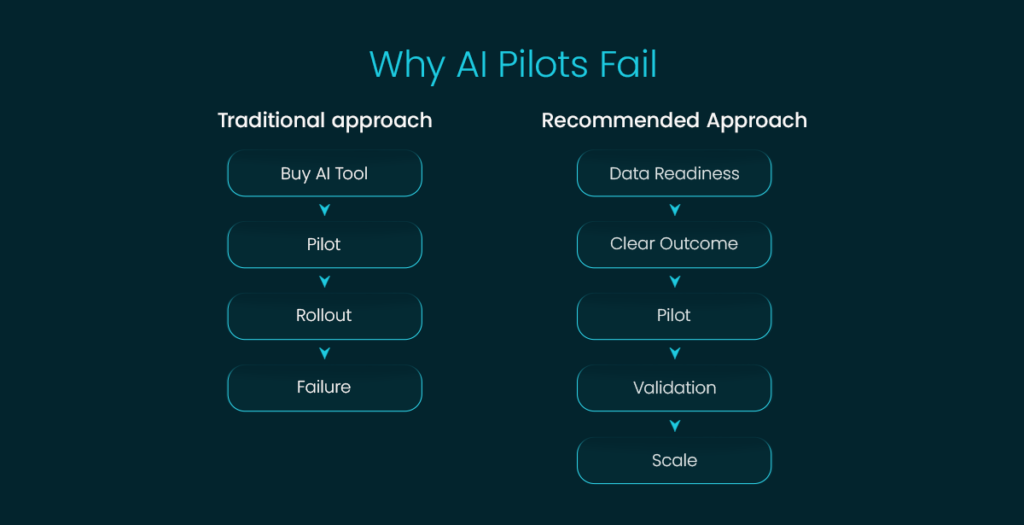
Most companies treat AI adoption as a shopping list. Pick a tool, run a pilot, hope it sticks. That approach explains why so many pilots quietly die.

MIT’s Project NANDA found that 95% of generative AI pilots produce no measurable return. The problem isn’t the model. It’s data readiness, unclear goals, and old workflows that never changed to fit new tools. Layer a smart tool on top of a broken process, and the process wins every time.

Real AI adoption challenges start with structure, not software. Our AI Adoption Roadmap for Growth-Stage Companies walks through the sequence that actually works. Audit your data first. Define one measurable outcome. Then build.

The AI Lab model solves this differently. Instead of one big rollout, it moves through three stages: ideation, MVP, and validated scaling.

Each stage has a gate. Nothing scales until it proves real value first. That structure alone counters the 65 to 70% failure rate common in traditional digital transformation efforts.
future of work

2. Organizational Culture Change Can’t Be Optional

You can buy the best AI stack on the market. It won’t matter if your culture still runs on fear and hierarchy.

Most organizations operate on what we call corporate DNA. It’s process-heavy and risk-averse. It’s built for compliance instead of speed. That model made sense on an assembly line. It fails inside a knowledge organization trying to move fast with AI.

Organizational culture change means shifting toward startup DNA. Think flat structures, fast decisions, and people who own outcomes instead of waiting for approval. Our piece on why agile structures still act like hierarchies breaks down the gap. Many companies claim agility. Few actually practice it.

This shift isn’t cosmetic. Teams with real ownership adapt to new tools faster. Teams run by fear just wait for permission, and permission is slow.

3. Workforce Transformation Needs More Than a Training Budget

Here’s a stat worth sitting with. The World Economic Forum projects that 39% of workers’ core skills will change by 2030. AI is the main driver, as it moves from experimentation into daily workflows.

Most companies respond with a single training session and call it done. That’s not workforce transformation. That’s a checkbox.

Real transformation means redesigning roles around what AI can now do, and what only humans still do well. It means building pods. Pods are small, cross-functional teams that pair people with AI agents. They replace rigid job descriptions and slow-moving Scrum teams.

We built our AI Upskilling Workshop around this exact gap. It goes past prompt basics. It focuses on how teams actually restructure work once AI joins the team as a working member, not just a tool.

4. AI Change Management Is a People Problem First

The fourth challenge is the one leaders avoid most. It’s managing the human side of change.

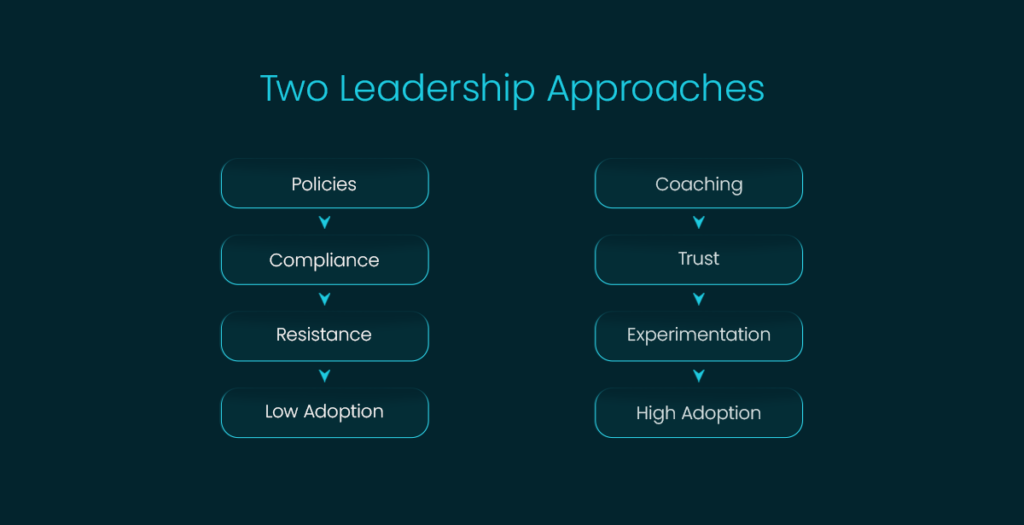
Policies and mandates don’t build trust. They just create compliance theater. Employees follow the letter of the rule while ignoring its spirit entirely.

AI change management works differently. It replaces enforcement with coaching. Leaders explain the why. They model the behavior themselves. They give people room to experiment without fear of punishment for an honest failure.

We cover this shift in The Future of HR: Why Coaching Will Replace Policy Enforcement. The short version is simple. People adopt change faster when they trust the person asking them to change.
future of work

What Actually Comes Next

These four future of work challenges share one root cause. Leaders treat AI as a technology problem. It’s actually an organizational one.

Fix the data and workflow gaps. Shift the culture toward ownership. Redesign roles around real skills, not old titles. Lead the change instead of mandating it. Do all four, and AI adoption stops being a gamble.

Common question: Why do most AI initiatives fail even with a good budget?

Money doesn’t fix broken workflows or a fearful culture. Most failures trace back to unclear ownership and no measurable goal. Add teams that never changed how they operate day to day, and failure becomes the default outcome, not the exception.

Common question: What’s the fastest way to start fixing this?

Start small and start honest. Pick one team, one workflow, and one clear outcome. Measure it before you scale anything further.

Ready to see where your organization actually stands? Start with a Discovery Workshop. You’ll get a clear read on your readiness before you spend another dollar on tools.

From SDLC to ADLC: How AI Is Rewriting the Software Development Lifecycle

For decades, the Software Development Lifecycle gave development teams a reliable map: plan, design, build, test, deploy, maintain, repeat.

That map is now obsolete.

AI is not just a tool inside the SDLC. It is fundamentally changing the AI SDLC — compressing timelines, shifting roles, and rethinking what a “team” even looks like. Organizations that keep running old frameworks on new infrastructure will not compete with those building AI-native delivery models from the ground up.

So what exactly is changing — and what should your team do about it?

The Traditional SDLC Was Built for a Different Era

Scrum gave development teams structure. Two-week sprints, backlog grooming, stand-ups, retrospectives — it was a real improvement over waterfall delivery.

But Scrum ran on human-paced execution. Planning assumed that writing, reviewing, testing, and shipping code required specific amounts of calendar time. That assumption no longer holds.

According to DORA’s research on AI in the software development lifecycle, AI-assisted coding produces productivity gains of 13% to 55% depending on the task. Today, more than 40% of code is AI-assisted. What used to take a quarter can now fit in a sprint — and what took a sprint can now take three days.

Traditional AI agile methodology hasn’t caught up.

Introducing the ADLC: AI Development Lifecycle

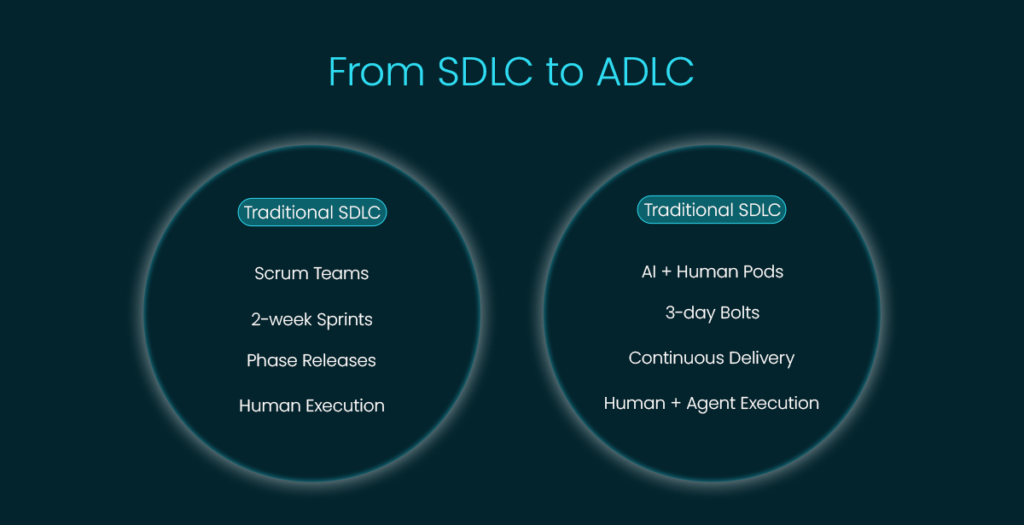
ADLC is the emerging framework built to replace traditional SDLC. Rather than adding AI tools to existing processes, it redesigns the entire delivery model around AI-native execution.

Three changes define it.

Pods Replace Scrum Teams

Classic Scrum teams rely entirely on human specialists — developers, QA engineers, designers, product owners. In the ADLC, pods take their place. Each pod is a small cross-functional unit of humans and AI agents working together. One agent generates and reviews code, another runs automated tests, another monitors production health. Human members direct the work, validate outputs, and make judgment calls.

Smaller teams. Faster decisions. Fewer coordination bottlenecks.

3-Day Bolts Replace 2-Week Sprints

Long sprints made sense when humans wrote every line of code. Now, AI agents generate, test, and iterate in hours. Consequently, 3-day bolts replace sprints in ADLC teams. Each bolt carries a clear intent, defined outputs, and a validation checkpoint.

This shift changes AI sprint planning fundamentally. Rather than grooming a backlog over two weeks, teams design intent — what problem does this bolt solve, what does success look like, and which agents execute which tasks?

Continuous Delivery Replaces Phase-Gated Releases

Phase-gated QA sign-offs and scheduled release windows worked when human review was the primary quality check. AI-native teams run continuous delivery loops instead — agents test in real time, flag issues immediately, and push incremental updates without waiting for a release window.

As a result, the AI development process becomes iterative at a much finer grain.

What This Means for Your Team

Most engineering teams are not failing because they lack talent. They’re failing because their process architecture suits a world that no longer exists.

Running Scrum ceremonies with AI tools stuffed inside is like fitting a Formula 1 engine into a 1990s sedan. The power is there — but the frame can’t handle it.

Shifting to an agile AI development model demands rethinking three things.

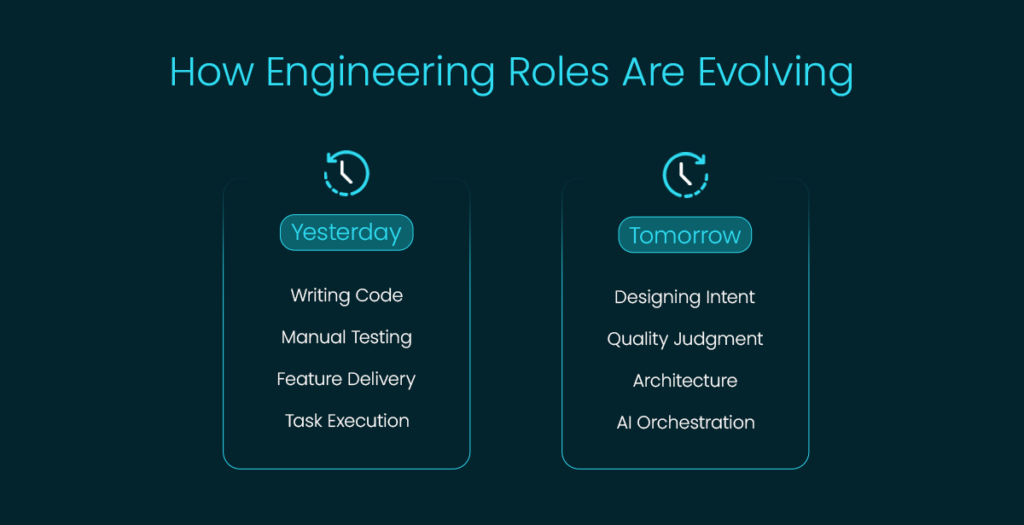
Roles and ownership. When AI agents handle code generation and testing, engineers shift toward architecture, intent design, and quality judgment. Your agile culture coaching strategy needs to reflect this — otherwise engineers will resist the transition rather than embrace it.

Decision velocity. ADLC only works when teams can make fast decisions. That means pushing authority down to pods, not waiting for manager approval on every bolt. This is as much a culture change as a process change.

Learning loops. Three-day bolts generate data fast. Teams that build strong retrospective habits — reviewing outcomes every 72 hours — compound their improvements quickly. Those that skip retrospectives will churn without progress.

If your team isn’t yet building these habits, a contained experiment through an innovation lab is a smart way to test the model before rolling it out organization-wide.

The Competitive Reality

Researchers studying agentic AI in the SDLC confirm that autonomous AI systems are now reshaping every phase of software delivery. Gartner projects that 60% of enterprise AI rollouts will include agentic capabilities by end of 2026.

Organizations building ADLC-native teams today carry a compounding advantage. Those waiting will face a delivery gap that grows wider every quarter.

We’ve written about this pattern in our piece on why the biggest companies move the slowest on enterprise AI adoption. Consistently, the framework outlasts its usefulness — and by the time the urgency is obvious, the gap is already wide.

The Bottom Line

The AI SDLC shift is not incremental. Moving from 2-week sprints to 3-day bolts, from Scrum teams to pods, and from phase-gated releases to continuous delivery requires deliberate redesign.

Start by auditing your current delivery model. Where are the slowest handoffs? Which steps still assume purely human execution? Target those first.

Your team doesn’t need a massive transformation program. It needs a focused experiment — one pod, one bolt, one learning cycle at a time. The AI upskilling workshop is a practical starting point for teams ready to build those capabilities.

SDLC served us well. ADLC is what comes next.

The AI Agile Methodology Replacing Scrum at Forward-Thinking Companies

Scrum built the modern software industry. For two decades, two-week sprints, daily standups, and backlog grooming gave development teams a reliable delivery rhythm.

But that rhythm no longer fits.

When AI tools compress days of work into hours, a fixed two-week planning cycle creates drag rather than direction. Teams produce more output but lose the ability to respond to what they learn. Forward-thinking companies already run a different playbook. They’ve adopted an AI agile methodology designed for how work actually moves today, not how it moved in 2005.

Here’s what that shift looks like, and why it’s spreading fast.

Why the 2-Week Sprint No Longer Works

For years, sprints made sense when writing code was the bottleneck. Two weeks gave developers time to design, build, test, and review a meaningful slice of work. That logic held firm for over two decades.

AI has changed the underlying physics of software development. Tasks that once took days — drafting requirements, writing boilerplate code, generating tests, reviewing pull requests — now take hours. Research from AI-augmented teams shows a 20–40% reduction in time-to-market, with execution work compressing from weeks to single days.

AWS research on the AI-driven development lifecycle confirms this: AI shifts bottlenecks rather than eliminating them. It moves pressure from building to reviewing, from coding to validating.

So what happens when faster work sits inside a slower structure? Teams either pad sprints with low-value tasks to justify the cycle, or they build features faster without validating whether those features are worth building.

As a result, the two-week sprint paradox intensifies: AI sprint planning inside a fixed two-week window disconnects from reality.

Planning sessions review yesterday’s assumptions. Retrospectives audit work from last week rather than responding to what’s changing right now.

What Forward-Thinking Companies Are Using Instead

The AI agile methodology replacing Scrum restructures around three core changes.

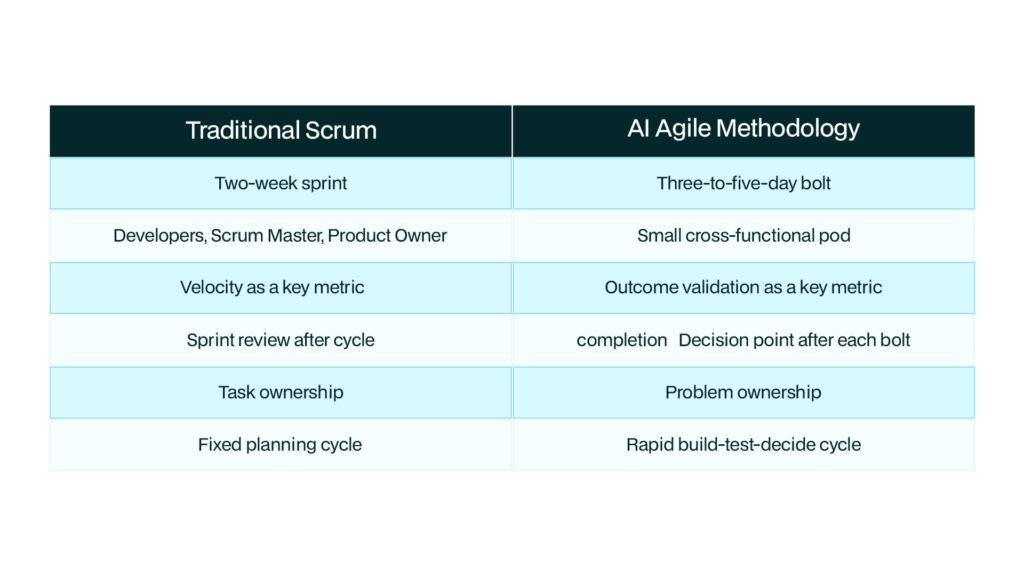
Shorter execution cycles. Leading teams now run what practitioners call “bolts”: focused cycles of three to five days. These aren’t mini-sprints with compressed planning and rushed ceremonies. Each bolt starts with sharp alignment on one outcome, runs fast, and ends with a working artifact and a clear decision point.

Pods instead of traditional Scrum teams. Standard Scrum separates roles into developers, a Scrum Master, and a Product Owner. In contrast, pods collapse those distinctions. A pod is a small cross-functional unit, typically three to five people, working alongside AI agents as active team members. The pod owns the problem, not a set of tasks.

Outcome over velocity. Velocity made sense when human effort drove all results. For AI agile teams, velocity becomes noise. What matters is whether users, data, or a market signal confirms the outcome before the team moves to the next bolt.

Together, these three changes form what Future At Work calls the AI Development Lifecycle: a framework built for how AI agile teams actually deliver.

How AI Agile Teams Operate in Practice

The clearest way to understand the difference is to compare a single week.

In a standard Scrum setup, a team spends Monday in sprint planning, moves through a ticket queue during the week, and holds a sprint review on Friday. Coordination demand stays high. At the same time, context switching stays high. The distance between individual tasks and real outcomes stays wide.

By contrast, a pod picks up one specific outcome on Monday morning. Wednesday finds the pod with a working prototype in front of real users. Thursday produces actual usage data. Friday brings one clear decision: scale it, pivot it, or drop it. No waiting for the next sprint cycle to act.

That three-to-five-day cycle of build, test, and decide is the heartbeat of agile AI development. It eliminates sprint theater: the standups and ceremonies that generate activity reports rather than real decisions.

Making the Shift

The structural changes are relatively straightforward. The cultural ones take more work.

Most organizations run Scrum teams where managers get rewarded for process compliance, not outcome delivery. Shifting to an AI agile methodology means changing what managers measure, how teams form, and how teams make decisions. That’s a leadership problem before it’s a tooling problem.

Still, many teams attempt this shift without rethinking the AI development process itself. They layer AI tools on top of a two-week sprint and expect productivity gains to follow.

Those gains rarely appear, because the biggest obstacle to AI adoption is never the technology. It’s the process wrapping it.

In practice, the fastest path to real change is to run a single bolt with a single pod. Pick one outcome. Give the team three days. Run a prototype in front of real users by day two. Review results against actual user feedback, not a definition of done. That experiment reveals more about team readiness than a year of process frameworks.

For teams ready to go further, agile culture coaching built around the ADLC delivers the fastest structural shift. A discovery workshop can surface exactly where the current agile process blocks AI adoption.

Scrum Solved Yesterday’s Problem

Scrum solved a real problem. It gave chaotic development teams a structure that worked, and it served the industry well for a long time.

Yet the problem Scrum solved differs from what AI agile teams face today. Back then, the challenge was coordinating large teams writing complex code over long timelines. Today, the challenge is speed of validation, not speed of delivery. Building the right thing in three days matters more than building anything in two weeks.

Forward-thinking companies already see this. They’re not abandoning discipline. Instead, they’re redesigning it for an era where the tools have fundamentally changed. The teams that move first will build smarter, waste less, and outpace organizations still running yesterday’s methodology.