






Agentic AI in Business: What Happens When Your AI Starts Making Decisions

Agentic AI in business is no longer a research demo. It’s live in procurement systems, customer service queues, and financial approval chains. These systems don’t just answer questions. They take actions, chain tasks together, and make calls that used to require a human sign-off.

Gartner expects task-specific AI agents to sit inside 40% of enterprise applications by the end of 2026. That’s up from under 5% a year earlier, a fast climb for something most leadership teams haven’t fully planned for.

The real question isn’t whether your AI will start making decisions. It already has, somewhere in your stack. The question is whether you’ve built the structure and oversight to handle it. That’s what separates an AI-native company from one that bolted AI onto an old operating model.

What Does It Mean When AI Starts Making Decisions?

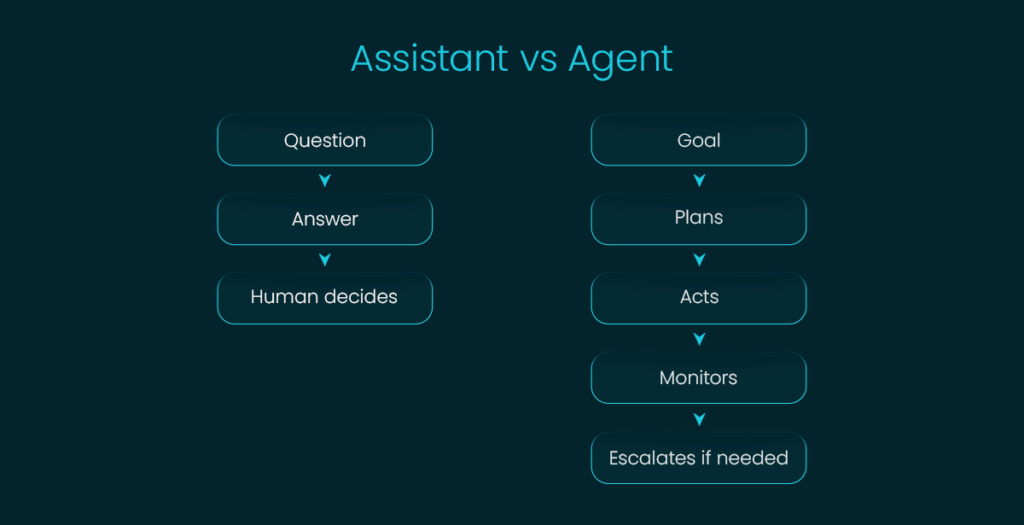
Agentic AI is software that plans, acts, and adjusts without waiting for a human at every step. A traditional AI tool answers a question. An agentic system decides what to do next and executes it. It loops in a person only when something falls outside its rules.

That distinction matters more than it sounds. Once an AI agent approves a refund, reroutes a shipment, or flags a hire, it has crossed a line. It moved from assistant to actor. Your business now has a non-human decision-maker on the payroll, in effect.

This is the heart of agentic AI in business: authority, not just intelligence, is shifting to machines.
Agentic AI

How Fast Is Agentic AI Moving in Business?

Adoption is accelerating fast. Gartner tracks this shift in its 2026 Hype Cycle for Agentic AI. The report shows task-specific agents climbing quickly, moving from under 5% of enterprise applications in 2025 toward 40% by the end of 2026.

Deloitte separately found that autonomous agent deployment will double among generative AI users. It grows from 25% in 2025 to 50% by 2027.

That pace creates a problem most leadership teams underestimate. Deloitte’s research on why AI agents are scaling faster than their guardrails found a gap. Only 21% of organizations have a mature governance model for autonomous agents. The rest are letting agents act before deciding who’s accountable when something goes wrong.

Building an AI-Native Company vs. Bolting AI On

An AI-native company designs its workflows around agents from the start. A company that bolts AI onto legacy processes just automates the same broken structure, faster.

The difference shows up first in how decisions get made. In a bolted-on setup, an agent drafts a recommendation. A manager approves it inside the same rigid hierarchy that existed before.

In an AI-native setup, the agent has clear boundaries and real authority within them. That’s the core distinction between an AI first organization and one running old playbooks with new tools.

This is also why the biggest companies tend to move slowest on agentic AI. Legacy hierarchies weren’t built to grant a machine decision rights. Rewriting them takes more courage than budget.

Future At Work’s AI Lab framework treats this shift as three stages: ideation, MVP development, and governed scaling. Skipping straight to scaling without validating an agent’s judgment is a common mistake. It’s exactly how most digital transformations fail, and agentic AI in business is no exception.

Managing AI Agents: New Team Structures for a New Kind of Worker

Managing AI agents isn’t a software problem. It’s a team design problem. Traditional Scrum teams weren’t built to include a non-human member that acts autonomously between stand-ups.

This is why forward-thinking companies are replacing two-week sprints with three-day bolts. The work runs through pods: small teams of humans and agents working side by side.

Future At Work breaks this down in its piece on AI agile methodology replacing Scrum. It also covers the underlying team design in decentralized, pod-based team structures.

The shift isn’t about adding an AI tool to an existing team. It’s about redesigning who owns which decisions. Managing AI agents works like managing any new hire: clear scope, feedback loops, and consequences.

Human-AI Collaboration: Who’s Actually Accountable?

Human AI collaboration works only when accountability stays human, even as execution becomes shared. An agent can recommend, act, and even learn. It cannot own the outcome the way a person can.

Leaders who get this wrong tend to repeat an old mistake: promoting technical capability without matching judgment. Future At Work’s work on executive leadership development for AI-era leaders makes a clear case. EQ, not technical fluency, decides whether human-AI collaboration works at scale.

Companies that treat this as a values shift, not just a technology rollout, see it stick. That’s where real AI business transformation happens.

Frequently Asked Questions

Do AI agents make decisions without any human oversight?

No. Most agentic AI systems in business operate inside defined rules and escalate anything outside them. Good systems design the oversight in, rather than bolting it on afterward.

What’s the first step toward becoming an AI-native company?

Start small. Map one workflow where an agent could safely own a decision. Test it in a contained environment, then expand once it proves reliable.

How is managing AI agents different from managing software?

Software executes fixed rules. AI agents interpret situations and choose actions. That means agents need ongoing feedback, monitoring, and clear escalation paths, much like a junior employee.

The Real Work Starts Now

Agentic AI in business isn’t a future scenario. It’s already approving refunds, screening resumes, and rerouting logistics inside companies that haven’t updated their org charts to match.

The organizations that win this shift won’t be the ones with the most advanced models. They’ll be the ones that redesigned team structures and built real governance. They trusted people to manage AI agents as seriously as they manage each other.

If you’re not sure where your organization stands, start with a discovery workshop. It’s a practical way to map where agent authority already exists. It also shows where a human still needs to stay in the loop.

Enterprise AI Adoption: Why the Biggest Companies Move the Slowest

There’s a puzzle that keeps coming up in boardrooms across Karachi, Dubai, and Riyadh. A company with 5,000 employees, a technology budget in the tens of millions, and a board mandate to “become AI-driven” is being consistently outmaneuvered by a 40-person startup running on open-source models and a shared Notion board.

The small team ships an AI feature in three days. The enterprise forms a committee to study the feasibility.

Enterprise AI adoption is not failing because of a lack of resources. It is failing because of a lack of organizational readiness. And the bigger the company, the deeper the misalignment runs.

The Slow Mover Paradox

The assumption is that large organizations have the advantage in AI. More data, more capital, more talent access. In theory, this should make them faster.

In practice, size compounds every structural problem that was already there.

According to McKinsey’s State of AI research, less than a third of companies report meaningful value from their AI investments, despite years of spending, announcements, and pilot programs. The organizations getting value tend to be the ones that moved fastest and embedded AI into actual operations, not those with the largest budgets.

The reason isn’t technology. It’s culture, structure, and decision-making architecture — things that scale with an organization’s age, not its ambition.

The Real Culprit: Corporate DNA

Most large organizations were built on assembly-line thinking. Work is broken into standardized, repeatable tasks. Accountability flows upward. Decisions require sign-off. Deviation is discouraged because deviation introduces variance, and variance is the enemy of operational efficiency.

That model was designed for manufacturing in the 20th century. It is actively hostile to the kind of experimentation that AI business transformation requires.

When an AI initiative lands inside a corporate DNA organization, it doesn’t get accelerated. It gets managed. Stakeholder committees are formed. Use cases are approved. Risk assessments are conducted. By the time anything is ready to test in production, the market has already moved.

Startups don’t have this problem, not because they’re smarter, but because they haven’t had time to build the institutional scaffolding that slows decision-making down. The goal isn’t to become a startup. It’s to cultivate startup DNA inside your existing structure: lean, cross-functional, empowered to act, and safe to fail fast.

Why Transformation Programs Keep Failing

The industry has known this for a while. Research consistently shows that 65 to 70% of digital transformation programs fail to meet their stated goals. That’s not a technology problem. The tools are available, capable, and increasingly affordable. It’s a leadership and culture problem, and AI adoption inherits every weakness the previous transformation failed to fix.

Three failure patterns show up consistently across industries and geographies.

Organizations try to run new AI workflows on old organizational structures. They layer the technology on top of a hierarchy that was never designed for rapid iteration. The result is AI tools that nobody uses the way they were intended.

They underfund the human layer. AI change management — the work of shifting how people think about their roles, accountability, and relationship with AI tools — rarely appears as a line item in transformation budgets. But it’s what determines whether a rollout sticks.

And they skip validation. Projects go from ideation to enterprise rollout without a real MVP phase. As our whitepaper on the AI Lab model outlines, the structured path from experimentation to proven ROI is the mechanism that separates successful transformations from expensive ones.

What Fast Movers Do Differently

The organizations winning at AI transformation strategy share a pattern worth studying closely.

They don’t start with technology selection. They start with a clear problem worth solving, a small cross-functional team with real authority to act, and a mandate to produce something working within days, not quarters.

This is the logic behind the AI Lab model: a dedicated hub for experimentation that operates outside the normal approval architecture, runs short validated cycles, and hands off only what has been proven. It’s the successor to the digital factory, designed for the probabilistic, data-centric nature of AI work rather than the deterministic logic of traditional software projects. Our Innovation Lab is how we help organizations stand this model up in practice.

The AI Lab also gives organizations something most transformation programs don’t: a place to build organizational muscle for working with AI before asking the entire enterprise to change how it operates.

The Human Layer: Where Most AI Strategies Stop Short

Here’s the uncomfortable truth about AI adoption for business at scale: the technology is the easy part.

What’s hard is the leader who built their reputation on knowing the answers, and now needs to be comfortable delegating to an AI agent. The middle manager whose job was aggregating information upward, and who now has to reimagine what value they add. The team that had a clear lane and is now being asked to work alongside tools that didn’t exist last year.

None of these people are obstacles to transformation. They are the transformation. Getting this right requires more than a technology rollout.

It requires AI upskilling that goes beyond prompt engineering, and leadership development that addresses the identity shifts AI adoption triggers, not just the workflow changes.

According to Harvard Business Review’s research on transformation failure, the most common reason digital initiatives stall is not technical. It’s that the people and culture side was treated as secondary to the technology implementation. AI adoption doesn’t escape this pattern. It amplifies it.

AI competitive advantage belongs to the organizations that solve the human problem first.

FAQ: Enterprise AI Adoption

Why do large companies struggle with AI adoption more than smaller ones?

Size compounds structural problems. Large organizations have approval hierarchies, risk frameworks, and incumbent processes built to reduce variance. AI experimentation requires variance. Smaller organizations move faster not because they are better resourced, but because they have fewer layers between an idea and a test.

What is the right first step toward AI transformation?

A realistic assessment of where you actually are, not where your AI strategy document says you should be. That means looking at decision-making speed, cultural appetite for failure, data readiness, and leadership alignment before selecting any tools. A discovery workshop is one of the most effective ways to surface what is actually blocking transformation before you spend on technology.

Conclusion

The companies moving fastest on enterprise AI adoption are not the biggest ones. They are the most organizationally honest ones, willing to examine the structures and cultural defaults making transformation slow, and willing to change them before they change the technology stack.

The window for getting this right is narrowing. Not because AI will stop developing, but because the gap between organizations that have embedded AI into how they work and those still discussing it is already visible in the market, and it widens every quarter. Future At Work works with founders and leadership teams who have decided to be on the right side of that gap