






The flat organizational structure has promised freedom from bureaucracy for decades. Most companies that tried it hit the same wall. No hierarchy, but also no clarity on who owns what. Now AI is forcing a rewrite. Pods, small human-plus-agent teams, give the flat model the operating discipline it always lacked. Founders rethinking how work actually happens in an AI-driven market aren’t reviving an old idea. They’re building a different one.
Why the Flat Organizational Structure Keeps Coming Back
A flat organizational structure is an operating model with few or no layers of middle management between leadership and frontline staff. It trades approval chains for direct ownership. That trade appeals to any founder tired of watching decisions die in committee.
The appeal isn’t new. What’s new is why it’s resurfacing now. Corporate DNA, process-heavy, risk-averse, standardized, fit an era when consistency mattered more than speed. AI flipped that priority. A lean organization built for experimentation now outcompetes one built for control.
This shows up clearly in family-run businesses across Pakistan and the Gulf. A single approval chain can stall a good idea for weeks. Every layer added for control quietly removes a layer of speed. Founders in these markets feel this tension the most, because their competitors are often global and dollar-funded. Their teams compare pay, tools, and pace against companies operating on a completely different clock.
From Decentralized Teams to AI Pods
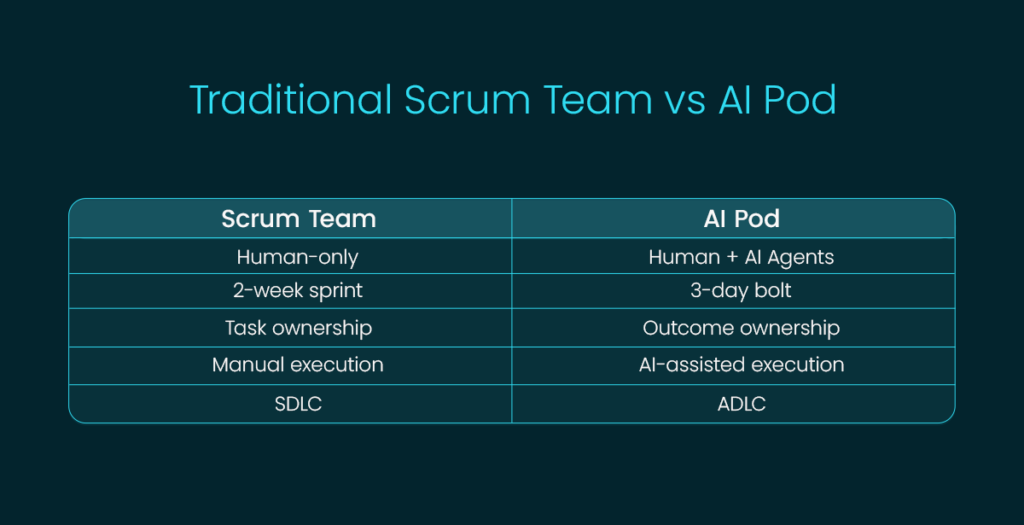
Traditional flat structures decentralized authority. AI pods decentralize capability. A pod is a small cross-functional team. It pairs humans with AI agents working side by side. It replaces the traditional Scrum team.
Instead of two-week sprints, pods run on 3-day bolts. These are short execution cycles that match how fast AI-augmented teams move. This is the core of the ADLC, the AI Development Lifecycle framework increasingly replacing SDLC.
A decentralized team structure built around pods does more than flatten the org chart. It changes the unit of work itself. It pairs judgment-heavy human roles with agents that handle execution at scale. Our agile culture coaching engagement walks leadership teams through exactly this shift, from Scrum rituals to pod-based delivery.
What Makes an Agile Organizational Structure Actually Work
An agile organizational structure succeeds when speed and accountability move together, not against each other. That’s the piece most digital transformation efforts miss. Research shows 65 to 70% of digital transformations fail to hit their goals. The leading causes aren’t technical. They’re cultural: no appetite for experimentation, no redesign of the underlying structure, and teams treating technology as an add-on instead of building it into how they work.
Pods fix all three at once. They give teams a contained space to experiment. They rely on structure instead of old hierarchy. And they embed AI as a working teammate, not a bolted-on tool. We saw this firsthand in our hackathon engagement with DPL, where cross-functional pods shipped working prototypes in days, not quarters.
That kind of speed is hard to fake. It comes from a structure designed for it, not a slogan pasted on top of an old one. A lean organization doesn’t get there by cutting headcount. It gets there by cutting the steps between an idea and its first real test.
Self-Organizing Teams Need Guardrails, Not Just Freedom
Here’s the uncomfortable part. Self-organizing teams don’t fail because autonomy is a bad idea. They fail because autonomy without structure turns into confusion. A Strategic Management Journal study on flat start-ups found that so-called flat companies often hide a real hierarchy. Informal power structures emerge precisely because no one designed a formal one.
Does going flat mean no leadership at all?
No. Flat doesn’t mean leaderless. Leadership shifts from title-based authority to context-based ownership. Someone leads because they’re closest to the problem, not because of where they sit on an org chart. Pods still need a clear owner for outcomes, even without a manager for approvals.
That’s the difference between Startup DNA and a flat structure that collapses under its own weight. Startup DNA keeps ownership distributed but visible. Everyone knows who’s accountable for what, even without a hierarchy enforcing it.
Organizational Design for the AI Era
Good organizational design now has to answer a harder question. Which decisions belong to humans, and which belong to agents? McKinsey’s State of Organizations 2026 report found that AI will reshape roughly 75% of current roles as it embeds into daily workflows. The report also found that once AI handles execution, the human dimensions of leadership, judgment, empathy, psychological safety, become the real differentiator.
The same report recommends organizations invest five dollars in people for every dollar they spend on AI technology. That ratio matters more than any tool choice. A pod can only work if the humans inside it have the EQ and judgment to lead without a hierarchy backing them up.
That’s exactly the job a pod-based flat structure does. It keeps humans on judgment and relationships. It lets agents absorb repeatable execution. Organizations still running on assembly-line thinking can’t make that split. In that model, people stay interchangeable and process stays king. A discovery workshop is usually the fastest way to find exactly where your current structure blocks that shift.
The Takeaway
The flat organizational structure isn’t dead. It’s finally getting the operating system it needed. Pods, 3-day bolts, and clear context-based ownership fix the accountability gaps that sank earlier attempts at going flat. Organizations that get this right won’t just be flatter. They’ll be faster, leaner, and ready for a workforce that includes AI agents as teammates, not tools.
If your current structure still runs on approval chains instead of ownership, that’s worth a direct conversation. Our leadership consulting work exists for exactly that shift. The founders who move first on this won’t just save time on decisions. They’ll build the muscle their competitors will spend years trying to copy.