





Cross-Functional Team Structure for AI-Native Companies

Most companies build teams like factories build cars. One department finishes its piece, then passes the work down the line. That model breaks the moment AI enters the workflow. AI-native companies need a cross-functional team structure that puts designers, engineers, and AI agents together from day one.

This is not a cosmetic change to an org chart. It’s a different way to get work done.

Below, you’ll see how pods, self-organizing teams, and AI agile teams replace the assembly line. Founders who make this shift move faster than competitors stuck in legacy structures.

What Is a Cross-Functional Team Structure?

A cross-functional team structure groups people from different disciplines into one unit, aimed at one outcome. A single pod might include a product manager, an engineer, and a designer.

Now add an AI agent that handles research or QA. Nobody waits in a queue for another department to finish its part.

This structure exists because assembly-line thinking doesn’t work for knowledge work. Ford’s factory model made sense when workers repeated one task all day. It makes no sense when a task depends on five different skill sets at once.

Cross-functional teams cut handoffs. Fewer handoffs mean fewer delays and faster decisions. That’s the whole point.

Why Pod Team Structure Beats Traditional Scrum for AI Work

A pod team structure is the clearest expression of cross-functional thinking. A pod is small, usually four to seven people, and it owns a problem from start to finish. It never hands work to another team and waits.

Traditional Scrum teams still separate roles by ceremony. Sprint planning, backlog grooming, and retros get bolted onto a structure built for humans only.

Pods assume something different. They assume AI agents sit inside the team, not outside it. Agents do research, draft code, or flag risks before a human opens the ticket.

We call this shift ADLC, the AI Development Lifecycle. It replaces the two-week sprint with a three-day bolt. Short cycles work because AI agents turn around research and drafts in hours, not days.

The Agile Organizational Structure Trap Most Companies Fall Into

Plenty of companies say they run an agile organizational structure. Few actually do. They keep the standups and the kanban board, but decision rights still sit three layers up.

A team can’t ship a feature without a director’s sign-off. That’s not agile. That’s corporate DNA wearing an agile costume.

Real agility means the pod decides. The people closest to the customer, the code, and the AI tooling make the call. Not the people three layers removed. That’s the gap between agile in name and agile in practice.

McKinsey’s State of Organizations 2026 report backs this up. Thirty-eight percent of leaders call rigid structures and processes their biggest obstacle to change. That number should worry any founder who thinks renaming a hierarchy “agile” fixes it.

Read more on why your agile organizational structure isn’t actually agile.

Self-Organizing Teams: The Real Engine of Ownership

Self-organizing teams don’t wait for a manager to assign the next task. They see the problem, split the work, and move. This only works when trust replaces control as the default.

History backs this up too. Lessons from the self-organized State of Medina show what happens when people take ownership without being told to. Clear principles replaced constant oversight, and the system still delivered results.

The same logic applies inside a company. Give a pod a clear outcome and the guardrails it needs, then get out of the way.

Self-organizing teams that understand the mission make better calls, faster, than any manager relaying instructions from three meetings away.

Building an AI Team Structure: Humans and Agents in One Pod

An AI team structure treats agents as teammates, not tools bolted onto a workflow. A pod might assign an agent to draft a spec or flag edge cases in QA.

Another agent can summarize customer feedback before a human touches it. AI agile teams still need human judgment for context and trade-offs, but the balance shifts.

MIT Sloan Management Review and BCG call this the emerging “agentic enterprise.” Structures must balance human and AI contributors, not treat AI as an afterthought.

Three steps get a team there:

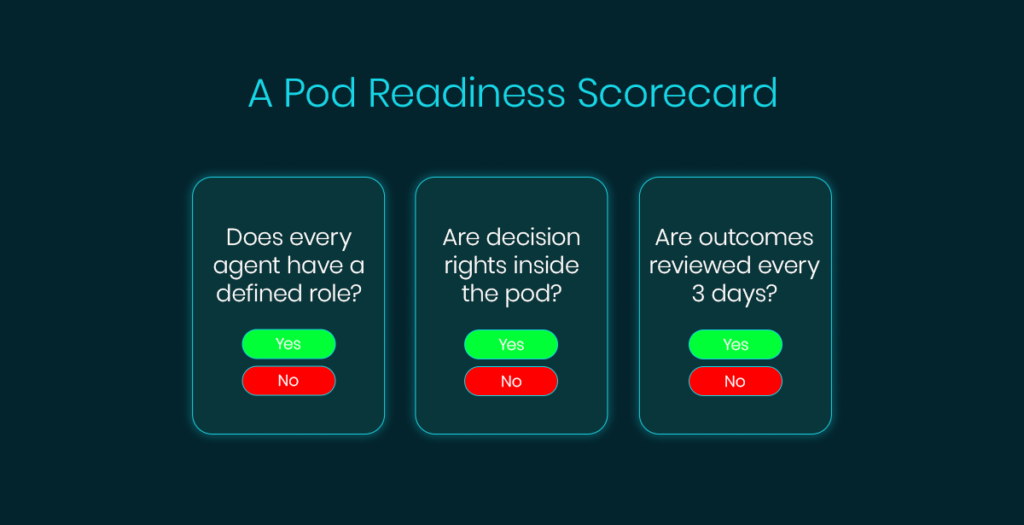
  1. Give every pod at least one AI agent with a defined role, not a vague “use AI more” mandate.
  2. Set decision rights inside the pod, so nobody waits on approval from outside it.
  3. Review outcomes every three days instead of every two weeks. Fast cycles catch problems early.
Cross-Functional Team Structure

Frequently Asked Questions

What’s the difference between a pod and a Scrum team?

A pod owns a problem end to end and includes AI agents as working members. A Scrum team follows fixed ceremonies and usually separates roles by department, even when it calls itself agile.

How many people belong in a cross-functional team structure?

Most pods work best with four to seven people. Add an AI agent or two for research, QA, or drafting. Keep the group small enough to talk without a meeting.

Do self-organizing teams need a manager at all?

Yes, but the manager’s job changes. Instead of assigning tasks, they set outcomes, remove blockers, and coach. The team decides how the work gets done.

Why do AI-native companies choose pods over traditional departments?

Pods cut the handoffs that slow departments down. A pod owns its outcome, uses AI agents for research and drafting, and ships without waiting on sign-off from three other teams.

Start Building Your Pod

Cross-functional team structure isn’t a trend. It’s the operating model that lets AI-native companies out-execute competitors still running assembly-line playbooks.

Pods, self-organizing teams, and AI agile teams work together for one reason. Ownership sits with the people doing the work, not the layers above them.

If your org chart routes every decision through five approvals, the structure is the problem, not your people. That’s what an AI-native operating model actually looks like in practice.

Book a discovery workshop and find out where your team can start moving like a pod instead of a department.

Executive Leadership Development in 2026: What the AI Shift Demands

Executive Leadership Development in 2026: What the AI Shift Demand

Something is happening at the top of most organizations right now. Executives feel the weight of AI transformation bearing down on every decision they make. Many respond by buying tools, hiring consultants, and announcing AI strategies. Outcomes rarely match the ambition.

Technology is not the core problem. Most leaders already have access to AI tools. That gap is a leadership gap — and no amount of new software closes it.

This is why executive leadership development matters more in 2026 than it ever has before.

The Old Leadership Model Is Buckling

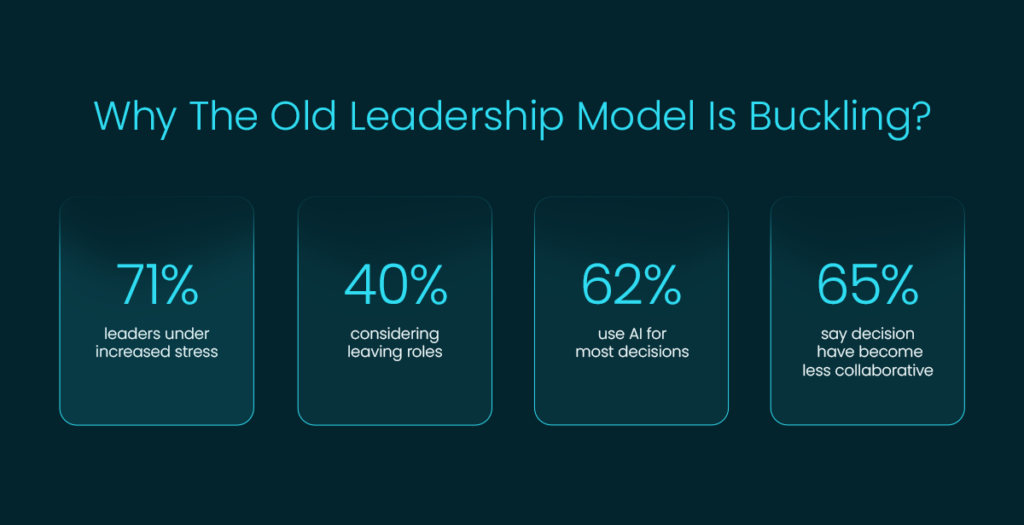
DDI’s Global Leadership Forecast found that 71% of leaders report being under increased stress, with 40% actively considering leaving their roles. Burnout is no longer an individual problem. It signals that the old leadership model is failing under new conditions.

Traditional leadership development programs built executives to manage processes, control information flows, and optimize existing operations. Those capabilities still matter. But they no longer cover the full job.

AI is reshaping what executives actually need to do. According to a 2026 survey, 62% of leaders now use AI to make the majority of their decisions. Meanwhile, 65% say decision-making has become less collaborative since they adopted AI. Think about what that means: leaders are offloading judgment to machines while simultaneously becoming more isolated.

Not transformation. Abdication.

The Real Gap: Judgment, Not Technical Fluency

Most organizations treat the AI skills gap as a training problem: get leaders up to speed on the tools and the gap closes. McKinsey’s 2025 State of AI report tells a different story. Only 1% of companies have achieved what researchers define as AI maturity, while 92% plan to increase AI investments.

Investment is outpacing maturity — and leadership is why.

WEF projects that 39% of core job skills will change by 2030. Leadership-related abilities (judgment, accountability, adaptability) are rising fastest alongside AI literacy. Technical fluency matters. But judgment is the variable that actually determines outcomes.

Executives who pursue genuine leadership transformation do not just learn how to use AI. They learn how to think, decide, and lead in environments where AI sits inside every meeting, every decision, and every team dynamic.

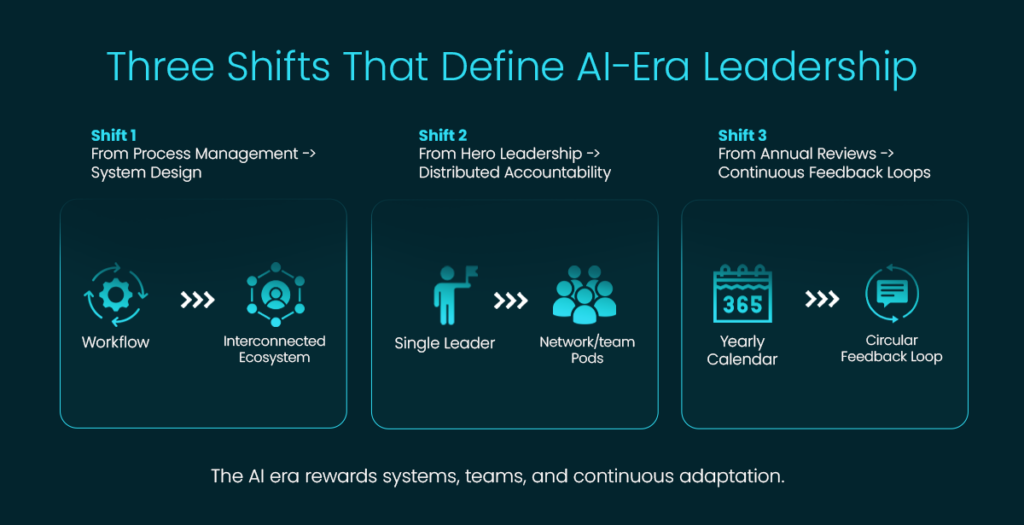
Three Shifts That Define AI-Era Leadership

Effective executive leadership development in 2026 builds three specific shifts. Not competencies that sit in a framework document. These are real behavioral changes that show up in how executives run their organizations day to day.

From managing processes to designing systems. Spending time on process oversight misuses an executive’s most valuable resource. AI handles execution faster than any human team. System design becomes the new role: structuring how humans and AI agents work together, where authority sits, and how teams measure outcomes.

From individual decisions to distributed leadership accountability. AI-era organizations reward teams, not heroes. Executives who push decisions down to pods and small cross-functional teams, and build the culture to support it, move faster and develop stronger organizational capacity. Leadership accountability becomes a team practice, not a solo performance.

From annual reviews to continuous feedback loops. Short execution cycles generate data faster than quarterly reviews can process. Executives who shift to continuous feedback, reading signals weekly and adjusting direction monthly, give their organizations a genuine competitive edge.

Leadership consulting is often the fastest path to making these shifts in practice. Embedded, ongoing coaching changes behavior in real working contexts. Classroom sessions don’t.

What a Real Leadership Development Program Looks Like in 2026

Many organizations still treat executive development as an event. A two-day offsite. A speaker. A workbook. Everyone returns to the same behaviors and the same incentive structures.

It does not work. It never did. But AI makes the gap between what organizations need and what those programs deliver impossible to ignore.

Modern executive leadership coaching embeds inside the work, not alongside it. Coaches work with leaders on live challenges: a market entry, a restructuring, an AI lab launch. Development happens through real decisions, not hypothetical case studies.

A strong leadership development program also builds culture alongside individual capability. An executive who develops genuine leadership accountability while their team still runs on fear and compliance has only solved half the problem.

Starting with a discovery workshop gives leadership teams a structured diagnosis: where they actually stand, where the real gaps are, and what a focused plan needs to address. Not a generic framework. A specific one.

For a broader view on building the organizational foundation that makes this stick, our piece on building a future of work strategy that survives the AI shift covers the full picture.

The Bottom Line

Executive leadership development in 2026 is not about staying current on AI trends. Building judgment, accountability structures, and behavioral habits is the real work.

Technology is here. Tools are accessible. What separates organizations that succeed from those that stagnate is whether the people at the top have done the hard work of developing themselves for the era they actually operate in.

None of it happens at an offsite. It happens in the trenches, with the right coaching, the right structure, and an honest commitment to change.

How to Create a Culture of Innovation in the Workplace (Without the Buzzwords)

Most companies say they value innovation. Many post it on their walls. Some make it a core value in the employee handbook.

Almost none have built a culture that actually produces it.

BCG research on innovation culture reveals the gap clearly: 80 to 90 percent of executives call innovation a top priority. Yet only 6 percent are satisfied with their results — a number that hasn’t moved in nearly a decade.

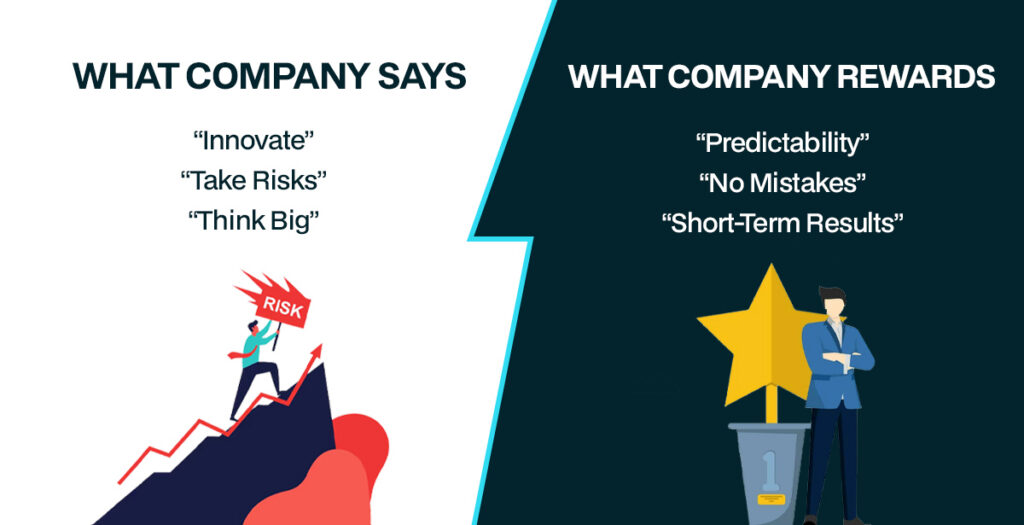
The problem isn’t a lack of ambition. It’s a culture that says “innovate” while structurally preventing it.

Why Corporate Innovation Culture Fails

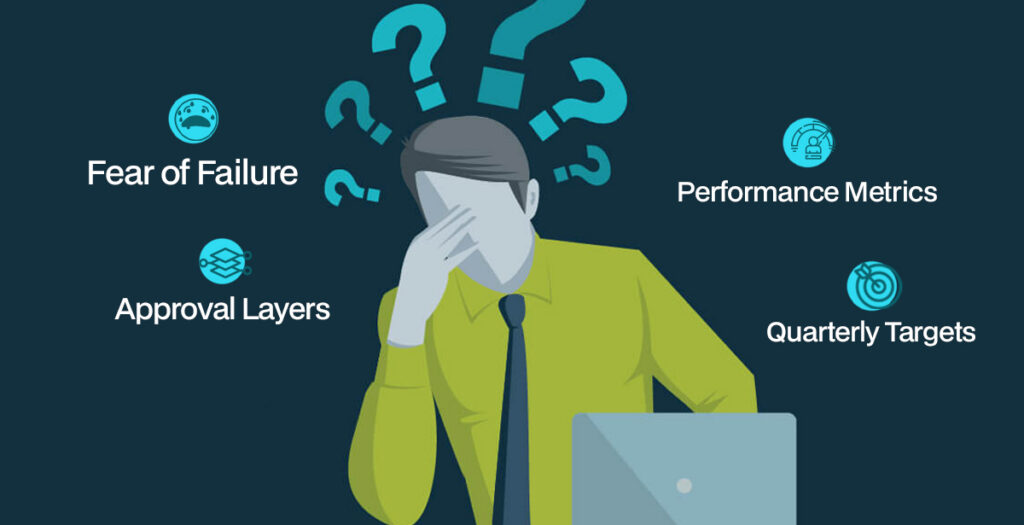
One stat captures what most organizations miss. McKinsey research on fear in innovation finds that more than 85 percent of innovation practitioners say fear regularly holds back innovation. Fewer than 11 percent of organizations are doing anything about it.

Fear shows up in specific ways: employees don’t share ideas that might be rejected. Middle managers filter out experiments that could threaten current performance metrics. Senior leaders declare innovation a priority, then punish the first team that misses a quarterly target while running an experiment.

In practice, this turns innovation into a performance — something organizations do visibly (hackathons, innovation days, idea portals) rather than an operating reality.

That mismatch has a name. At Future At Work, we call it Corporate DNA: the set of structures, incentives, and habits that large organizations build to optimize for consistency, not creation. Corporate DNA isn’t bad — it scales what already works. Yet it actively suppresses what might work next.

What Building a Culture of Innovation Actually Require

Genuine innovation culture examples look different from the outside than they feel from the inside.

From the outside, they often look like process: rapid prototyping, structured experiments, fast feedback loops. From the inside, they feel like permission. Employees at genuinely innovative organizations report feeling safe to try things, fail in front of colleagues, and change direction when they learn something new.

Great Place to Work research shows that psychological safety is the highest-leverage variable in innovation culture — teams with high psychological safety are 60 percent more likely to transform diverse perspectives into innovative solutions.

That safety doesn’t emerge from culture statements or off-site retreats. Instead, it builds through consistent, observable behavior: leaders who admit mistakes publicly, teams that debrief failures without blame, managers who ask questions rather than give answers.

The distinction matters because it shifts the intervention. Building a culture of innovation isn’t a communications exercise. It’s a behavioral one — starting with what leadership does on Tuesday morning, not what the strategy deck says.

The Structural Conditions That Make Innovation Stick

Culture is real, but it needs structural support to sustain.

Several concrete conditions separate organizations with a positive workplace culture for innovation from those that only aspire to one.

Short cycles with real outcomes. Innovation culture examples from leading companies consistently include a mechanism for fast, bounded experiments — not innovation theater, but structured cycles with real deliverables and real decisions at the end. Future At Work’s Innovation Lab runs on this model: 3-day bolts where teams build something real, test it, and decide whether to scale.

Cross-functional ownership. 83 percent of digitally mature organizations use cross-functional approaches to innovation, compared to 55 percent of early-stage companies. Siloed teams optimize their own function. Cross-functional pods optimize for the outcome.

Distributed decision-making. Organizations that extend decision authority beyond senior leadership see 30 percent efficiency gains. More importantly, they create the conditions where people feel ownership — and ownership is what turns an idea into an action.

Leadership’s Role in a Corporate Innovation Culture

None of this happens without leadership behavior change.

Senior leaders set the temperature for innovation culture in three ways.

First, they control resource allocation. Organizations where senior leaders visibly protect time and budget for experimentation — not just in good quarters, but especially in hard ones — build stronger innovation cultures than those that cut experiment budgets at the first sign of pressure.

Second, leadership consulting for innovation-ready organizations centers on one core shift: from leaders who are expected to have answers to leaders who are expected to ask better questions. That shift changes what teams bring to conversations, and therefore what gets explored.

Third, leaders model the behavior they want to see. An executive who presents failed experiments as learning moments makes the cultural statement that no communication campaign can. In contrast, an executive who only celebrates wins trains the organization to hide losses.

Innovation Culture Is Built, Not Declared

Building a culture of innovation isn’t about declaring innovation important. Most organizations already do that.

What separates companies that genuinely innovate from those that only talk about it comes down to three things: whether fear gets addressed structurally, whether experiments have real support, and whether leadership models the behavior it expects from teams.

Agile culture coaching built around these conditions produces sustainable change. A discovery workshop identifies exactly where the current culture blocks innovation — before committing to a full transformation.

Innovation culture isn’t a mindset. It’s a set of conditions. Build the conditions and the culture follows.