







Most companies build teams like factories build cars. One department finishes its piece, then passes the work down the line. That model breaks the moment AI enters the workflow. AI-native companies need a cross-functional team structure that puts designers, engineers, and AI agents together from day one.
This is not a cosmetic change to an org chart. It’s a different way to get work done.
Below, you’ll see how pods, self-organizing teams, and AI agile teams replace the assembly line. Founders who make this shift move faster than competitors stuck in legacy structures.
What Is a Cross-Functional Team Structure?
A cross-functional team structure groups people from different disciplines into one unit, aimed at one outcome. A single pod might include a product manager, an engineer, and a designer.
Now add an AI agent that handles research or QA. Nobody waits in a queue for another department to finish its part.
This structure exists because assembly-line thinking doesn’t work for knowledge work. Ford’s factory model made sense when workers repeated one task all day. It makes no sense when a task depends on five different skill sets at once.
Cross-functional teams cut handoffs. Fewer handoffs mean fewer delays and faster decisions. That’s the whole point.
Why Pod Team Structure Beats Traditional Scrum for AI Work
A pod team structure is the clearest expression of cross-functional thinking. A pod is small, usually four to seven people, and it owns a problem from start to finish. It never hands work to another team and waits.
Traditional Scrum teams still separate roles by ceremony. Sprint planning, backlog grooming, and retros get bolted onto a structure built for humans only.
Pods assume something different. They assume AI agents sit inside the team, not outside it. Agents do research, draft code, or flag risks before a human opens the ticket.
We call this shift ADLC, the AI Development Lifecycle. It replaces the two-week sprint with a three-day bolt. Short cycles work because AI agents turn around research and drafts in hours, not days.
The Agile Organizational Structure Trap Most Companies Fall Into
Plenty of companies say they run an agile organizational structure. Few actually do. They keep the standups and the kanban board, but decision rights still sit three layers up.
A team can’t ship a feature without a director’s sign-off. That’s not agile. That’s corporate DNA wearing an agile costume.
Real agility means the pod decides. The people closest to the customer, the code, and the AI tooling make the call. Not the people three layers removed. That’s the gap between agile in name and agile in practice.
McKinsey’s State of Organizations 2026 report backs this up. Thirty-eight percent of leaders call rigid structures and processes their biggest obstacle to change. That number should worry any founder who thinks renaming a hierarchy “agile” fixes it.
Read more on why your agile organizational structure isn’t actually agile.
Self-Organizing Teams: The Real Engine of Ownership
Self-organizing teams don’t wait for a manager to assign the next task. They see the problem, split the work, and move. This only works when trust replaces control as the default.
History backs this up too. Lessons from the self-organized State of Medina show what happens when people take ownership without being told to. Clear principles replaced constant oversight, and the system still delivered results.
The same logic applies inside a company. Give a pod a clear outcome and the guardrails it needs, then get out of the way.
Self-organizing teams that understand the mission make better calls, faster, than any manager relaying instructions from three meetings away.
Building an AI Team Structure: Humans and Agents in One Pod
An AI team structure treats agents as teammates, not tools bolted onto a workflow. A pod might assign an agent to draft a spec or flag edge cases in QA.
Another agent can summarize customer feedback before a human touches it. AI agile teams still need human judgment for context and trade-offs, but the balance shifts.
MIT Sloan Management Review and BCG call this the emerging “agentic enterprise.” Structures must balance human and AI contributors, not treat AI as an afterthought.
Three steps get a team there:
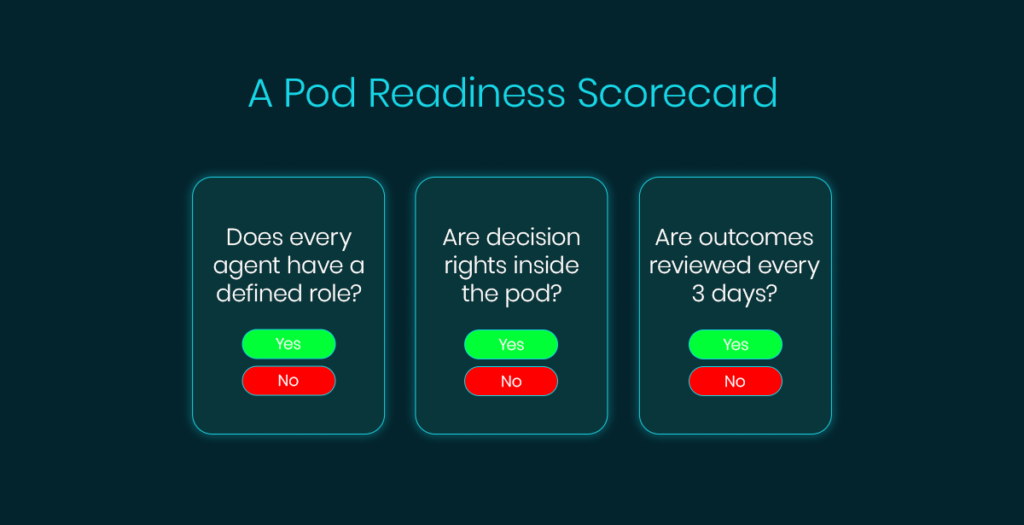
- Give every pod at least one AI agent with a defined role, not a vague “use AI more” mandate.
- Set decision rights inside the pod, so nobody waits on approval from outside it.
- Review outcomes every three days instead of every two weeks. Fast cycles catch problems early.
Frequently Asked Questions
What’s the difference between a pod and a Scrum team?
A pod owns a problem end to end and includes AI agents as working members. A Scrum team follows fixed ceremonies and usually separates roles by department, even when it calls itself agile.
How many people belong in a cross-functional team structure?
Most pods work best with four to seven people. Add an AI agent or two for research, QA, or drafting. Keep the group small enough to talk without a meeting.
Do self-organizing teams need a manager at all?
Yes, but the manager’s job changes. Instead of assigning tasks, they set outcomes, remove blockers, and coach. The team decides how the work gets done.
Why do AI-native companies choose pods over traditional departments?
Pods cut the handoffs that slow departments down. A pod owns its outcome, uses AI agents for research and drafting, and ships without waiting on sign-off from three other teams.
Start Building Your Pod
Cross-functional team structure isn’t a trend. It’s the operating model that lets AI-native companies out-execute competitors still running assembly-line playbooks.
Pods, self-organizing teams, and AI agile teams work together for one reason. Ownership sits with the people doing the work, not the layers above them.
If your org chart routes every decision through five approvals, the structure is the problem, not your people. That’s what an AI-native operating model actually looks like in practice.
Book a discovery workshop and find out where your team can start moving like a pod instead of a department.